
Western Digital: The HDD Infrastructure Layer for the AI Data Lake S-Curve
The AI revolution is hitting a wall. Not a compute wall, but a storage wall. The industry has moved past the initial GPU sprint, and now the critical bottleneck is where to keep the petabytes of data those models generate. This inflection point is creating a structural "Storage Supercycle" for high-capacity hard disk drives, and Western DigitalWDC-- is the pure-play infrastructure layer capturing it.
The company's strategic pivot was decisive. In February 2025, Western Digital completed its corporate split, spinning off its volatile flash memory business into a new entity. This move created a lean, focused pure-play on HDDs, shedding the cyclical baggage of the consumer NAND market to concentrate entirely on the high-margin enterprise storage needs of hyperscale data centers. The result is a company now perfectly aligned with the exponential growth curve of AI data.
The scale of this data explosion is staggering. According to IDC, the amount of data generated worldwide each year will more than triple between 2024 and 2029. That isn't just incremental growth; it's a paradigm shift in data complexity. In this new era, storage is not a commodity to be optimized away. It is the non-negotiable strategic foundation that makes the AI revolution possible. Without scalable, intelligent storage, even the most powerful models stall.
Western Digital's position is now that of a foundational infrastructure provider. Its success is a direct result of the industry's transition into the "AI Data Lake" era, where the desperate need to store data has outpaced the earlier focus on compute. The company's recent financial resurgence-reporting a 27% year-over-year revenue increase and a gross margin expansion to 43.5%-is the financial proof of this structural shift. It's the story of a company that bet on the rails of the next paradigm, not the latest gadget.
Competitive Analysis: The ePMR vs. HAMR Adoption S-Curve
The race for the AI data lake is not just about capacity; it's about which technology can scale fastest to meet an exponential demand curve. Here, Western Digital's strategy is a masterclass in navigating the S-curve. While its main rival, SeagateSTX--, bet early on a next-generation technology, Western Digital chose to rapidly scale its current, proven platform. The result is a decisive lead in the near-term supercycle.
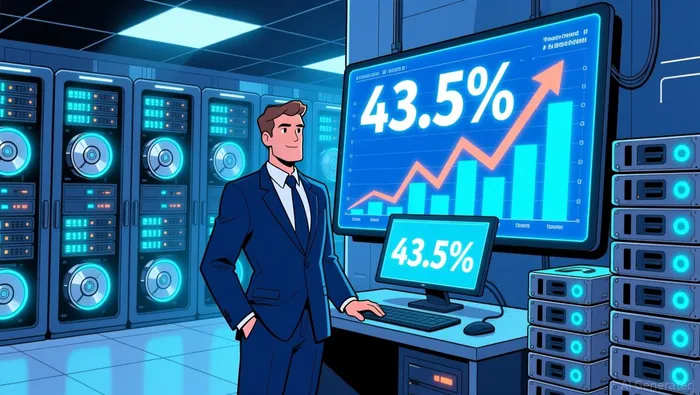
Western Digital's playbook is to squeeze maximum performance from its existing energy-assisted PMR (ePMR) technology. This approach allows the company to achieve faster time-to-market and operational execution. In the midst of a 2025 capacity crunch, this focus on high-volume, reliable ePMR gave Western Digital a critical advantage. While Seagate was still ironing out the kinks in its volume production of Heat-Assisted Magnetic Recording (HAMR), Western Digital was shipping drives to meet the urgent needs of hyperscalers. This translated directly to financial outperformance, with the company reporting a 27% year-over-year revenue increase and gross margins expanding to 43.5% in its first full quarter as a pure-play HDD company.
The adoption curve for new technologies like HAMR is inherently slower and more complex. It requires new manufacturing processes, new materials, and a longer validation cycle with customers. By contrast, Western Digital's strategy is to capture the immediate, massive demand for high-capacity storage. This focus on proven ePMR isn't a retreat; it's a calculated move to dominate the current phase of the S-curve. It allows the company to secure long-term data center contracts by demonstrating resilience and reliability at scale, which are paramount for mission-critical AI workloads.
Western Digital's product resilience and customer-centric innovation are key differentiators in this battle. The company's principles emphasize building solutions around customer business outcomes, not just specs. This was evident in its ability to help a major beverage manufacturer unlock delayed AI projects simply by adding 860TB of capacity. In a market where lead times for 32TB drives ballooned to over a year, this kind of operational execution and partnership built trust. While Seagate may eventually catch up on raw capacity, Western Digital has already secured its position as the infrastructure layer of choice for the current AI data lake paradigm.
Financial Execution: Exponential Metrics in the New Paradigm
The numbers from Western Digital's first quarter of fiscal 2026 are a textbook case of exponential adoption hitting the bottom line. This isn't just growth; it's the financial signature of a company operating on the steep part of the AI data storage S-curve. Revenue surged 27% year-over-year to $2.82 billion, a figure that itself is a lagging indicator of the underlying data explosion. More telling is the operational discipline behind it: gross margin expanded 710 basis points to 43.5% in the same period. That kind of simultaneous top-line acceleration and margin expansion is rare and signals a powerful mix of pricing power and scale.
The primary engine is clear. Cloud revenue, the direct beneficiary of AI data lakes, grew 31% year-over-year and now makes up 89% of total revenue. This isn't a niche segment; it's the entire business. The company shipped 204 exabytes of storage last quarter, a 23% year-over-year increase. These metrics track the data explosion with remarkable precision. Each exabyte shipped is a tangible unit of the paradigm shift, and the growth rate shows it's accelerating.
The market's reaction was a classic case of short-term noise drowning out long-term signal. Despite beating both revenue and earnings estimates, the stock fell after hours. This disconnect highlights a common investor bias: focusing on quarterly noise while overlooking the structural, exponential trajectory. The company's own guidance reinforces the momentum, with the board increasing the quarterly dividend by 25% to $0.125 per share as a sign of confidence in the "strong business momentum."
The bottom line is that Western Digital is executing a perfect operational playbook for the new paradigm. It's capturing massive demand with proven technology, converting that demand into exceptional profitability, and returning capital to shareholders-all while the fundamental infrastructure need for AI data storage continues its exponential climb.
Valuation and Catalysts: Pricing the Infrastructure Play
The stock's 280% surge through 2025 has priced in a massive chunk of the anticipated growth. This isn't a cheap story anymore; it's a premium play on a structural shift. Yet, analysts argue the current multiple remains reasonable given the secular AI storage tailwind. The market is paying for Western Digital's unique position as the foundational infrastructure layer for the AI data lake, not just for its recent operational execution. The rally from undervalued levels has been supported by robust top-line growth and a strong outlook, making the stock a top pick for 2026 according to firms like Morgan Stanley.
The next major catalyst is the upcoming Q2 earnings call on January 28, 2026. This event will be critical for confirming the trajectory. Management will provide its business outlook and operational performance, offering a forward view on demand trends, pricing power, and the health of the storage supercycle. The company expects gross margin in the range of 44% to 45% for the quarter, a key metric to watch for sustainability. This call is the next data point that could accelerate the S-curve adoption narrative, either by confirming the exponential demand or by revealing any early signs of inventory correction.
Western Digital's strategic focus on customer-centric innovation and product resilience aims to solidify its position as the 'unsung hero' of the AI era. The company's principles emphasize building solutions around customer business outcomes, not just specs. This was evident in its ability to help a major beverage manufacturer unlock delayed AI projects simply by adding 860TB of capacity. In a market where lead times for 32TB drives ballooned to over a year, this kind of operational execution and partnership built trust. By engineering a portfolio that enables innovation today and scales for tomorrow, Western Digital is not just selling drives-it's architecting the foundation of the AI data economy. The stock's run has been impressive, but the real test is whether the company can continue to deliver on that promise, turning its infrastructure role into sustained, exponential returns.
Risks and Watchpoints: Guardrails on the Exponential Curve
The exponential growth story is powerful, but it operates on a fragile foundation of sustained capital expenditure. The primary risk is a slowdown in AI data center capex. If hyperscalers and enterprises begin to temper their spending on new infrastructure, the demand for high-capacity HDDs would directly decelerate. This would challenge the growth trajectory that has fueled the current "Storage Supercycle." The company's recent financials show the immediate impact of tight supply, but the long-term thesis depends on the continued, multi-year investment in AI data lakes.
Competition remains a persistent, long-term threat. While Western Digital's pure-play HDD focus insulates it from the volatile NAND cycle, the broader flash memory market is a reminder of the industry's shifting sands. The spin-off of its flash business into SanDisk has created a separate, thriving entity that is also capitalizing on AI inference needs. This bifurcation is a strategic win for Western Digital in the short term, but it underscores that the battle for AI infrastructure is multi-front. The company must guard against any future integration or competitive pressure that could blur this clean separation.
The most critical operational watchpoint is technological execution. Western Digital's current lead is built on maximizing its existing ePMR platform. To maintain its edge in the data lake era, the company must successfully transition to next-generation recording technologies like HAMR. The adoption curve for these innovations is inherently slower, and any delay or manufacturing issue would give rivals like Seagate a window to close the gap. The company's principles emphasize customer-centric innovation and engineering a portfolio that enables innovation today and scales for tomorrow. This is not just marketing; it's a mandate to deliver the high-capacity, energy-efficient drives that will define the next phase of the S-curve. The upcoming Q2 earnings call will be a key test, offering a forward view on both demand and the health of this technological transition.





Comentarios
Aún no hay comentarios