
WeRide's Breakthrough in Abu Dhabi and the Path to Autonomous Driving Scalability
Unit Economics: From Losses to Breakeven
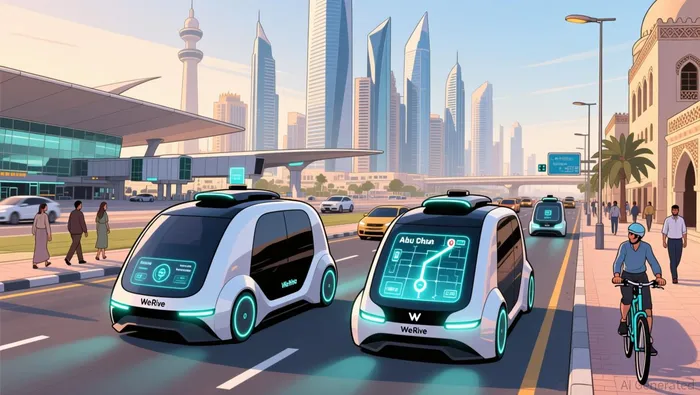
WeRide's financial performance in Q2 2025 underscores its progress toward sustainable unit economics. The company's robotaxi revenue surged 836.7% year-on-year to $6.4 million, accounting for 36.1% of total revenue for the quarter. This growth was driven by its Abu Dhabi operations, where the removal of in-vehicle safety officers in October 2025 enabled financial breakeven on a per-ride basis.
The cost structure has also improved significantly. WeRide's HPC 3.0 platform, powered by NVIDIA DRIVE AGX Thor chips, reduces autonomous driving system costs by 50%. This technological leap, combined with higher vehicle utilization rates-each robotaxi completing dozens of rides daily during 12-hour shifts-has narrowed the gap between revenue and expenses. While exact cost-per-ride figures remain undisclosed, the company's ability to achieve breakeven in Abu Dhabi suggests that unit economics are no longer a distant aspiration but a tangible reality.
Regulatory Leadership: A Global Permit Powerhouse
WeRide's regulatory achievements are equally transformative. The company now holds autonomous driving permits in six countries-Saudi Arabia, China, the UAE, Singapore, France, and the U.S.-a feat unmatched by peers. In Abu Dhabi, it secured the world's first city-level fully driverless robotaxi permit, a milestone that validates its safety protocols and operational reliability.
This regulatory leadership is not accidental. WeRide's partnerships with local authorities, such as the Roads and Transport Authority in Dubai and Uber in Abu Dhabi, have accelerated approvals. For instance, its collaboration with Uber in the UAE has tripled the robotaxi fleet size since December 2024, covering 50% of Abu Dhabi's core areas. Such alliances not only reduce entry barriers but also create a blueprint for replication in other markets.
Global Expansion: A Blueprint for Scalability
WeRide's expansion strategy is ambitious and methodical. In Saudi Arabia, it launched a pilot service in Riyadh, leveraging its first autonomous driving permit to test commercial viability. Meanwhile, Dubai's partnership with Uber and the Roads and Transport Authority aims to deploy driverless robotaxis by 2026 according to company projections.
The company's long-term vision is even more audacious. WeRide plans to scale its Middle East fleet to 1,000 robotaxis by 2026 and tens of thousands by 2030. This growth is underpinned by its HPC 3.0 platform, which lowers costs, and its focus on high-demand corridors such as airports and downtown areas. The Abu Dhabi model-where vehicle utilization rates and ride volumes are doubling-provides a scalable template for other cities.
Conclusion: A Compelling Investment Thesis
WeRide's breakthrough in Abu Dhabi is more than a regional success; it is a harbinger of its global potential. By achieving breakeven unit economics, securing regulatory permits, and expanding strategically, the company is addressing the three pillars of scalability. For investors, this represents a rare opportunity to back a firm that is not only surviving in the autonomous vehicle race but leading it.





Comentarios
Aún no hay comentarios