
Wellness as a Strategic Investment Theme in 2025
Financial Wellness: The ROI of Holistic Health
Financial wellness, a cornerstone of the nine dimensions, is no longer viewed as a standalone metric but as a critical enabler of broader well-being. A 2025 report by McKinsey highlights that every dollar invested in workplace wellness programs yields up to $3.27 in reduced healthcare costs, alongside a 20% productivity boost and a 56% reduction in absenteeism. These outcomes are particularly significant for financially stressed employees, who are 34% more likely to remain with employers offering comprehensive wellness initiatives.
However, financial wellness is not merely about income or savings. A 2025 analysis by the Financial Planning Association categorizes individuals into four quadrants based on objective financial health and subjective well-being. Only 38% of individuals fall into the "content" quadrant-those with both high financial health and high well-being-highlighting a systemic gap between perceived and actual financial stability. This misalignment underscores the need for targeted interventions, such as AI-driven financial coaching tools, which have seen a 52% adoption rate since 2020. Investors in fintech and behavioral economics platforms stand to benefit from this growing demand for personalized financial wellness solutions.
Physical and Mental Wellness: The Productivity Imperative
Physical and mental wellness remain foundational to economic stability. The 2025 Global Wellness Economy report notes that wellness spending now accounts for 60% of global health expenditures, driven by rising demand for preventive care and mental health services. For instance, mental wellness-a subcategory of the nine dimensions-has grown at a 12.4% annual rate since 2019, outpacing traditional healthcare sectors.
Workplace wellness programs that address mental health have demonstrated measurable returns. A 2025 survey by the International Foundation of Employee Benefit Plans) found that companies integrating mental health support into their wellness strategies see a 15% reduction in healthcare claims and a 12% increase in employee retention. These outcomes are critical) for industries facing labor shortages, such as healthcare and technology, where burnout rates exceed 40%.
Social and Cultural Wellness: Building Resilient Communities
Social and cultural wellness dimensions are reshaping societal resilience. The 2025 Future of Wellness survey reveals that Gen Z and millennials, who comprise 36% of the U.S. adult population, drive 41% of annual wellness spending. This demographic prioritizes inclusivity, with 72% of Gen Z respondents valuing culturally responsive wellness programs. Such trends are fueling investments in DEI-focused initiatives, which have been shown to reduce "emotional tax" in workplaces by 28%.
Cultural wellness, a newer dimension emphasizing heritage and identity, is also gaining traction. A 2025 study by the Global Wellness Institute highlights that communities with strong cultural wellness frameworks report 30% higher social cohesion and 20% lower crime rates. These metrics suggest that investments in cultural preservation and community-building initiatives can yield both societal and financial dividends.
Environmental and Occupational Wellness: Sustainability as a Catalyst
Environmental wellness, once a niche concern, is now a mainstream investment priority. The 2025 Global Wellness Economy report notes that wellness real estate-a subset of environmental wellness-is growing at 19.5% annually, driven by demand for eco-friendly living spaces and green workplaces. Similarly, occupational wellness-focused on job satisfaction and work-life balance-is reshaping labor markets. Companies with robust occupational wellness programs report 25% higher productivity and 18% lower turnover.
Investors are increasingly aligning with ESG (Environmental, Social, and Governance) frameworks that integrate these dimensions. For example, firms adopting circular economy principles in their operations see a 15% reduction in operational costs and a 10% increase in brand loyalty.
Intellectual and Spiritual Wellness: Long-Term Cognitive and Emotional Resilience
Intellectual and spiritual wellness dimensions are gaining attention for their role in long-term cognitive health and emotional resilience. A 2025 OECD report finds that individuals engaged in lifelong learning (an aspect of intellectual wellness) are 40% less likely to experience cognitive decline. Meanwhile, spiritual wellness-linked to purpose and meaning-correlates with a 30% reduction in stress-related illnesses. These trends are driving demand for edutainment platforms, mindfulness apps, and purpose-driven brands. The global meditation app market, for instance, is projected to grow at 22% annually through 2029.
Conclusion: A Holistic Investment Framework
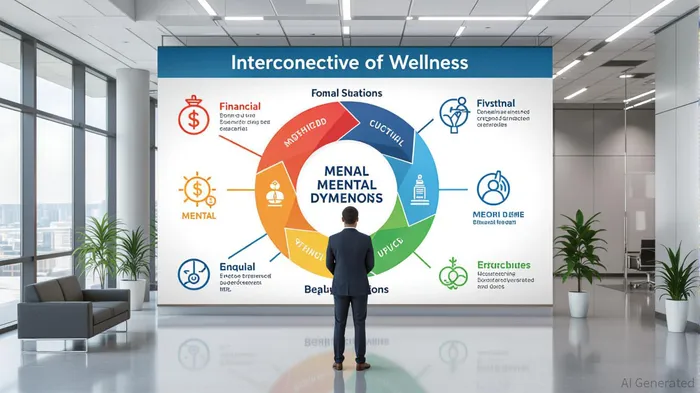
The nine dimensions of wellness are no longer siloed concepts but interconnected pillars of a new economic paradigm. For investors, the key lies in adopting a holistic framework that balances financial returns with societal impact. By targeting sectors such as fintech, mental health, sustainable real estate, and DEI initiatives, investors can capitalize on the $9.8 trillion wellness economy while addressing systemic challenges like inequality, burnout, and environmental degradation.
As the 2025 data demonstrates, wellness is not merely a trend but a strategic imperative-one that demands innovation, inclusivity, and long-term vision.







Comentarios
Aún no hay comentarios