
WeightWatchers’ Menopause Program and the Emerging $100B+ Women’s Health Market
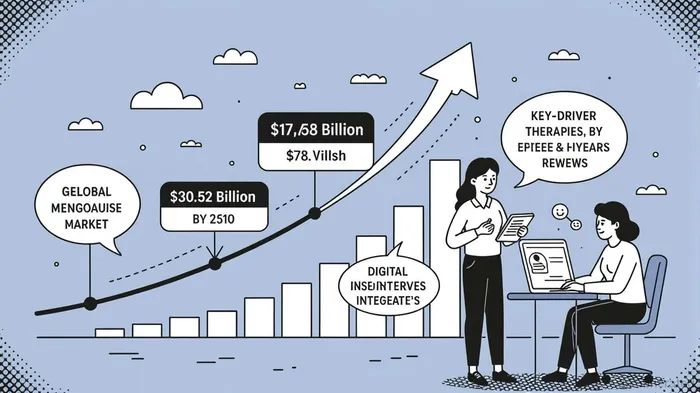
The women’s health market is undergoing a seismic shift, driven by a confluence of demographic, technological, and cultural forces. At the heart of this transformation lies the menopause segment—a $100B+ opportunity by 2030, according to Boston Consulting Group (BCG), if all women with moderate or severe symptoms are treated [5]. WeightWatchers, once a household name for weight loss, has repositioned itself as a leader in this high-growth space with its WeightWatchers for Menopause program, leveraging clinical innovation, celebrity endorsements, and strategic partnerships to capture an underserved demographic.
A Market in Motion: Growth, Drivers, and Gaps
The global menopause market, valued at $17.79 billion in 2024, is projected to reach $24.35 billion by 2030, growing at a 5.42% CAGR [2]. However, broader women’s health market forecasts are even more ambitious: valued at $51.36 billion in 2025, it is expected to surge to $78.98 billion by 2030, fueled by a 9% CAGR [5]. This growth is underpinned by three key trends:
1. Rising Awareness: Searches for terms like “menopause” and “hormone balancing” have spiked by 32.1% and 193.8%, respectively, in the past year [1].
2. Non-Hormonal Therapies: Innovations such as fezolinetant (Veozah) and GLP-1 agonists are redefining treatment paradigms [2].
3. Digital Health Adoption: Telehealth platforms and wearables are addressing gaps in accessibility, particularly in rural or underserved areas [4].
Despite this momentum, the market remains fragmented. For instance, only 18% of U.S. employers offered menopause benefits in 2025, up from 4% in 2023 [5], signaling untapped potential for corporate wellness programs.
WeightWatchers’ Strategic Reentry: Clinical Rigor Meets Brand Power
WeightWatchers’ foray into menopause care is not a lateral move—it is a calculated pivot into a $600B+ women’s health market [2]. The program, launched in 2025, combines science-backed nutrition, medical interventions (including hormone replacement therapy and GLP-1 medications), and community support. Clinical outcomes are striking: participants using the WeightWatchers Clinic lost 18.6% of body weight (40.1 lbs) over one year, compared to four times less weight loss in self-managed cases [1]. A Mayo Clinic study further validates this approach, showing that hormone therapy combined with GLP-1 semaglutide led to 30% greater weight loss than GLP-1 alone [1].
The program’s credibility is amplified by its leadership. Dr. Kim Boyd, newly appointed Chief Medical Officer, has integrated emerging therapies like GLP-1s into the WeightWatchers model [3]. This medicalization of weight management aligns with broader industry shifts, as seen in Hims & Hers’ expansion into hormonal health [3].
Celebrity Endorsements and Cultural Resonance
WeightWatchers’ partnership with Queen Latifah as its first menopause program spokesperson is a masterstroke. Latifah, a 54-year-old icon who has openly discussed her menopause journey, brings authenticity to a demographic often overlooked in mainstream media. Her endorsement not only humanizes the program but also challenges stigmas around aging and body image [2]. This aligns with NielsenIQ data showing 54% of women aged 35–49 actively seek supplements for menopause symptoms [1], underscoring the need for relatable, inclusive messaging.
Underserved Opportunities and Future Trajectories
The menopause market’s growth is not just numerical—it is structural. Innovations in personalized treatment plans (e.g., Midi Health’s 90% symptom improvement rate in two months [5]) and employer-sponsored care are creating new revenue streams. Meanwhile, the Gates Foundation’s $2.5 billion investment in women’s health R&D through 2030 [4] signals a systemic shift toward addressing long-neglected health disparities.
For WeightWatchers, the path forward is clear: scale its integrated model (nutrition + medical + community) while expanding into adjacent services like telehealth and corporate wellness. With 1.3 million U.S. women entering menopause annually [1], and global postmenopausal populations set to exceed 1 billion by 2030 [1], the company is poised to dominate a market where competitors are still catching up.
Conclusion: A $100B+ Bet on Women’s Health
WeightWatchers’ Menopause Program exemplifies how strategic positioning—backed by clinical evidence, celebrity influence, and digital innovation—can unlock value in an underserved sector. As the market evolves, investors should watch for three metrics:
- Adoption rates of GLP-1 and non-hormonal therapies in menopause care.
- Employer partnerships expanding menopause benefits.
- Digital engagement metrics from telehealth platforms like Care by HerMD [5].
In a landscape where women’s health has historically been underfunded and overlooked, WeightWatchers is not just filling a gap—it is redefining the rules of the game.
Source:
[1] Innovating for the Underserved Women's Health Market [https://nielseniq.com/global/en/insights/report/2025/hot-flashes-cold-shoulders-the-underserved-womens-health/]
[2] Menopause Market Size, Share & Trends Analysis Report and ... [https://finance.yahoo.com/news/menopause-market-size-share-trends-080900810.html]
[3] Hims & Hers Fuels Growth via Market Expansion and New Care Verticals [https://www.tradingview.com/news/zacks:d48026713094b:0-hims-hers-fuels-growth-via-market-expansion-and-new-care-verticals/]
[4] New Funding to Catalyze Women's Health Research [https://www.gatesfoundation.org/ideas/media-center/press-releases/2025/08/womens-health-funding-commitment]
[5] Improving Women's Health is a $100 Billion–Plus Opportunity [https://www.bcg.com/publications/2025/improving-womens-health-opportunity]







Comentarios
Aún no hay comentarios