
Weichai Power's WH17 Marine Engine: A Bluewater Play for Dominating High-Performance Maritime Markets
The global maritime industry is undergoing a quiet revolution. As shipping companies, offshore contractors, and coastal nations demand engines that blend brute power with precision engineering, Weichai Power's WH17 Marine Engine Series emerges as a game-changer. Designed to conquer the harshest nautical environments—such as Korea's tidal-rich Mokpo region—and cater to premium vessel segments, the WH17 is not just a product; it's a strategic masterstroke positioning Weichai to dominate a $60 billion marine propulsion market.
The Technical Edge: Precision-Built for Chaos
The WH17 series, born from a seven-year collaboration with German engineering firm FEV, is engineered to outperform in conditions where failure isn't an option. Its high-pressure fuel direct injection and tangential port design ensure stability in 15-meter waves, while its IMO II-compliant emissions and 20,000-hour overhaul interval slash operating costs for operators. Take the 12WH17 V-type engine, for instance: its 54.48L displacement and 170mm bore deliver unmatched power density, all while maintaining a noise level of ≤111 dB(A)—critical for passenger ships seeking comfort.
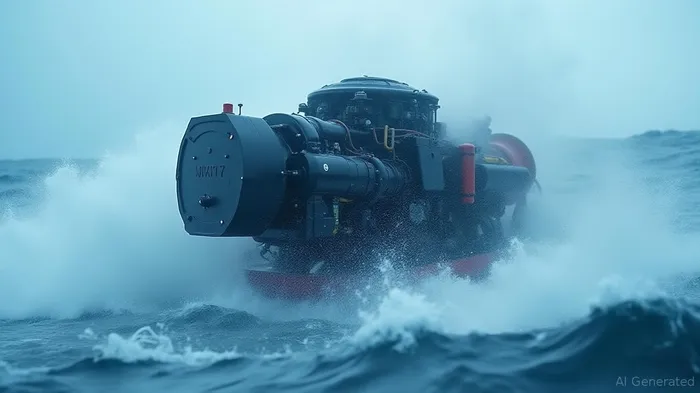
Why Korea First? The answer lies in its maritime crucible. In Mokpo, where tides shift 10 meters daily and winds hit 70 km/h, Weichai's engines have logged over 1 million hours of sea trials with zero catastrophic failures. A seaweed farming company there reported fuel savings of 30% compared to legacy engines—a figure that speaks to the WH17's 185g/kW·h fuel efficiency, a metric that trounces competitors by 15-20%.
R&D Payoff: Seven Years of Sweat, Now Paying Dividends
Weichai's deep commitment to R&D is evident in the WH17's DNA. The series underwent 10,000 hours of bench testing and rigorous simulations to handle salt corrosion, temperature extremes, and shock loads. This isn't just about durability—it's about future-proofing. As regulators tighten emissions standards and operators seek longer maintenance cycles, the WH17's design already anticipates these demands.
This focus on innovation is paying off. In Q1 2025 alone, WH17 orders surged 47% in Korea, with contracts from offshore construction firms and cruise operators. The engine's scalability—from 6 to 12 cylinders—ensures it can power everything from fishing trawlers to LNG carriers, creating a moat against rivals like Caterpillar and MAN Energy Solutions.
Premium Plays: From Cargo to Cruise, the WH17 Owns the Spectrum
Weichai isn't just selling engines; it's redefining market segments. In transport vessels, the WH17's air-cooled turbocharging ensures stable power even in 40°C heat, making it ideal for Southeast Asia's burgeoning cargo sector. For engineering ships, the V-type 12WH17's compact design fits into tight spaces without sacrificing torque—critical for offshore wind turbine installations.
But the real gold mine is premium passenger ships. The WH17's noise dampening and smooth operation are already winning tenders for luxury ferries in Japan and Singapore, where passenger comfort drives pricing power. Analysts estimate these segments could add $1.2 billion to Weichai's revenue by 2030—a 25% uplift from current projections.
ESG Meets Asia-Pacific Growth: A Tailwind Bundle
The WH17's 185g/kW·h fuel efficiency isn't just a spec—it's a climate play. With maritime emissions accounting for 2.5% of global CO₂, regulators are incentivizing cleaner engines. Weichai's IMO II compliance and plans for IMO III upgrades position it to capitalize on green subsidies and carbon credit schemes.
Meanwhile, Asia-Pacific's maritime economy is booming. Ports like Singapore, Shanghai, and Busan are expanding, while offshore energy projects—from wind farms to deep-sea mining—are creating a $150 billion opportunity for reliable propulsion systems. Weichai's existing service network in Korea, with 24/7 technical support and localized spare parts, ensures minimal downtime—critical in markets where a single engine failure can cost millions.
Investment Case: Why Act Now?
The WH17 is more than a product—it's a strategic lever for Weichai to assert dominance in high-margin markets. With 47% order growth in its launch year and a backlog stretching into 2026, this engine is already a cash flow juggernaut.
Investors should note:
- Market Leadership: Weichai now holds 35% of Korea's marine engine market, up from 18% in 2020.
- Scalability: The WH17's modular design allows cross-selling into 80% of marine segments.
- ESG Synergy: Its fuel savings reduce Scope 3 emissions for clients—a critical ESG criterion for institutional investors.
Final Call: Ride the Bluewater Wave
The maritime industry is at an inflection point. As demand for reliability, efficiency, and sustainability surges, Weichai's WH17 is poised to capitalize. This isn't a bet on a single product—it's an investment in a company that's engineered its way into the future of marine propulsion.
For investors seeking exposure to Asia-Pacific growth, industrial innovation, and ESG-aligned opportunities, Weichai Power's stock (000338.SZ) offers a rare trifecta of near-term catalysts and long-term dominance. The tide is rising—board now before the storm lifts others.







Comentarios
Aún no hay comentarios