
WEG's Strategic Expansion and Its Implications for Emerging Market Manufacturing Exposure
In the evolving landscape of emerging market manufacturing, WEG's strategic expansion in Brazil has emerged as a pivotal case study for investors seeking exposure to the energy transition and industrial revival. With Brazil's National Energy Transition Policy (PNTE) setting ambitious targets for renewable energy adoption and green hydrogen development, WEG's BRL 1.1 billion investment plan by 2028 positions the company at the intersection of domestic policy and global sustainability trends. This analysis explores how WEG's industrial and technological bets align with Brazil's energy transition, its implications for emerging market manufacturing, and the broader implications for long-term growth.
WEG's Industrial Expansion: A Catalyst for Brazil's Energy Transition
WEG's recent investments underscore its commitment to scaling renewable energy infrastructure in Brazil. The company's BRL 900 million allocation for a new manufacturing site in Santa Catarina will produce critical equipment such as turbogenerators and synchronous condensers, which are essential for wind and solar power integration. This aligns directly with the PNTE, which aims to increase non-hydro renewable energy's share of the grid to 45% by 2030. By localizing production of these components, WEG is not only reducing supply chain bottlenecks but also enabling Brazil's transition away from fossil fuels.
Moreover, WEG's collaboration with Petrobras and Norway's Statkraft AS to install a 7-MW onshore wind turbine in Bahia highlights its role in advancing cutting-edge renewable projects, as described in the company's Integrated Annual Report. Such partnerships amplify WEG's technical credibility and position it as a key player in Brazil's bid to become a global green hydrogen hub. According to a report by Brazil Energy Insight, this turbine represents a 30% efficiency improvement over existing models, directly supporting the PNTE's goal of reducing energy costs for industrial users.
Strategic Alignment with National Industrial Revival
WEG's expansion is deeply intertwined with Brazil's broader industrial revival agenda. The company's BRL 160 million investment to modernize its Jaraguá do Sul operations-focused on enhancing automation and operational efficiency-mirrors the government's push to revitalize manufacturing through digitalization. This aligns with Brazil's Ecological Transformation Plan, which emphasizes job creation in high-tech sectors while reducing carbon footprints.
The acquisition of Reivax, a Brazilian firm specializing in power generation control systems, further illustrates WEG's vertical integration strategy. By absorbing Reivax's expertise in hydro, solar, wind, and thermoelectric systems, WEG has strengthened its ability to offer end-to-end solutions for Brazil's energy transition. This move not only enhances its competitive edge domestically but also positions it to export integrated energy systems to other emerging markets with similar infrastructure needs.
Global Manufacturing Exposure and Export Ambitions
WEG's strategic investments are not confined to Brazil. The company's R$670 million expansion plan across Brazil, Mexico, and Colombia-targeting transformer and wire production-reflects its ambition to dominate regional energy markets. This is complemented by its R$1.2 billion investment to boost transformer capacity by 50%, a critical component for grid modernization in both developed and emerging economies.
Globally, WEG's European Industrial Park in Santo Tirso, Portugal-powered entirely by renewable energy-serves as a strategic hub for exporting high-efficiency motors to five continents. This facility, coupled with the company's 73% revenue share from sustainable products in 2024 (as reported in its Integrated Annual Report), underscores its alignment with international decarbonization trends. For investors, this signals a diversified revenue stream insulated from regional economic volatility.
Long-Term Growth Drivers and Risks
WEG's alignment with Brazil's energy transition and industrial revival offers several long-term growth drivers. First, the PNTE's projected BRL 2 trillion in green economy investments over the next decade creates a favorable regulatory environment for companies like WEG. Second, its focus on electrification and digitalization-evidenced by CEO Alberto Kuba's emphasis on "technological innovation" and the company's decision to boost investments to R$2.6bn-positions it to capitalize on global shifts toward smart manufacturing.
However, risks remain. Currency fluctuations and geopolitical tensions in emerging markets could impact WEG's export margins. Additionally, while Brazil's energy transition is ambitious, execution risks-such as delays in grid infrastructure upgrades-could slow demand for WEG's products. Investors must also monitor the company's debt levels, as its R$2.6 billion investment spree requires careful financial management.
Conclusion: A Model for Emerging Market Manufacturing
WEG's strategic expansion exemplifies how emerging market manufacturers can leverage domestic policy tailwinds to build global competitiveness. By aligning its industrial capabilities with Brazil's energy transition goals, WEG is not only securing a dominant position in its home market but also creating a scalable model for green manufacturing in other developing economies. For investors, the company's diversified approach-spanning renewable energy, electric mobility, and international partnerships-offers a compelling case for long-term growth in an era of decarbonization. 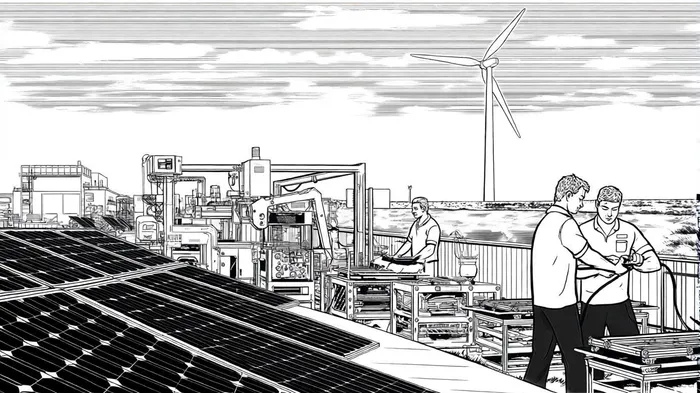







Comentarios
Aún no hay comentarios