

WeChange's 190-Country On-Ramp: A Flow Analyst's Fee vs. Volume Analysis
WeChange launched globally on January 30, targeting a massive initial footprint with support across more than 190 countries. This scale is the first critical metric for capturing onboarding flows, aiming to reach users in most of Europe, the Americas, Asia Pacific, and Africa. The platform's noncustodial design, where WeChange does not hold user funds, is a key differentiator from custodial exchanges.
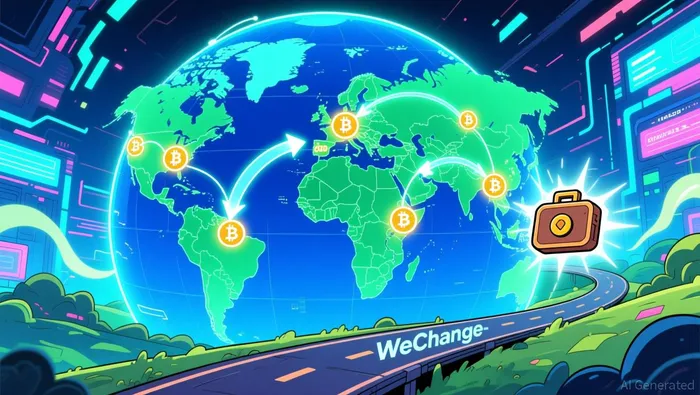
The fee structure is the second major flow variable. WeChange offers fees starting at 2.5 percent, positioning itself as a transparent and affordable alternative. This is a direct attack on the high fees often charged by traditional exchanges, a friction point that can deter new users. The starting rate is a clear signal to price-sensitive on-ramp users.
The immediate flow potential hinges on execution. The launch is built on supported bank transfer methods like SEPA and ACH, which are familiar and low-friction rails. However, the platform's ability to convert this geographic scale and low fee into actual transaction volume will depend on user acquisition and the seamless integration of these payment methods. Card support, planned for Q2 2026, represents the next major lever for volume growth.
Market Context: On-Ramp Demand and Competitive Flows
The onboarding opportunity is massive, driven by a structural shift in how people interact with money. Crypto is no longer a niche market; it has become embedded in everyday financial behavior, from investing to cross-border payments. This mainstream adoption has created a new user expectation: the ability to move funds between fiat and crypto as seamlessly as transferring money between bank accounts. For a platform like WeChange, this sets the stage for high-volume flows.
The demand is concentrated in a few high-activity countries. Between January and July 2025, India, the United States (US), Pakistan, the Philippines, and Brazil ranked highest for crypto adoption globally. The US market, in particular, saw a surge, with crypto activity jumping around 50% year-over-year. This concentration means WeChange's global launch targets the most fertile ground for immediate user acquisition and transaction volume.
The underlying flow is staggering. In 2025, stablecoins recorded their highest annual volume to date, reaching over USD 4 trillion—an 83% increase from the prior year. This massive volume, which now comprises 30% of all on-chain crypto transaction volume, is the lifeblood of the on-ramp market. It represents the continuous, high-frequency movement of value that platforms facilitating fiat-crypto conversion are built to capture. The sheer scale of this flow underscores the critical need for easier, more accessible on-ramps.
Catalysts and Risks: What to Watch
The launch is just the beginning. The critical metric to watch is user acquisition and transaction volume growth in the weeks and months ahead. WeChange's global scale and low 2.5 percent fee are designed to capture flows, but translating that into sustained volume requires successful onboarding. The platform's ability to convert its 190-country footprint into active users will be the primary indicator of its initial traction.
A major risk is competitive response from established players. As the on-ramp market grows, incumbents with larger user bases and deeper capital may accelerate their own offerings or lower fees to defend market share. This could compress margins for new entrants and slow WeChange's volume ramp-up. The competitive landscape is already crowded, and any price war would directly impact the platform's flow economics.
Regulatory clarity in key markets like the U.S. and EU is a non-negotiable factor for sustainable growth. While the platform launched globally, its availability is subject to local compliance standards. Ongoing regulatory developments will determine which regions can be fully exploited and which may face restrictions, directly shaping the total addressable market for transaction volume.







Comentarios
Aún no hay comentarios