
Webster, NY's $9.8M FAST NY Grant and Xerox Campus Redevelopment: A Strategic Catalyst for Upstate NY's Real Estate and Infrastructure Renaissance
Infrastructure as a Foundation for Value Creation
The FAST NY Grant's allocation is meticulously designed to address the critical bottlenecks that often deter industrial investment. According to a report by , the funds are being directed toward road construction and extension, sanitary sewer upgrades, and electrical master planning. These improvements are not merely incremental; they are transformative. By creating a fully developed site with multimodal connectivity-including proximity to I-390 and the Rochester International Airport-the project positions Webster as a logistics and manufacturing nexus for sectors such as semiconductors, renewable energy, and cold-chain distribution.
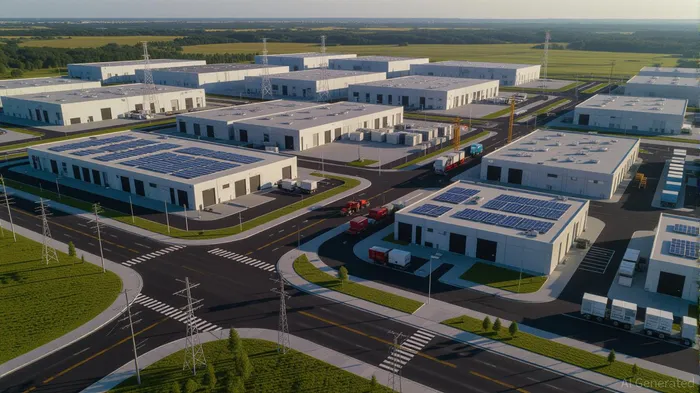 The strategic focus on infrastructure is already yielding measurable results. Data from recent property market analyses indicates that residential property values in Webster have surged by 10.1% since the grant's announcement. This price appreciation reflects a broader trend: when industrial zones are upgraded with modern infrastructure, they generate positive spillover effects on adjacent residential markets. The reduced industrial vacancy rate to 2% further signals the site's attractiveness to employers, a critical factor in sustaining long-term economic momentum.
Private-Sector Synergies and Regional Multipliers
The public investment in Webster is not operating in isolation. It has already catalyzed private-sector participation, most notably the $650 million fairlife® dairy facility, which is projected to create 250 jobs by 2025. Such projects exemplify the "multiplier effect" of infrastructure spending: public funds lower the cost of entry for private developers, who in turn generate employment and tax revenues. This dynamic is particularly significant in upstate New York, where depopulation and underinvestment have long constrained growth.
The Xerox campus redevelopment also benefits from its location within a broader regional movement. Nearby industrial projects, coupled with the state's emphasis on clean energy and advanced manufacturing, create a cluster effect that enhances Webster's competitive positioning. As stated by a spokesperson for the New York State Department of Economic Development, the site's readiness for 2026 completion ensures it will capitalize on the current wave of corporate reshoring and supply-chain diversification. For investors, this timeline aligns with global trends that prioritize geographic redundancy and resilience-a post-pandemic imperative.
Risks and Considerations
While the prospects are promising, investors must remain cognizant of potential risks. The success of the Xerox campus hinges on sustained private-sector demand, which could be influenced by macroeconomic shifts such as inflation or trade policy changes. Additionally, the environmental remediation of brownfield sites, though already underway, requires ongoing monitoring to ensure compliance with regulatory standards. However, the fact that the site is being marketed as "shovel-ready" suggests that these challenges have been proactively addressed, reducing execution risk.
Conclusion: A Model for Future-Proofing Regional Economies
Webster's redevelopment offers a blueprint for how infrastructure investment can unlock latent value in underutilized assets. By combining public funding with private-sector innovation, the project not only revitalizes a former corporate campus but also positions upstate New York as a viable alternative to overpriced coastal hubs. For real estate investors, the 10.1% residential price surge and declining industrial vacancies signal a market in transition. For infrastructure-focused capital, the $9.8 million grant represents a small but catalytic seed that could grow into a $1 billion ecosystem. In an era where location advantages are being redefined by supply-chain realities, Webster's story is one to watch.





Comentarios
Aún no hay comentarios