
Web3 Scalability Solutions: How Specialized Infrastructure is Solving the Trilemma and Fueling a $100B Market
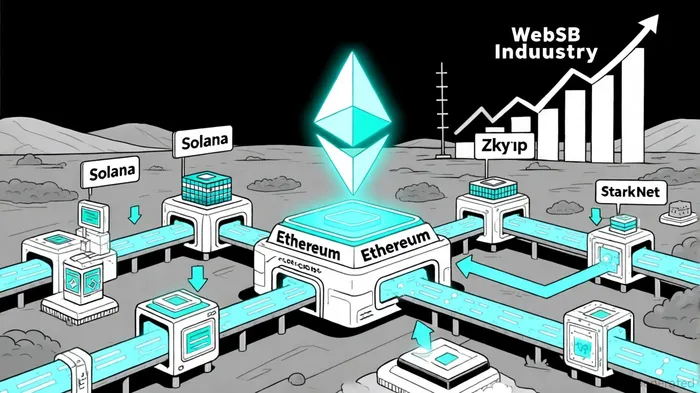
The Web3 scalability trilemma—balancing decentralization, security, and scalability—has long been the industry's most intractable problem. For years, projects were forced to make painful trade-offs: prioritize decentralization at the cost of speed (Bitcoin), or security at the expense of throughput (Ethereum pre-2022). But in 2024–2025, a new wave of specialized infrastructure is rewriting the rules. From intra-chain parallelism to EVM-compatible high-throughput blockchains, the industry is no longer just theorizing about scalability—it's delivering it.
The Trilemma's New Frontier: Specialized Infrastructure
The key to breaking the trilemma lies in modular, composable systems that optimize for specific use cases. Take intra-chain parallelism, where blockchains execute transactions concurrently within a single block. Projects like Solana, Sui, and Aptos have pioneered this approach, achieving throughput rates that dwarf Ethereum's. Solana's Alpenglow upgrade, for instance, hit 107,540 TPS in 2025, a figure that would have been unthinkable just three years ago [2].
Meanwhile, EVM-compatible high-throughput chains like Monad and MegaETH are bridging the gap between Ethereum's ecosystem and next-gen performance. These projects use pipelined execution, asynchronous consensus, and micro-VM architectures to reduce latency and increase resource utilization without sacrificing EVM compatibility [2]. The result? Developers can build on a familiar framework while accessing throughput rates that rival centralized systems.
Layer 2 (L2) solutions are also evolving rapidly. Base, Optimism, and Arbitrum now dominate the L2 landscape, with ArbitrumARB-- alone holding $2.43 billion in TVL and processing millions of daily transactions [1]. Innovations like zero-knowledge proofs (zkSync Era, StarkNet) and EVM equivalence (Polygon zkEVM) are pushing the boundaries of what's possible in terms of speed, cost, and security.
Market Validation: Capital, M&A, and Institutional Adoption
The market is voting with its wallet. In Q2 2025 alone, Web3 infrastructure startups raised $9.6 billion in venture capital, with investors like Andreessen Horowitz and Polychain prioritizing foundational projects over speculative tokens [2]. This capital influx has fueled a surge in M&A activity, as seen in the $175 million raise by Helio and Alterya's $150 million deal—both focused on high-compliance, high-performance infrastructure [2].
Institutional adoption is another critical tailwind. By Q1 2025, institutional-grade custodians held $300 billion in digital assets, driven by firms like Fidelity and Anchorage Digital [3]. Regulatory clarity, including the U.S. FIT21 Act and the EU's MiCA framework, has further reduced friction for institutional participation [3]. Meanwhile, strategic cloud partnerships with AWS and Alibaba have slashed infrastructure costs by up to 50%, making global deployment of Web3 solutions more viable [2].
The Road Ahead: From Trilemma to Trifecta
The scalability trilemma is no longer a theoretical debate—it's a solved problem in practice. CrustChain, for example, uses a reputation-weighted Proof-of-Capacity mechanism and MDP-optimized sharding to achieve 1,450 TPS with sub-second latency, all while maintaining decentralization [4]. Similarly, a novel consensus mechanism combining elliptic curve cryptography and zk-SNARKs claims to process 1,700+ TPS without compromising security [5].
These advancements are not isolated experiments. They represent a paradigm shift toward interoperable, modular infrastructures that can scale for enterprise-grade use cases. As DeFi, real-world asset (RWA) tokenization, and AI-driven smart contracts gain traction, the demand for scalable infrastructure will only accelerate.
Investment Thesis: The $100B Opportunity
The numbers tell a compelling story. The global Web3 industry is projected to grow from $4.62 billion in 2025 to $99.75 billion by 2034, with a 41.18% CAGR [1]. This growth is driven by three pillars:
1. Decentralized Finance (DeFi): High-throughput chains and L2s enable institutional-grade DeFi platforms.
2. Real-World Assets (RWAs): Scalable infrastructure supports tokenization of government bonds, real estate, and more.
3. Enterprise Adoption: Modular systems allow corporations to deploy blockchain solutions without sacrificing performance.
Conclusion: The Infrastructure Era is Here
Web3's next phase isn't about speculative tokens or NFT hype—it's about building the rails that will carry the industry into mass adoption. Specialized infrastructure is the linchpin of this transformation, turning the scalability trilemma into a trifecta of decentralization, security, and throughput. For investors, the message is clear: the winners of this era will be the builders of modular, composable, and scalable systems.
The time to act is now.






Comentarios
Aún no hay comentarios