
Web3's Machine Economy: Why x402 and ERC-8004 Signal the Next Infrastructure Megatrend
The Web3 landscape is undergoing a quiet but profound transformation. As human-centric narratives around tokenized ownership and decentralized finance (DeFi) plateau, a new frontier is emerging: the machine economy. This shift is not merely speculative-it is being driven by foundational infrastructure protocols like x402 and ERC-8004, which are redefining how autonomous systems interact, transact, and build trust in decentralized environments. For investors, these protocols represent a predictive on-ramp to Web3's next phase, where AI agents, automation scripts, and machine-native markets become the dominant economic actors.
The Infrastructure Rationale: x402 and ERC-8004 as Building Blocks
At the heart of this transformation lies x402, a protocol that reimagines internet payments by reviving the HTTP 402 status code. Traditionally, HTTP 402 was a placeholder for digital payments, but x402 has transformed it into a functional mechanism for machine-to-machine (M2M) transactions. By enabling fully automated, machine-readable payments, x402 allows systems to initiate, execute, and settle transactions in a decentralized and programmable manner. This is critical for scaling the machine economy, where speed, efficiency, and interoperability are non-negotiable according to a deep dive analysis.
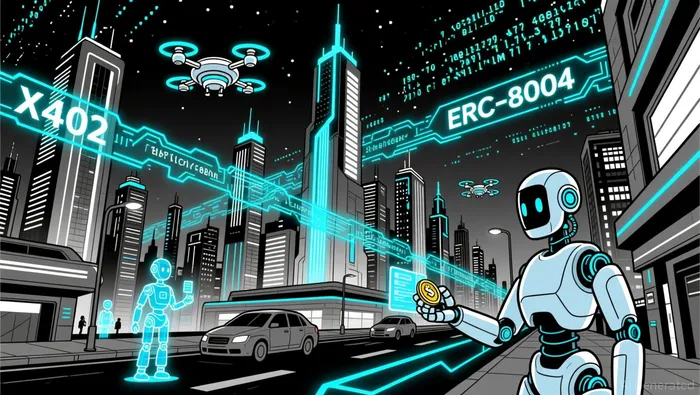
Complementing x402 is ERC-8004, an Ethereum-based standard that introduces a trust layer for autonomous systems. Unlike traditional smart contracts, ERC-8004 focuses on verifiable identity, reputation, and execution proofs for AI agents. This ensures that interactions between machines are not only transparent and traceable but also secure against malicious behavior. Together, x402 and ERC-8004 form a minimal infrastructure stack that enables machines to participate in economic activity, shifting Web3 from a human-centric system to a foundational layer for machine-native markets.
Strategic Implications for Early-Stage Investment
HTX Ventures, a leading Web3 investment firm, has identified x402 and ERC-8004 as pivotal to the machine economy's infrastructure. In a recent report, the firm emphasized that such protocols often emerge during market downturns, when attention shifts from speculative narratives to structural innovations according to analysis. This aligns with historical patterns in tech infrastructure development, where foundational layers (e.g., TCP/IP, HTTP) gained traction during periods of market consolidation.
The strategic value of x402 and ERC-8004 lies in their ability to create a closed loop of payment, execution, verification, and reputation. For instance, stablecoins are increasingly positioned as "machine money" due to their programmability and low volatility, while on-chain identity becomes a core component of trust in M2M interactions according to a deep dive analysis. Projects like CARV's Cashie 2.0 system exemplify this vision in action, integrating x402 and ERC-8004 to bridge social interactions with on-chain value. By automating reward distribution for AI agents while preserving privacy, CARV demonstrates how these protocols can operationalize the machine economy.
Why Now? Market Conditions and Institutional Backing
The timing for strategic exposure to x402 and ERC-8004 is fortuitous. As the Web3 market navigates a prolonged downturn, attention is shifting toward infrastructure that addresses long-term challenges rather than short-term gains. This mirrors the 2016-2018 period, when foundational protocols like IPFS and The GraphGRT-- gained traction amid bear market conditions.
Moreover, institutional backing from entities like CoinbaseCOIN--, Google, and the EthereumETH-- Foundation underscores the growing consensus around these protocols according to industry reports. Such support is not merely symbolic-it signals a validation of x402 and ERC-8004's role in addressing critical gaps in the machine economy. For example, the Ethereum Foundation's involvement in ERC-8004 highlights its potential to enhance the security and scalability of decentralized systems, a priority for both developers and regulators.
Risks and the Road Ahead
Despite their promise, x402 and ERC-8004 face challenges. Regulatory uncertainty, scalability limitations, and competition from alternative solutions (e.g., Layer 2 networks, AI-specific blockchains) could hinder adoption. However, these risks are inherent to early-stage infrastructure investments and are often mitigated as ecosystems mature.
For investors, the key is to focus on the compounding effects of these protocols. As AI agents and automation scripts become primary users of the internet, the demand for infrastructure that enables seamless M2M transactions will only grow. Early adopters who recognize this shift-much like those who invested in blockchain during its nascent stages-stand to benefit from a paradigm shift in digital commerce.
Conclusion: A Predictive On-Ramp to Web3's Next Phase
The machine economy is not a distant future-it is being built today through protocols like x402 and ERC-8004. These innovations represent more than technical advancements; they are the scaffolding for a new economic model where machines operate as autonomous actors. For investors, the opportunity lies in identifying infrastructure that enables this transition before it becomes mainstream.
As HTX Ventures' analysis suggests, the next technical inflection point in Web3 is already underway. By prioritizing x402 and ERC-8004, investors can position themselves at the forefront of a transformation that will redefine how value is created, exchanged, and governed in the digital age.





Comentarios
Aún no hay comentarios