
Web3 Infrastructure Resilience: Investing in Undervalued Projects Fighting Centralization
The recent AWS and CloudflareNET-- outages in 2025 have exposed a critical vulnerability in Web3 infrastructure: the paradox of decentralization. While blockchain protocols like BitcoinBTC-- and EthereumETH-- maintained consensus layer uptime, layer-2 solutions and crypto platforms reliant on centralized cloud services faced catastrophic disruptions. For instance, Base's single AWS-hosted sequencer failed entirely during the October 20–21 outage, revealing how "decentralized" networks remain tethered to centralized infrastructure according to a detailed analysis. This fragility has accelerated demand for protocols that address centralization risks in storage, governance, and identity-areas where Vitalik Buterin has long advocated for systemic change.
Vitalik Buterin's Blueprint for Decentralization
Vitalik Buterin's 2025 writings underscore a three-pronged approach to decentralization: identity, storage, and governance. On identity, he champions zero-knowledge proofs (ZKPs) and attribute-based verification to enable privacy-preserving self-sovereignty, where users disclose only necessary information for a given application according to Buterin's vision. For storage, he warns against over-reliance on centralized cloud providers, advocating for adversarial interoperability and open-source frameworks to prevent monopolistic control as detailed in his writings. In governance, Buterin critiques the concentration of power in "Big Government," "Big Business," and "Big Mob" movements, proposing mechanisms like quadratic voting and mandatory diffusion of technology to ensure equitable access according to his analysis.
These principles are not theoretical. The AWS outage demonstrated how even Ethereum's execution layer nodes, 37% of which were hosted on AWS, struggled during the crisis, contrasting with Solana's 100% uptime due to its diversified infrastructure according to the detailed report. Buterin's vision is increasingly urgent as 60% of countries now develop decentralized identity systems, yet interoperability and governance centralization persist as barriers .
Undervalued Projects in Decentralized Storage
The post-outage landscape has spotlighted projects addressing storage centralization. Arweave (AR), for example, offers permanent, censorship-resistant data storage by incentivizing nodes to store data indefinitely, ensuring accessibility even during infrastructure failures according to expert analysis. Unlike ephemeral cloud solutions, Arweave's "permaweb" aligns with Buterin's call for decentralized, open-source frameworks as noted in industry reports.
EarthMeta (EMT) is another standout, building a blockchain-powered metaverse where virtual activity maps to real-world geography. Its city-based ownership model grants governance rights and revenue shares, reinforcing self-sovereignty in a post-outage era according to expert assessment. Meanwhile, Celo (CELO) targets mobile-first accessibility, enabling low-power devices to participate in decentralized storage and governance. Its carbon-negative network and integration with stablecoins like cUSD position it as a resilient, eco-conscious alternative according to expert analysis.
Decentralized Governance and Infrastructure Resilience
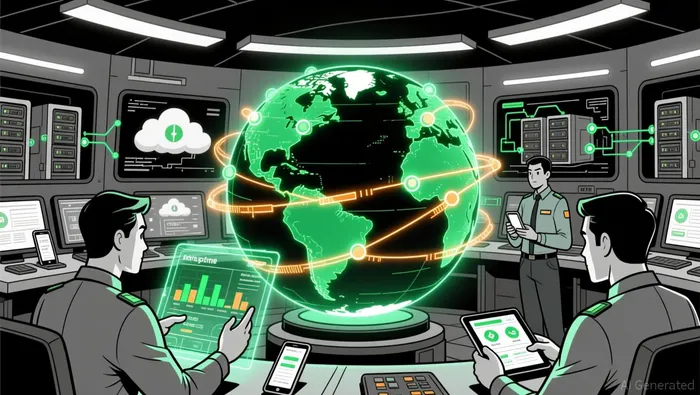
The AWS outage also catalyzed interest in Decentralized Physical Infrastructure Networks (DePIN), which replace centralized cloud dependencies with distributed compute resources. Projects like Fluence and Aethir are pioneering this shift, offering peer-to-peer infrastructure that mitigates single points of failure according to industry reports. Solana's resilience during the outage-attributed to its geographically diverse validator set-highlights the importance of such models as detailed in the analysis.
Buterin's advocacy for adversarial interoperability further supports these efforts. By enabling new products to integrate with existing platforms without permission, DePINs and open-source frameworks can prevent monopolistic control and ensure equitable access to innovation according to his vision.
Investment Opportunities and the Path Forward
The undervalued projects discussed-Arweave, EarthMeta, CeloCELO--, and DePINs like Fluence-represent a new wave of infrastructure that aligns with Buterin's decentralized ethos. Their focus on self-sovereignty, post-outage resilience, and open-source frameworks addresses the core vulnerabilities exposed in 2025. For investors, these protocols offer long-term potential as Web3 transitions from theoretical decentralization to practical, resilient systems.
However, challenges remain. Interoperability between SSI projects and governance models like quadratic voting require standardized frameworks to scale adoption . Yet, as Buterin notes, the broader mission of Ethereum and similar networks is to become a "world computer" supporting durable, censorship-resistant infrastructure . The projects leading this charge are not just surviving the current crisis-they're redefining the future of Web3.





Comentarios
Aún no hay comentarios