
Web3 Community-Driven Marketing: Decoding the ROI of Token-Based User Engagement
In the evolving landscape of digital marketing, Web3 platforms have redefined user engagement through token-based incentives. By leveraging blockchain's transparency and gamification, these strategies create value not just for platforms but for users who become stakeholders. The ROI of such campaigns is no longer speculative-it's measurable, scalable, and, in many cases, transformative.
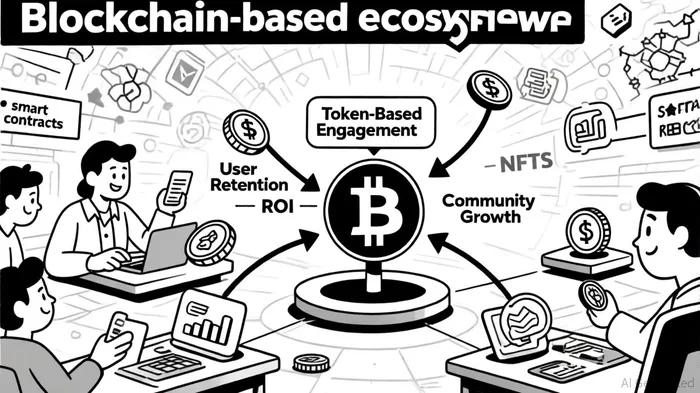
The Mechanics of Token-Based Engagement
Token-based engagement operates on three pillars: ownership, gamification, and aligned incentives. Unlike traditional loyalty programs, Web3 tokens grant users tangible assets that can be traded, staked, or utilized across ecosystems. For instance, Nike's .SWOOSH platform rewarded users with exclusive NFT sneakers, fostering emotional and financial investment[1]. Similarly, Warner BrosWBD--. Discovery's "B/R Watch to Earn" program incentivized NBA viewers with tokens redeemable for rewards, creating a flywheel of organic growth[1].
Gamification amplifies this effect. Axie Infinity's play-to-earn model, which distributed SLPSLP-- and AXSAXS-- tokens, attracted 2.7 million daily users in 2021 by turning gameplay into income[1]. DeFi platforms like UniswapUNI-- further align incentives by rewarding liquidity providers with governance tokens, directly tying user participation to protocol growth[3].
Case Studies: Proven ROI in Action
The financial returns of these strategies are staggering. StepN's move-to-earn model, which rewards users with GST tokens for physical activity, acquired 5 million users in six months[3]. This viral growth was driven by referral mechanics and social sharing, reducing user acquisition costs (UAC) while boosting lifetime value (LTV).
Arbitrum's 2023 airdrop campaign distributed 1.162 billion $ARB tokens to 625,143 wallets, with 200,000 delegating voting rights within 48 hours[1]. The campaign's anti-Sybil measures ensured genuine engagement, stabilizing the token's value and fostering governance readiness. Meanwhile, Pudgy Penguins' Walmart partnership bridged physical and digital markets, generating $10 million in revenue and a 11.2% increase in NFT floor prices[1].
DeFi's Flexe.io demonstrated precision targeting by using wallet-based advertising to attract high-value liquidity providers. The campaign increased TVL by $15 million in three months, proving the efficacy of data-driven token distribution[2].
ROI Metrics: Beyond Traditional KPIs
Measuring ROI in Web3 requires a blend of on-chain and off-chain metrics. User Acquisition Cost (UAC) is calculated not by sign-ups but by active on-chain interactions, such as staking or governance participation[1]. For example, a $5,000 campaign yielding 2,000 token holders results in a $2.50 UAC[3].
Token Holder Growth Models and TVL Growth Models further quantify success. A DeFi platform's gamified quest system, which rewarded users for swapping and staking, tripled engagement compared to flat airdrops[4]. Meanwhile, multi-touch attribution models distribute credit across user interactions, from social media to on-chain transactions, offering a holistic view of campaign effectiveness[1].
AI Tokens vs. Community Tokens: A Tale of Two ROI Profiles
The 2023–2025 period highlighted stark differences between AI-driven tokens and community-based tokens. AI tokens, such as Cogni AI (833% ROI) and Fetch.ai (444% ROI), demonstrated sustainable growth through utility in DeFi automation and AI trading[2]. Their lower token velocity and strong fundamentals contrast with community tokens like HexyDog (1275% ROI) and DOGS Token (1247% ROI), which thrive on viral marketing but face pump-and-dump risks[2].
The key distinction lies in token velocity and long-term utility. AI tokens prioritize real-world applications, while community tokens rely on social hype. Investors must weigh these factors: high ROI in community tokens often comes with volatility, whereas AI tokens offer more predictable, albeit slower, growth[3].
Challenges and Mitigation Strategies
Despite their potential, token-based campaigns face challenges like botting and unsustainable token economics. Platforms combat this with wallet segmentation, sybil detection, and behavior-based airdrops[4]. Tools like Dextr Apps enable wallet-first campaigns, ensuring rewards align with meaningful actions[4].
Analytics platforms such as Dune Analytics and Nansen provide real-time insights into user behavior, allowing for dynamic optimization of marketing strategies[4]. These tools are critical for tracking metrics like unique wallet interactions and TVL, which reflect true engagement[3].
Future Outlook: The Next Frontier
As Web3 matures, token-based engagement will become even more sophisticated. AI-driven personalization, cross-ecosystem interoperability, and hybrid models (e.g., token + physical rewards) will dominate. For investors, the lesson is clear: prioritize projects with strong utility, transparent tokenomics, and proven community engagement.
Conclusion
Web3's token-based marketing strategies have proven their mettle, delivering measurable ROI through ownership, gamification, and aligned incentives. While challenges persist, the tools and frameworks to mitigate them are rapidly evolving. For investors, the opportunity lies in discerning projects that balance innovation with sustainability-those that treat their communities not as metrics, but as stakeholders.







Comentarios
Aún no hay comentarios