
Weatherford's $700M Tender Offer: A Strategic Move to Strengthen Financial Foundations
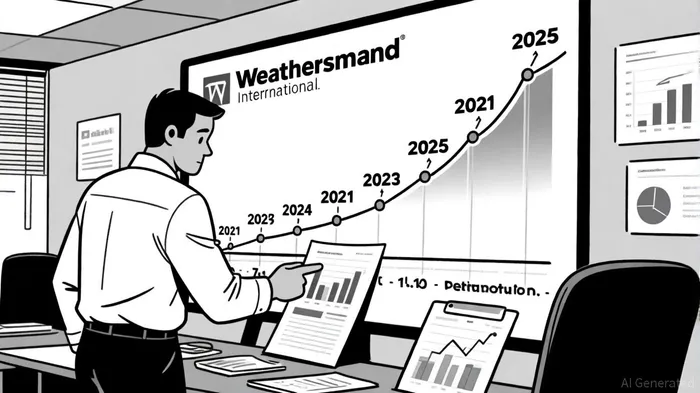
Weatherford International's recent $700 million cash tender offer for its 8.625% Senior Notes due 2030 represents a calculated step in its broader debt restructuring strategy. By incentivizing holders to tender their notes with a $30.00 early tender premium—equivalent to a 3% yield boost for those who act by October 3, 2025—the company aims to reduce its reliance on high-cost debt while extending its maturity profile[1]. This move, paired with a concurrent $600 million issuance of new 2033 senior notes[2], underscores a disciplined approach to optimizing capital structure in a volatile energy market.
Strategic Rationale: Refinancing High-Cost Debt
Weatherford's current tender offer builds on a multiyear strategy to delever and stabilize its balance sheet. In 2021, the company executed a $1.6 billion refinancing of its 11.00% Senior Notes due 2024, using proceeds from new 8.625% 2030 notes to retire higher-coupon obligations[3]. By 2024, it had further reduced its debt burden by redeeming $249 million of 6.50% secured notes[4], leaving $1.6 billion in unsecured 2030 notes outstanding. The current tender targets a portion of these remaining 2030 notes, which carry a coupon rate of 8.625%, a significant discount to the 11.00% rates retired in 2021.
This sequential refinancing strategy reflects a focus on reducing interest expenses and extending maturities. For context, the 2021 refinancing alone saved WeatherfordWFRD-- approximately $65 million annually in interest costs[3]. Retiring a portion of the 2030 notes now—while issuing lower-cost 2033 debt—could further smooth cash flow obligations and reduce refinancing risk as the company navigates cyclical energy market fluctuations.
Implications for Shareholder Value
The tender offer's success hinges on its ability to enhance shareholder value through improved financial flexibility. By reducing near-term debt maturities, Weatherford minimizes the risk of liquidity crunches during periods of low commodity prices or operational disruptions. According to a report by Investing.com, the early tender premium of $30.00 per $1,000 note is designed to accelerate debt reduction, potentially freeing up capital for reinvestment in growth initiatives or shareholder returns[1].
Moreover, the company's cumulative debt reduction of over $1 billion since 2021[4] has already contributed to a decline in net leverage ratios, a critical metric for credit rating agencies. A lower leverage profile could position Weatherford to secure more favorable borrowing terms in the future, indirectly boosting shareholder value by reducing the cost of capital.
Financial Flexibility and Risk Mitigation
The concurrent $600 million 2033 notes offering[2] highlights Weatherford's intent to replace short-term obligations with longer-dated debt, a tactic to avoid refinancing pressures in a rising interest rate environment. While the new 2033 notes' coupon rate is not disclosed, the company's historical preference for lower-cost refinancing suggests the rate will likely be below 8.625%. This would further reduce interest expenses and align with its goal of achieving a “sustainable and flexible capital structure”[4].
However, the tender's $700 million cost—including the early tender premium—must be weighed against potential benefits. If the company retires a significant portion of its 2030 notes, it could reduce future principal repayments by over $700 million in 2030, providing additional liquidity for operational needs or strategic acquisitions.
Conclusion
Weatherford's $700 million tender offer is a strategic continuation of its debt optimization playbook, aimed at reducing interest costs, extending maturities, and enhancing financial resilience. While the immediate cash outlay is substantial, the long-term benefits—lower leverage, reduced refinancing risk, and improved credit metrics—position the company to navigate energy market volatility with greater agility. For shareholders, this disciplined approach signals a commitment to balancing debt reduction with operational flexibility, a critical combination in the cyclical energy sector.





Comentarios
Aún no hay comentarios