
The Weakening U.S. Labor Market and Its Implications for Consumer-Driven Sectors
The U.S. labor market, once a cornerstone of economic resilience, is showing signs of strain in 2025. Rising unemployment in vulnerable demographics, stagnant wage growth, and a "low-hire" environment are reshaping consumer behavior and investment dynamics. For investors, these trends signal a critical shift in sector performance, with defensive and essential goods sectors gaining prominence over discretionary ones. Strategic rotation toward healthcare, utilities, and essential services is not merely prudent-it is increasingly necessary to navigate the evolving economic landscape.
Labor Market Pressures: A Deepening Divide
The U.S. unemployment rate rose to 4.6% in November 2025, with stark disparities across racial and ethnic groups. Black workers faced an unemployment rate of 8.3%, while Hispanic workers saw 5.0%, compared to 3.9% for White workers. These figures underscore persistent inequities and highlight a labor force struggling to adapt to structural shifts. Meanwhile, wage growth, though nominally up 3.9% year-over-year, has been eroded by 2.9% inflation, leaving real wage growth at a meager 1%.
The labor market's "low-hire" condition-marked by a hiring rate at its lowest since 2013-has further compounded challenges. Over 6 million Americans reentered the workforce in Q3 2025, yet job creation has failed to keep pace. This mismatch between supply and demand is particularly acute for lower-income households, where job security concerns rose by three percentage points in Q4 2025. Such instability is a harbinger of reduced consumer spending, especially in discretionary categories.
Consumer Spending: A Bifurcated Landscape
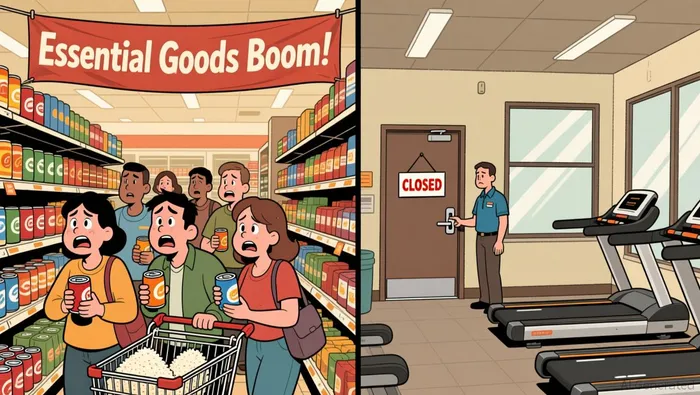 Consumer behavior in 2025 reflects a clear prioritization of essentials over luxuries. Grocery spending remains robust, with demand for canned goods and rice surging as households tighten budgets. Conversely, discretionary sectors like fitness, home improvement and jewelry are experiencing declines. This trend is most pronounced among lower- and middle-income households, with 68% of Americans living paycheck to paycheck and 25% struggling to meet monthly expenses.
High-income households, meanwhile, account for nearly half of U.S. consumer spending-the highest share since 1989. While this provides temporary support for sectors like travel and luxury goods, it also creates systemic vulnerability. A downturn in high-income spending could disproportionately impact overall demand, particularly as tariffs and inflationary pressures build.
Sector Performance: Defensive Sectors Outperform
Health Care's resilience stems from its role as a safe-haven asset during economic uncertainty. Essential services like utilities also benefit from stable demand, particularly as AI-driven energy needs boost electricity consumption. Conversely, discretionary sectors face headwinds from high tariffs, a sluggish housing market, and shifting consumer priorities.
Strategic Rotation: A Path Forward
For investors, the case for sector rotation is compelling. Defensive sectors like Health Care and Utilities offer both stability and growth potential in a weakening labor market. Essential services, including consumer staples, are insulated from cyclical downturns, as demand for necessities remains inelastic.
Conversely, discretionary sectors-while historically cyclical-now face structural challenges. The "lipstick effect," where younger generations splurge on affordable luxuries, is a temporary reprieve rather than a sustainable trend. Tariff-driven inflation and labor market fragility will likely exacerbate volatility in these sectors.
Conclusion
The U.S. labor market's weakening trajectory-marked by wage stagnation, uneven job growth, and rising unemployment in marginalized communities-demands a recalibration of investment strategies. Defensive and essential goods sectors, with their resilience and stable demand, are poised to outperform in this environment. By underweighting discretionary sectors and overweighting healthcare, utilities, and essential services, investors can position portfolios to weather macroeconomic headwinds while capitalizing on long-term structural trends.







Comentarios
Aún no hay comentarios