
The Weakening Dollar/Yen Pair: A Strategic Entry Point for Currency Hedgers?
The USD/JPY pair has long been a barometer of global macroeconomic imbalances and central bank policy divergence. As of late 2025, the pair's weakening trajectory-trading within a 151.00–140.25 range-has sparked debate among currency hedgers about whether this represents a strategic entry point. To assess this, we must dissect the interplay of U.S. inflationary pressures, Federal Reserve (Fed) dovishness, and the Bank of Japan's (BoJ) cautious tightening, all against a backdrop of unresolved trade tensions.
Macroeconomic Imbalances: Diverging Inflation and Trade Dynamics
The U.S. economy remains anchored by inflation stubbornly above the Fed's 2% target, with third-quarter 2025 readings hovering near 3%, according to the CBO outlook. Tariffs imposed under the Trump administration have exacerbated this trend, with the Morningstar outlook estimating their flow-through to consumer prices could add 0.5–1.0% over the next 12 months. Meanwhile, Japan's inflation has moderated slightly to 3.3% year-over-year in Q3 2025, though its trade balance has improved dramatically, posting a 153 billion JPY surplus in June 2025 after a 639 billion JPY deficit in May, according to a Dai-ichi Life report. This divergence creates a tug-of-war: U.S. inflationary pressures weaken the dollar, while Japan's improving trade position supports the yen.
Central Bank Policy Divergence: Fed Cuts vs. BoJ Hesitation
The Fed's September 2025 rate cut-lowering the federal funds rate to 4.00%–4.25%-marked a pivotal shift toward dovishness, driven by slowing job gains and elevated inflation risks, per the Fed statement. Markets now price in two additional 25-basis-point cuts before year-end, and, as a Morningstar report notes, the Fed is signaling a cautious approach into 2026. In contrast, the BoJ remains hesitant to tighten, despite Japan's inflationary pressures. A 25-basis-point rate hike in October 2025 is anticipated, but further hikes depend on the resolution of trade tensions, particularly the expiration of U.S. tariffs on July 9, 2025, as discussed in the Archyde outlook. This policy asymmetry-U.S. easing versus Japanese conditional tightening-creates a structural headwind for the dollar against the yen.
Technical Indicators: Range-Bound Volatility and Momentum Shifts
From a technical perspective, USD/JPY has been range-bound since early 2025, with key support levels at 140.25 and 138.00 acting as psychological barriers, according to an Investing.com forecast. Recent volatility, including a September 3 peak of 150.83 JPY, suggests traders are testing these levels. Momentum indicators like the RSI and MACD point to a potential shift toward a neutral-to-bullish bias, and the Archyde outlook assigns a 65% probability of continued sideways trading with a 15% chance of an upside breakout in Q4 2025. However, downside risks persist if U.S. labor data weakens further or trade tensions escalate.
Strategic Entry Points for Hedgers: Balancing Macro and Technical Factors
For currency hedgers, the current USD/JPY environment offers both opportunities and risks. A strategic entry point might involve:
1. Long Yen Positions: Given the BoJ's potential October hike and the Fed's dovish trajectory, yen-strengthening trends could accelerate if trade tensions ease.
2. Range-Bound Strategies: Hedgers could use the 140.25–151.00 range to implement straddles or strangles, capitalizing on volatility without directional bets.
3. Political Risk Mitigation: With the Fed's independence under scrutiny due to Trump-era appointments, hedgers should factor in policy uncertainty via options or futures.
Conclusion: A Calculated Bet Amid Uncertainty
The weakening USD/JPY pair reflects a complex interplay of macroeconomic imbalances and central bank policy divergence. While the Fed's rate cuts and U.S. inflationary pressures favor the yen, the BoJ's cautious approach and unresolved trade tensions introduce volatility. For hedgers, the key lies in balancing technical signals with macroeconomic fundamentals, using tools like options and futures to navigate a landscape where political risks and policy surprises remain ever-present.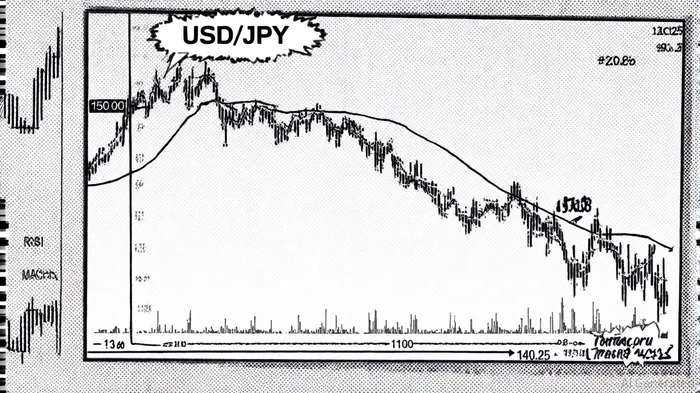







Comentarios
Aún no hay comentarios