
WDI's Underperformance Amid Rising Rates: A Deep Dive into Valuation Compression and Sector Sensitivity
The Western Asset Diversified Income Fund (WDI) has struggled to maintain competitive returns in 2025, with a year-to-date return of 4.84% and a 12-month decline of -0.47% [2]. This underperformance, juxtaposed against the S&P 500's robust Sharpe ratio of 0.83, underscores a critical challenge for fixed-income investors: navigating the dual pressures of valuation compression and sector-specific sensitivity in a prolonged high-interest-rate environment.
Valuation Compression: A Silent Erosion of Value
Rising interest rates have triggered a phenomenon known as valuation compression, where the present value of future cash flows from long-duration assets declines sharply. For WDIWDI--, this dynamic is amplified by its heavy allocation to corporate bonds (70.34%) and securitized assets (45.49%), including asset-backed securities and agency mortgage-backed securities [4]. These holdings, characterized by fixed or semi-fixed cash flows, lose market value as discount rates rise.
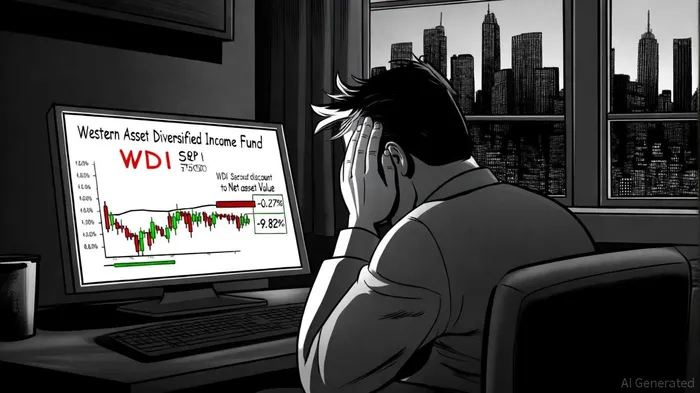
The fund's leverage—32.21% of its portfolio—further exacerbates this risk. While leverage can amplify returns in stable environments, it magnifies losses when asset values contract. This is evident in WDI's 38.92% maximum drawdown in October 2023, a period when the Federal Reserve's hawkish stance kept rates elevated [1]. The resulting discount to net asset value (NAV), which has ranged from -0.27% to -9.82% over the past year [4], reflects investor skepticism about the fund's ability to recover quickly in a persistently high-rate climate.
Sector-Specific Sensitivity: The Hidden Culprits
WDI's portfolio is not uniformly affected by rate hikes. Sectors such as technology and high-growth industries, though not directly part of WDI's holdings, indirectly influence its performance through broader market dynamics. For instance, rising rates reduce the present value of distant cash flows, which disproportionately impacts high-growth equities and, by extension, the credit quality of corporate bonds tied to these sectors [1].
Moreover, WDI's exposure to long-term fixed-income securities—particularly those with low credit ratings—heightens its vulnerability. As noted by Sapient Investment, long-duration bonds experience inverse price movements with interest rates, and the longer the maturity, the more pronounced this effect becomes [2]. This is compounded by the fund's focus on below-investment-grade credits, which often lack the liquidity to withstand sudden repricing in a tightening monetary environment.
Financials, conversely, have historically shown resilience in rising rate scenarios. However, WDI's portfolio does not appear to capitalize on this dynamic. Its emphasis on high-yield corporate debt and securitized assets leaves it underexposed to financial institutions, which could benefit from wider interest rate spreads [1]. This misalignment highlights a strategic gap in sector allocation during a period when defensive positioning in rate-sensitive industries could have mitigated losses.
Strategic Implications for Investors
For investors considering WDI, the current environment demands a nuanced approach. The fund's high-yield focus and leverage, while attractive in low-rate periods, now act as headwinds. A potential path forward may involve rebalancing toward shorter-duration assets or sectors with inherent rate resilience, such as financials. However, given the Fed's prolonged tightening cycle, such adjustments may require patience and a tolerance for near-term volatility.
Conclusion
WDI's underperformance is a case study in the perils of valuation compression and sector-specific sensitivity during a protracted rate hike cycle. While the fund's high-yield strategy offers income potential, its structural vulnerabilities—leverage, long-duration exposure, and misaligned sector allocations—have magnified losses. For investors, the lesson is clear: in a rising rate environment, portfolio resilience hinges on proactive management of duration, leverage, and sector risk.





Comentarios
Aún no hay comentarios