
WD-40: A Value vs. Growth Dilemma in a Mature Dividend-Paying Business
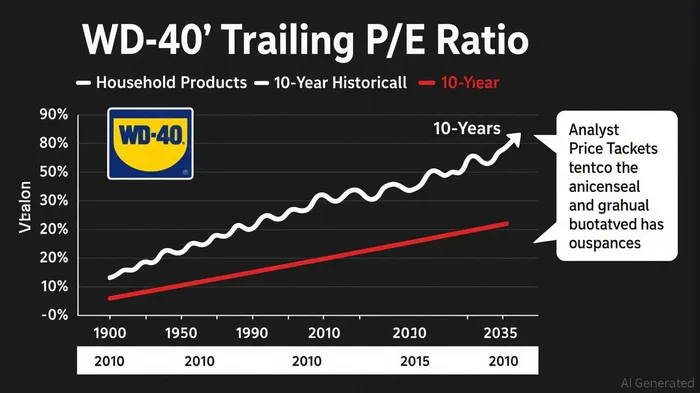
The WD-40 CompanyWDFC-- (WDFC) has long been a staple of conservative portfolios, prized for its reliable dividends and unyielding brand recognition. Yet, as of September 2025, the stock trades at a trailing price-to-earnings (P/E) ratio of 34.13, a figure that remains 16% below its 10-year average of 40.43 but still towers over the household products industry's 2025 average of 24.94 [1]. This valuation disconnect raises a critical question: Is WD-40's recent correction sufficient to justify its current price, or does a fundamental mismatch between its mature business model and growth-oriented multiples persist?
The Valuation Paradox: High Multiples for a Low-Growth Business
WD-40's financials are undeniably robust. The company has delivered an average annual revenue growth of 7.5% and maintained a dividend yield of 1.75%, with $3.76 per share distributed in 2025 [2]. These metrics reflect the stability of a mature business, yet its P/E ratio of 34.13—well above both its 5-year average of 44.82 and the industry benchmark—suggests investors are paying a premium for growth that may not materialize [3].
Data from StockAnalysis reveals that WDFC's forward P/E of 38.98 implies expectations of slowing earnings growth, with analysts projecting a 3.6% annual increase [2]. By contrast, the household products sector's average P/E of 24.94 reflects a market that demands more immediate returns for less predictable revenue streams. This divergence highlights a classic value vs. growth tension: investors are willing to overpay for WD-40's consistency while underpricing riskier, faster-growing peers.
Price-to-Book Discrepancies and Industry Comparisons
The company's price-to-book (P/B) ratio further underscores this valuation puzzle. While some sources report a P/B of 11.43 [2], more recent data from CompaniesMarketCap places it at 4.75881 as of September 2025 [4]. Regardless of the exact figure, WD-40's P/B remains significantly higher than the industry's 7.33 benchmark [5]. This suggests the market is valuing WD-40's intangible assets—its iconic brand and loyal customer base—more heavily than its tangible book value. However, for a company with limited reinvestment opportunities, such a premium may be unjustified.
Dividend Appeal vs. Growth Constraints
WD-40's 1.75% yield, while modest by today's standards, is attractive in a low-interest-rate environment. Yet, this yield alone does not justify its elevated P/E. A report by SimplyWall St notes that WDFC's P/E of 34x exceeds both its peer average of 15.7x and its estimated fair P/E of 18.9x [6]. Analysts' consensus price target of $277.50—a 27.84% upside from current levels—reflects optimism about the company's ability to sustain dividends and navigate inflationary pressures. However, this optimism appears disconnected from the reality of its earnings trajectory, which has grown at just 3.6% annually [2].
Conclusion: A Fair Valuation or a Mispriced Relic?
WD-40's recent correction has brought its P/E closer to historical norms, but it remains a premium stock in a sector that rewards efficiency over consistency. For value investors, the company's strong balance sheet and dividend track record are compelling, yet its multiples suggest a growth story that diverges from its operational reality. As SimplyWall St observes, WDFC's valuation sits in a “Fair” zone relative to its 5-year average [6], but this may mask a deeper mismatch between its mature business model and the expectations embedded in its stock price.
In the end, WD-40's appeal lies in its ability to deliver steady returns in uncertain markets. However, investors must weigh this reliability against the risk of overpaying for a company whose growth potential is inherently constrained. For those seeking capital appreciation, the household products sector offers more compelling opportunities at lower valuations. For income-focused investors, WD-40WDFC-- remains a durable, if overpriced, option—provided they are comfortable with the premium they pay for its dividend stability.





Comentarios
Aún no hay comentarios