
Waymo's Scaling Momentum and Implications for the Autonomous Mobility Sector
The autonomous mobility sector is at a pivotal inflection point, with Waymo emerging as a dominant force in the U.S. robotaxi market. As of November 2025, Waymo operates a fleet of 2,500 autonomous vehicles across five U.S. cities-Phoenix, San Francisco, Los Angeles, Austin, and Atlanta-with plans to expand to Detroit, Las Vegas, and San Diego by 2026. This growth trajectory, coupled with strategic partnerships and technological advancements, positions Waymo as a key player in shaping the future of transportation. However, intensifying competition from U.S. rivals like Cruise and global expansion by Chinese firms such as Baidu Apollo Go and WeRideWRD-- necessitates a nuanced analysis of Waymo's strategic positioning and its implications for the broader sector.
Strategic Expansion and Partnerships: A Foundation for Dominance
Waymo's aggressive scaling is underpinned by its app-based robotaxi service, which delivers over 250,000 rides weekly, with Phoenix as its largest and most mature market according to recent reports. The company's collaboration with UberUBER--, allowing users to hail autonomous vehicles via the Uber app, exemplifies its focus on accessibility and integration with existing mobility ecosystems as research shows. This partnership not only enhances user adoption but also leverages Uber's extensive rider base to accelerate Waymo's market penetration.
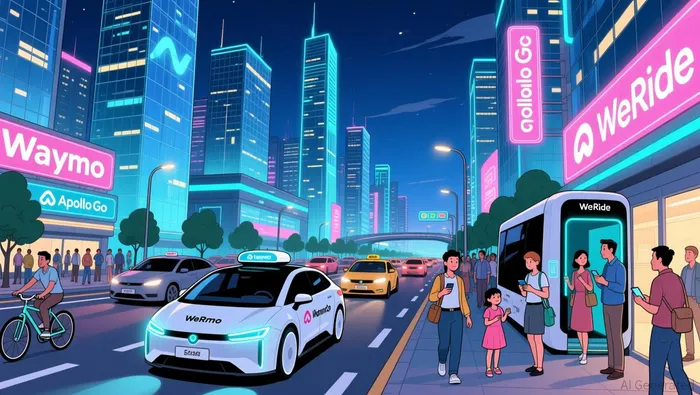 Globally, Chinese competitors are outpacing Waymo in expansion. Baidu's Apollo Go, for instance, claims to have completed 14 million rides as of August 2025 and plans to scale to 1,000 vehicles in the Middle East by 2028. These firms benefit from lower vehicle costs-Baidu's Apollo Go RT6 model costs $28,800 compared to Waymo's vehicles, which are estimated at hundreds of thousands of dollars each-and government support, including fast-tracked permits and 5G infrastructure. While Waymo plans to enter London and Tokyo, Chinese companies have already established operations in Dubai, Abu Dhabi, and Singapore.
Technological Innovation and Regulatory Challenges
Waymo's technological edge lies in its level 4 autonomous systems and extensive safety disclosures, which have earned it regulatory trust in the U.S. The company has surpassed 100 million fully autonomous miles driven and emphasizes transparency in its safety protocols. However, Chinese firms are closing the gap through centralized strategies and access to dense urban data. For example, Pony AI's CFO noted that its hardware costs are "much, much lower than Waymo's", enabling rapid fleet scaling.
Regulatory hurdles remain a critical differentiator. U.S. companies face fragmented state-level regulations, delaying large-scale deployment, while Chinese firms benefit from a unified policy environment. Baidu Apollo Go has achieved per-vehicle profitability in Wuhan, a feat Waymo has yet to replicate. Meanwhile, Waymo's recent incidents, such as school bus detection failures, highlight the ongoing challenges of public trust and safety.
Financial Sustainability and Market Dynamics
Financially, Waymo relies on Alphabet's deep pockets, but its path to profitability is clouded by high operational costs. In contrast, Chinese companies like Baidu and WeRide are leveraging government incentives and cost-effective supply chains to achieve scale. The U.S. robotaxi market is valued at $8 billion, while China's is $12 billion as of 2024, with projections of $174 billion by 2045 at a 37% CAGR.
Waymo's focus on the U.S. market contrasts with the global ambitions of Chinese firms, which are expanding into Europe and the Middle East. This divergence underscores the importance of regulatory acceptance and geopolitical factors. For instance, U.S. restrictions on Chinese EVs limit the global reach of competitors like Baidu, but Waymo faces its own challenges in navigating international markets.
Implications for the Autonomous Mobility Sector
Waymo's momentum in the U.S. reinforces its role as a technological benchmark, but the sector's future will hinge on overcoming regulatory, financial, and public trust barriers. Chinese firms' cost advantages and global expansion suggest a bifurcated market, where U.S. players dominate domestic innovation while Asian companies lead in scalability and international adoption. For investors, the key differentiators will be:
1. Regulatory agility: Companies that navigate fragmented U.S. policies or secure favorable international permits will gain an edge.
2. Cost efficiency: Lower vehicle and operational costs, as demonstrated by Chinese firms, are critical for long-term profitability.
3. Partnership ecosystems: Integrations with platforms like Uber or DoorDash will determine market reach and user adoption.
Waymo's strategic partnerships and technological rigor position it to maintain U.S. leadership, but its ability to compete globally will depend on addressing cost inefficiencies and regulatory complexities. Meanwhile, the sector's projected growth underscores the transformative potential of robotaxis, with early movers like Waymo and Baidu Apollo Go likely to shape the next decade of mobility.





Comentarios
Aún no hay comentarios