
Is D-Wave Quantum (QBTS) Overhyped Amid Prolonged Burn Rate and Share Dilution?
The quantum computing sector has long been a magnet for speculative capital, with investors betting on the transformative potential of nascent technologies. D-Wave QuantumQBTS-- (QBTS), a pioneer in quantum annealing and gate-model systems, has captured significant attention in 2025 despite persistent financial challenges. This article critically examines whether the company's valuation-currently trading at a forward price-to-sales (P/S) ratio of 250.58X-is justified given its prolonged cash burn, aggressive share dilution, and mixed operational performance.
Financial Performance: Revenue Growth vs. Sustained Losses
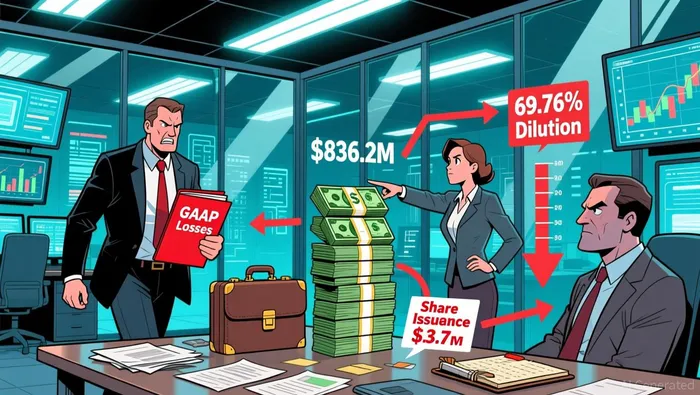
D-Wave's Q3 2025 results highlight a paradox: revenue doubled year-over-year to $3.7 million, while GAAP net losses widened to $140 million. This disconnect stems largely from non-cash charges, such as the $121.9 million remeasurement of warrant liabilities, which distort earnings but do not reflect operational inefficiencies. Excluding these items, the company's adjusted net loss narrowed to $18.1 million, and gross profit surged 156% to $2.7 million, driven by higher-margin product sales and cloud computing services.
However, the company's cash burn remains alarming. Despite a record $836.2 million cash balance, D-Wave's trailing twelve-month operating cash flow is negative at -$51.59 million. This suggests that while the firm has secured liquidity through equity offerings (e.g., a $400 million ATM raise in Q2 2025), its ability to convert revenue into sustainable cash flow is limited. The reliance on capital raises to fund operations raises concerns about long-term viability, particularly as the market for speculative tech stocks remains volatile.
Share Dilution: A Double-Edged Sword
D-Wave's equity structure has been a focal point of investor scrutiny. In October 2025, the company redeemed 5 million warrants at $0.01 per warrant, triggering the issuance of 7.2 million shares-a dilution of less than 2.1% for existing shareholders. This move, while minimizing immediate dilution, reflects a broader trend: diluted shares outstanding ballooned 69.76% year-over-year to 342.205 million as of September 30, 2025. Such dilution, though manageable in the short term, risks eroding shareholder value if revenue growth fails to outpace share issuance.
The CFO's recent sale of 200,000 shares for $4.6 million further underscores internal skepticism about near-term valuation sustainability. While insider sales are not inherently negative, they often signal caution in companies with stretched multiples.
Valuation Multiples: A Sector-Wide Problem or D-Wave's Unique Challenge?
D-Wave's valuation appears extreme even by quantum computing sector standards. The industry's average P/S ratio of 5.59X pales in comparison to QBTS's 250.58X multiple, which implies investors are pricing in decades of future growth. This disconnect is partly justified by D-Wave's technological leadership- its Advantage2 system and fluxonium qubit roadmap position it ahead of many peers-but also reflects a lack of profitability benchmarks. For context, the sector's average P/E ratio is -19.78, highlighting the absence of earnings.
The company's R&D spending trends add nuance. After a 6.8% decline in 2024, R&D expenses rebounded 39.7% year-over-year to $47 million in 2025, with Q3 alone seeing a 62.4% sequential increase. This suggests D-WaveQBTS-- is prioritizing innovation, but the question remains: Can these investments translate into scalable revenue streams before cash reserves dwindle?
Operational Sustainability: A Ticking Clock?
D-Wave's cash runway appears robust on paper, with $836 million in reserves. However, the company's operating expenses are projected to rise 15% sequentially in late 2025, driven by personnel costs and stock-based compensation. At current burn rates, the firm could exhaust its liquidity within 18–24 months unless revenue growth accelerates dramatically. This timeline is optimistic given that revenue, while doubling annually, still represents a small base $3.7 million in Q3 2025.
Conclusion: Hype vs. Reality
D-Wave's story is a classic case of "innovation premium" versus operational reality. The company's technological advancements and revenue growth are undeniably impressive, but its valuation is predicated on speculative bets rather than proven scalability. While the quantum computing sector's high P/S ratios provide some context, D-Wave's multiples remain extreme, particularly given its negative operating cash flow and reliance on dilutive financing.
For investors, the key risk lies in the mismatch between current valuations and near-term financial performance. If D-Wave fails to achieve profitability or secure recurring revenue streams within the next 12–18 months, the market may reassess its premium, leading to significant downside risk. Conversely, breakthroughs in commercial adoption-such as the €10 million Advantage2 contract in Italy-could justify the hype. For now, however, the balance tilts toward caution.





Comentarios
Aún no hay comentarios