
D-Wave Quantum: Mapping the Infrastructure Layer on the Quantum S-Curve
The quantum computing industry is firmly in its early adoption phase, a classic S-curve inflection point. Global revenues are projected to grow from $260 million in 2020 to around $9 billion by 2030, representing over 40% annual growth for the decade. This explosive trajectory is the engine behind the sector's recent rally, and D-Wave QuantumQBTS-- is positioning itself as a potential infrastructure layer player within this paradigm shift.
The company's recent stock surge, with shares up nearly 200% over the past year, is largely a reflection of this industry-wide optimism. Good news for one company in an industry can inadvertently boost the stock price of similar companies. The catalyst was a major industry inflection point late last year when Google announced a breakthrough in error-corrected quantum computing. This news, coupled with geopolitical tailwinds, has created a rising tide that D-WaveQBTS-- is riding.
D-Wave's strategic move is to build a comprehensive technological stack. Its recent $550 million acquisition of Quantum Circuits Inc. is a pivotal step in that direction. The deal aims to combine D-Wave's established quantum annealing expertise and cloud platform with Quantum Circuits' advanced, error-corrected gate-model technology. This is a classic picks-and-shovels play, attempting to control key infrastructure layers-both the annealing hardware and the path toward fault-tolerant gate models-before the commercial adoption curve steepens.
The company is already demonstrating technical milestones that address scaling bottlenecks. Its recent achievement of scalable on-chip cryogenic control of gate-model qubits is described as an industry-first. This technology, which reduces wiring complexity, could be a critical enabler for building large, commercially practical quantum systems. Yet, the financial reality underscores the early stage. While revenue is doubling year-over-year, it remains modest at around $3.7 million per quarter, and the company is burning cash at a rate of over $30 million per quarter. The path to profitability is long, but the acquisition provides a clear roadmap to integrate complementary technologies into a unified platform.
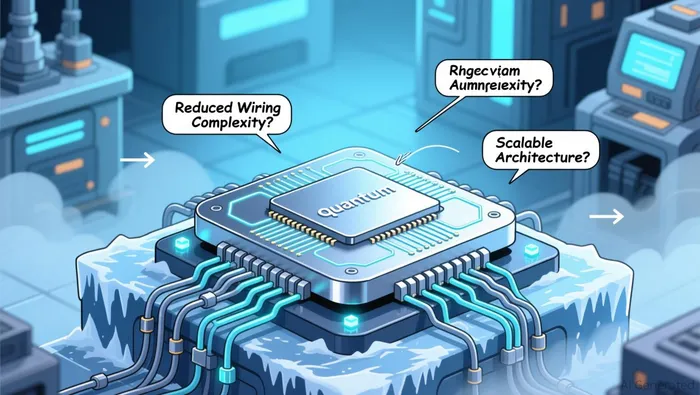
First-Principles Analysis: The Scalability Breakthrough
The recent announcement of an industry-first breakthrough in scalable, on-chip cryogenic control for gate-model qubits is a critical step toward solving the fundamental scaling problem in quantum computing. The core challenge is straightforward: as you add more qubits to a system, the number of required control lines and connections grows linearly, creating a massive bottleneck in space, materials, and overall system complexity. This is the same kind of wiring nightmare that classical computing overcame with multiplexed control on a chip.
D-Wave's claim is that it has now engineered a solution to this bottleneck. By demonstrating a way to control additional quantum computing power with fewer resources, the company is attempting to replicate the exponential scaling seen in classical integrated circuits. This is not just a minor efficiency gain; it is a potential paradigm shift for system architecture. If successful, it means the path to building large, commercially practical quantum systems is no longer blocked by an insurmountable wiring problem.
The practical implication is clear. This technology could be the key enabler for the company's ambitious goal of building a scaled, fully error-corrected gate-model quantum computer. It directly addresses a long-standing obstacle that has held back the industry. For D-Wave, this breakthrough provides a tangible technical foundation for its strategic acquisition of Quantum Circuits Inc., which brings complementary error-corrected gate-model technology. The combined stack now has a clearer path to integration.
The near-term test of this integration and commercial viability is already mapped out. An initial dual-rail system, a product of the Quantum Circuits acquisition, is expected to be available in 2026. This system will serve as the first real-world demonstration of whether the scalable control technology can be successfully married with advanced gate-model hardware. Its performance will be a critical signal for the company's roadmap and its ability to transition from a collection of promising technologies to a unified, scalable platform.
Financial Metrics: Momentum vs. Scale and the War Chest
The financial story here is a study in exponential promise versus current scale. On one hand, D-Wave is showing the kind of explosive growth that signals a product gaining traction. For the third quarter of fiscal 2025, revenue jumped 100% year-over-year to $3.7 million. More impressively, gross profit surged 156% to $3.0 million, indicating that the company is not just selling more but doing so with a healthy margin. This momentum is backed by a record cash balance of over $836 million, the largest in its history.
This war chest is the fuel for its picks-and-shovels strategy. It funds the $550 million acquisition of Quantum Circuits Inc. and the massive R&D required to integrate scalable cryogenic control with gate-model hardware. The cash position provides a long runway, but it also highlights the company's reliance on external capital. With revenue still in the low tens of millions, the path to self-sustaining profitability remains distant. The market is pricing in a future far beyond this current scale.
The valuation reflects this gap between present and potential. With a market cap near $10 billion and sales of just $3.7 million per quarter, the price-to-sales ratio is astronomical, estimated at over 383. This multiple is not a reflection of today's operations but a bet on the entire quantum S-curve. Investors are paying for the infrastructure layer D-Wave is building, not for its current commercial output. The high gross margin of 82.82% suggests the business model can be highly profitable at scale, but the company must first achieve that scale.
The bottom line is that D-Wave has strong operational momentum and a fortress balance sheet. Yet, the financials underscore the early stage. The company is burning cash at a rate of over $27 million per quarter, and its revenue growth, while stellar, is from a very small base. The record cash balance is a strategic asset, but it is also a reminder that the commercial adoption curve has not yet steepened enough to support its current valuation. The war chest buys time, but the clock is ticking to demonstrate that the scalable infrastructure it is building can translate into a large, profitable business.
Valuation, Catalysts, and the Exponential Risk
The investment thesis for D-Wave Quantum is a classic bet on a technological S-curve. The bullish analyst consensus, with an average price target of $40.67 and a 39% upside, reflects this forward-looking optimism. Yet, the valuation leaves almost no room for error. The stock trades at a price-to-sales multiple that is astronomical for a company with quarterly revenue in the low tens of millions. This is not a valuation based on current earnings but on the potential to capture the infrastructure layer as quantum computing scales from niche research to commercial reality.
The key catalysts are now mapped out on a tight timeline. The most immediate is the expected availability of an initial dual-rail system in 2026. This product, born from the Quantum Circuits acquisition, will be the first real-world test of the company's integrated stack. Its performance will signal whether the scalable cryogenic control breakthrough can be successfully married with advanced gate-model hardware. Success here would validate the picks-and-shovels strategy and provide a tangible product for commercial pilots. Beyond that, continued progress in error correction and system scaling remains the fundamental driver of the entire paradigm shift. Each milestone brings the industry closer to the steep part of the adoption curve.
The primary risk is the exponential nature of the technology itself. The S-curve is longer and steeper than many anticipate. D-Wave's high valuation assumes a rapid acceleration in commercial adoption, but the path to a $9 billion industry is fraught with technical hurdles and customer education. The company's own financials highlight the gap: revenue is doubling, but from a tiny base, while it burns cash at a rate of over $30 million per quarter. Any delay in the 2026 launch, or slower-than-expected scaling of the integrated system, could disrupt the narrative that supports the current price. The market is pricing in a future far ahead; execution must be flawless to deliver it.





Comentarios
Aún no hay comentarios