
Waste Energy Corp's Breakthrough USMCA Certification and Cross-Border Technology Deployment Signal a Pivotal Shift to Revenue Generation in the Waste-to-Energy Sector
The recent USMCA certification of Waste Energy Corp's (WEC) patent-pending waste-to-energy (WtE) conversion technology marks a critical inflection point for the company, positioning it to capitalize on a rapidly expanding global market. By securing this regulatory milestone, WECWEC-- has not only cleared the final barrier to U.S. market entry but also demonstrated its ability to execute on a strategic vision that aligns with the energy transition, AI-driven infrastructure, and circular economy principles. With cross-border technology deployment underway and revenue generation expected by Q1 2026, WEC's operational progress underscores its potential as a high-conviction investment in a sector poised for sustained growth.
Strategic Execution: USMCA Certification as a Catalyst for U.S. Market Entry
WEC's USMCA certification is more than a regulatory formality-it is a strategic lever that unlocks preferential tariff treatment and streamlined customs procedures under the U.S.-Mexico-Canada Agreement according to CBP. This certification ensures that WEC's technology, which converts non-recyclable waste into usable energy, can enter the U.S. market without the financial and logistical friction that often stifles cross-border innovation. As of late 2025, the majority of the technology has already cleared U.S. customs and is en route to WEC's facility in Midland, Texas, with remaining components expected by early January 2026. Installation and commissioning are scheduled to begin in January 2026, with full operational status anticipated by month-end. This precise timeline reflects WEC's disciplined execution, a critical trait in an industry where delays can erode competitive advantage.
The U.S. market is particularly ripe for WEC's solution. With municipal solid waste (MSW) accounting for 69% of global WtE feedstock in 2025, and landfill usage under increasing regulatory scrutiny, WEC's technology addresses a pressing need. By converting waste streams into energy, WEC aligns with U.S. environmental policies that prioritize waste diversion and renewable energy generation. The company's ability to navigate USMCA's rules of origin and secure certification also signals its readiness to scale, a prerequisite for attracting institutional capital in a capital-intensive sector.
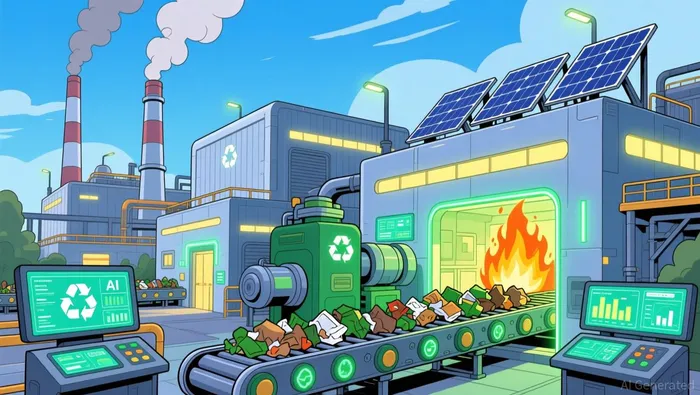
Scalable Market Potential: A $82.1 Billion Opportunity by 2035
The global WtE market, valued at $42.7 billion in 2025, is projected to grow at a compound annual rate of 6.8%, reaching $82.1 billion by 2035. This growth is driven by three interlinked trends: the energy transition, AI-driven infrastructure, and the circular economy. WEC's technology is uniquely positioned to benefit from all three.
First, the energy transition demands scalable solutions to decarbonize power generation. WEC's waste-to-energy systems offer a dual benefit: reducing landfill methane emissions (a potent greenhouse gas) while generating baseload renewable energy. According to a report by Future Market Insights, the shift away from landfills and toward energy recovery is accelerating, particularly in regions with stringent waste management regulations.
Second, AI integration is transforming WtE operations. Advanced algorithms optimize combustion efficiency, predict equipment failures, and enhance emission controls. WEC's deployment of AI-driven infrastructure not only improves margins but also ensures compliance with evolving environmental standards, a critical factor in securing long-term contracts with municipalities and utilities.
Third, the circular economy-a $4.5 trillion opportunity by 2030 according to Research and Metric-emphasizes resource conservation and waste valorization. WEC's technology embodies circular principles by converting waste into energy, thereby reducing reliance on fossil fuels and minimizing environmental degradation. As governments and corporations prioritize circularity, WEC's solutions will become increasingly indispensable.
A Confluence of Trends: Why WEC Stands Out
WEC's strategic positioning at the intersection of energy transition, AI innovation, and circular economy adoption creates a defensible competitive moat. Unlike traditional WtE players, which often struggle with high capital costs and regulatory uncertainty, WEC's USMCA-certified technology offers a scalable, cost-competitive alternative. The company's ability to deploy its systems rapidly-fully operational by late 2026-positions it to capture market share ahead of slower-moving competitors.
Moreover, WEC's cross-border deployment under USMCA highlights its global scalability. The agreement's preferential treatment extends beyond the U.S., facilitating future expansion into Canada and Mexico, where waste management infrastructure is similarly under strain. This regional footprint, combined with the company's AI-driven operational efficiency, creates a blueprint for replication in other markets.
Conclusion: A High-Growth, Low-Carbon Investment
Waste Energy Corp's USMCA certification and cross-border technology deployment represent more than operational milestones-they are proof of the company's ability to execute in a complex regulatory environment while aligning with macroeconomic tailwinds. As the WtE sector accelerates toward a $82.1 billion market by 2035, WEC's combination of strategic execution, technological innovation, and alignment with circular economy principles positions it as a compelling investment. For investors seeking exposure to the energy transition and sustainable infrastructure, WEC's imminent revenue generation phase offers a rare opportunity to participate in a company poised for exponential growth.





Comentarios
Aún no hay comentarios