
Warren Buffett's Strategic Shift: From Tech and Banks to High-Yield Treasury Bills
In a market environment marked by historically high valuations and uneven risk-reward dynamics, Warren Buffett's Berkshire Hathaway has executed a strategic reallocation of capital, shifting away from overvalued equities-particularly in the tech and banking sectors-toward high-yield Treasury bills. This move, underscored by a record $381 billion cash and T-bill position as of September 30, 2025, reflects a disciplined approach to capital preservation and risk-adjusted returns. By prioritizing liquidity and flexibility, Berkshire is positioning itself to capitalize on future dislocations while navigating the challenges of a market where "everything's too expensive".
High Valuations and the Case for Risk-Adjusted Returns
The shift is rooted in a clear-eyed assessment of market fundamentals. The Buffett Indicator-a metric comparing U.S. stock market capitalization to GDP suggests equities are overvalued relative to economic output. This aligns with broader concerns about stretched valuations in sectors like technology, where speculative fervor has driven multiples to unsustainable levels. For Berkshire, the calculus is straightforward: when risk-adjusted returns in equities fall below those of fixed income, capital reallocation becomes imperative.
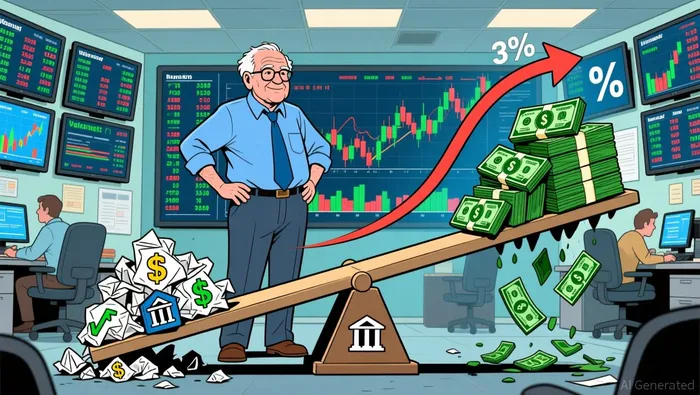 Short-term U.S. Treasury bills, now yielding over 4%, offer a compelling alternative. These instruments provide safety, liquidity, and a predictable return stream, which Buffett has long emphasized as critical in volatile environments. As he noted in his 2025 shareholder letter, "Mistakes are inevitable, but the key to success lies in learning from them and making strategic, patient decisions." By parking capital in T-bills, Berkshire avoids the risks of overpaying for equities while maintaining the flexibility to act when attractive opportunities emerge.
Capital Reallocation: A Defensive Posture with Offensive Potential
Berkshire's Q3 2025 portfolio adjustments highlight this dual strategy. The company reduced its long-standing positions in Apple and other tech stocks, net selling $6.1 billion in equities for the 12th consecutive quarter. Simultaneously, it allocated $306 billion to Treasury bills, a move that not only preserves capital but also generates income in a low-growth macroeconomic context. This reallocation is not a retreat but a calculated hedge against market overvaluation.
The insurance segment further reinforces this approach. With combined ratios below 100% and underwriting profits surging, Berkshire's float-generated from its insurance operations-has become a powerful tool for deploying capital at favorable terms according to financial analysis. The recent $9.7 billion acquisition of Occidental's OxyChem unit demonstrates the company's disciplined capital allocation, prioritizing tangible assets with predictable cash flows over speculative equity bets.
Strategic Patience and the Buffett Philosophy
Buffett's emphasis on patience is central to this strategy. As he stated in his 2025 letter, "Patience pays dividends in a high-valuation market." The massive cash reserves-now exceeding the market caps of Coca-Cola and Bank of America-are not a sign of complacency but a deliberate choice to wait for dislocations. This approach mirrors Berkshire's historical playbook, where large-scale investments (e.g., in Coca-Cola in 1988) were made when valuations aligned with intrinsic value.
However, the current environment presents unique challenges. With compelling investment opportunities scarce, Buffett has acknowledged the need to hold cash until "attractive deals emerge". This patience is not passive; it is a strategic stance that leverages Berkshire's size and liquidity to act decisively when the market corrects.
Implications for Investors and the Market
Berkshire's shift offers valuable lessons for investors. In a high-valuation market, the pursuit of risk-adjusted returns demands a balance between defensive positioning and opportunistic flexibility. By prioritizing Treasury bills, Berkshire mitigates downside risk while maintaining the capacity to deploy capital at favorable terms. For individual investors, this underscores the importance of diversification and liquidity, particularly in sectors where valuations are stretched.
Moreover, the move signals broader market skepticism. When a top-tier allocator like Buffett opts for fixed income, it reflects a reassessment of risk-reward dynamics. This could pressure other institutional investors to adopt similar strategies, potentially amplifying the shift toward safer assets. Yet, as Buffett emphasized, equities remain the core of Berkshire's portfolio-a reminder that long-term value creation still hinges on ownership of durable, high-quality businesses according to his 2025 letter.
Conclusion
Warren Buffett's strategic shift from tech and banks to high-yield Treasury bills is a masterclass in capital reallocation. By prioritizing risk-adjusted returns and maintaining a fortress-like balance sheet, Berkshire is navigating a high-valuation market with discipline and foresight. While the immediate focus is on preservation, the long-term goal remains clear: to deploy capital when the market offers compelling opportunities. In an era of uncertainty, this approach exemplifies the enduring power of patience, prudence, and a relentless focus on intrinsic value.







Comentarios
Aún no hay comentarios