
Warren Buffett's Hidden Warnings: Why Cash Piles and Selective Buys Signal a Market at a Precipice
Warren Buffett's Berkshire Hathaway has long been a barometer for market sentiment, with its strategic decisions often interpreted as signals for broader economic trends. As of Q3 2025, Berkshire's cash reserves have surged to a record $381.7 billion, a figure surpassing the combined liquid assets of tech giants like AppleAAPL--, MicrosoftMSFT--, and Alphabet. This unprecedented accumulation of liquidity, coupled with a 12-quarter streak of net stock sales totaling $184 billion, has sparked intense debate about Buffett's stance on current market valuations. For investors, these actions are not merely operational adjustments but profound psychological signals that warrant closer scrutiny.
The Cash Pile: A Defensive Strategy or a Cautionary Flag?
Buffett's cash hoarding reflects a deliberate shift toward defensive positioning. According to a report by , Berkshire's large cash holdings are driven by a combination of market skepticism and strategic patience. 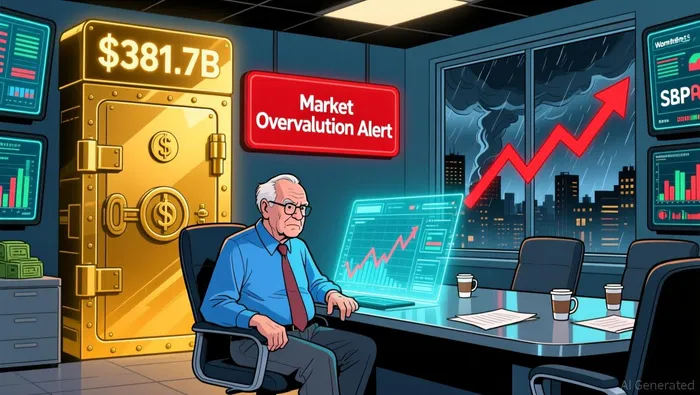 The S&P 500's cyclically adjusted price-to-earnings (CAPE) ratio, a key valuation metric, has reached 40 in November 2025-a level historically associated with a 30% average decline over the subsequent three years. This metric, developed by economist Robert Shiller, places the market in the top 3% of its 70-year history, suggesting extreme overvaluation.
Buffett's adherence to his principle of "being greedy when others are fearful" underscores his belief that current conditions are not conducive to value investing. By avoiding new stock purchases and trimming overvalued positions-such as its stake in Apple-Berkshire is signaling that it sees limited opportunities in a market dominated by speculative fervor according to market analysis. This approach aligns with Buffett's emphasis on a "margin of safety," a concept he has long championed to mitigate downside risk as documented in multiple reports.
The Buffett Indicator and the Psychology of Overvaluation
Beyond the CAPE ratio, Buffett has also highlighted the Buffett Indicator-a comparison of U.S. market capitalization to GDP-as a critical gauge of market health. As of 2025, this indicator stands at an all-time high of 210%, a level Buffett himself has described as "dangerous territory." Data from notes that such elevated readings historically precede market corrections, reinforcing the idea that the current bull market may be nearing a turning point.
The psychological implications of these metrics are profound. When a figure as revered as Buffett adopts a cautious stance, it can amplify investor anxiety and trigger a self-fulfilling prophecy of selling pressure. observes that Buffett's cash buildup has been interpreted by some as a "$184 billion warning" to the broader market. This sentiment is further amplified by the fact that Berkshire has not repurchased its own shares since early 2024, a move that suggests even its own stock is perceived as overvalued.
Market Psychology and the Illusion of Growth
The current market environment is further complicated by rapid technological advancements, particularly in artificial intelligence (AI). Some analysts argue that AI-driven earnings growth could justify elevated valuations, potentially moderating the risk of a sharp correction. However, this optimism may be misplaced. points out, Buffett's strategy remains rooted in fundamentals, not speculative narratives. His reluctance to chase momentum stocks or tech darlings reflects a skepticism toward narratives that prioritize short-term hype over long-term value.
This divergence between market psychology and Buffett's approach highlights a growing disconnect. While investors are increasingly drawn to high-growth sectors, Berkshire's actions suggest that such valuations are unsustainable. The CAPE ratio's historical correlation with market downturns-particularly after reaching levels above 39-further underscores the fragility of current optimism.
Conclusion: A Call for Prudence
Warren Buffett's cash reserves and selective investments are not mere operational choices but a clear-eyed assessment of a market teetering on the edge of overvaluation. By maintaining a fortress of liquidity, Berkshire is positioning itself to capitalize on opportunities that may arise during a correction-a strategy that aligns with Buffett's philosophy of "waiting for the ball to come to you" as noted in financial analysis. For individual investors, the message is equally clear: patience and discipline are paramount in an environment where psychological biases and speculative excesses threaten to distort rational decision-making.
As Buffett steps down as CEO, his final actions serve as a cautionary tale. The market's current trajectory, marked by historically high valuations and a lack of attractive investment opportunities, demands a reevaluation of risk tolerance. In a world where "greed and fear" drive asset prices, Buffett's cash pile stands as a stark reminder that the most enduring wealth is often built by staying grounded in value.







Comentarios
Aún no hay comentarios