
Walmart's Margin Expansion and Tech-Driven Transformation: A Catalyst for Long-Term Shareholder Value
In an era where retail margins are under relentless pressure from inflationary forces and shifting consumer behavior, Walmart's Q3 2025 earnings report has emerged as a beacon of disciplined execution and strategic innovation. The company's ability to expand gross margins while accelerating automation and AI integration underscores its position as a leader in operational efficiency. For investors, this dual focus on margin resilience and technological reinvention presents a compelling case for long-term value creation.
Strategic Margin Expansion: A Foundation for Resilience
Walmart's U.S. , a testament to its strategic pivot toward higher-margin offerings and cost optimization. This growth was fueled by robust performance in digital channels and membership programs, which not only diversified revenue streams but also enhanced customer retention. Notably, WalmartWMT-- Connect, the company's advertising platform, ., reflecting the untapped potential of monetizing its vast customer base. By leveraging its scale to capture advertising revenue-a sector with inherently higher margins-Walmart is effectively insulating itself from the volatility of traditional retail pricing pressures.
 The company's operating expense discipline further amplifies its margin resilience. Adjusted operating expenses leveraged four basis points in Q3 FY26, . This achievement, driven by strict cost management, highlights Walmart's ability to balance investment in growth initiatives with fiscal prudence. In a competitive landscape where rivals like Target and Amazon face margin compression, Walmart's operational rigor positions it as a defensive play with upside potential.
Tech-Driven Transformation: Automating the Future of Retail
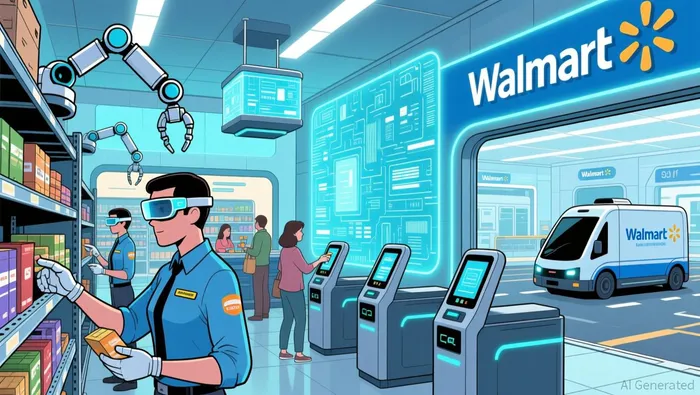
Walmart's investments in automation and AI are not merely incremental improvements-they represent a fundamental reimagining of retail logistics. , and boosting unit productivity. This shift is critical in an industry where last-mile delivery costs can erode profitability. By automating 60% of U.S. stores' freight operations, Walmart is also streamlining inventory management, ensuring that shelves remain stocked while minimizing waste.
The company's foray into AI-driven tools, such as the Sparky AI agent and agentic AI experiments, signals a broader commitment to enhancing customer experience and operational agility. These innovations are not just about cost reduction-they aim to create a feedback loop where data-driven insights optimize everything from inventory forecasting to personalized marketing. For instance, Sparky's ability to analyze customer interactions in real time could unlock new revenue streams by tailoring promotions to individual preferences.
Collaborations like Walmart's partnership with Wiliot to implement ambient IoT technology further illustrate its tech-forward strategy. By embedding low-power sensors into its supply chain, Walmart is poised to achieve near-perfect inventory accuracy, a critical advantage in an era where out-of-stock items cost retailers billions annually. While specific 2025 technology investment figures remain undisclosed, the tangible outcomes validate the company's long-term vision.
Implications for Shareholder Value
Walmart's margin expansion and tech-driven transformation are not isolated successes; they are interconnected pillars of a broader strategy to secure long-term shareholder value. By prioritizing higher-margin businesses like advertising and automation, the company is diversifying its revenue base while reducing reliance on commodity-driven sales. This diversification is particularly valuable in a macroeconomic environment marked by uncertainty, as it provides a buffer against cyclical downturns.
Moreover, Walmart's focus on operational efficiency ensures that cost savings are reinvested into innovation rather than distributed as one-time windfalls. For example, . This flywheel effect-where efficiency gains fuel growth-creates a self-reinforcing cycle of value creation.
Conclusion
As the retail sector grapples with the dual challenges of affordability crises and digital disruption, Walmart's Q3 2025 results demonstrate a rare combination of margin resilience and forward-looking innovation. By expanding gross margins through strategic diversification and leveraging automation and AI to redefine operational efficiency, the company is not only defending its market position but also building a moat for future growth. For investors seeking stability in a volatile market, Walmart's disciplined execution and tech-driven transformation offer a compelling blueprint for long-term success.







Comentarios
Aún no hay comentarios