
Walmart's Drone Network: Assessing the Scalability of a First-Mover Growth Play
Walmart's partnership with Alphabet's Wing is a classic high-risk, high-reward growth bet. The core thesis is straightforward: by locking in a first-mover advantage in drone delivery, WalmartWMT-- aims to capture a dominant share of the rapidly expanding last-mile logistics market. This isn't about incremental efficiency; it's about building a scalable, proprietary network that could redefine speed and convenience in retail delivery.
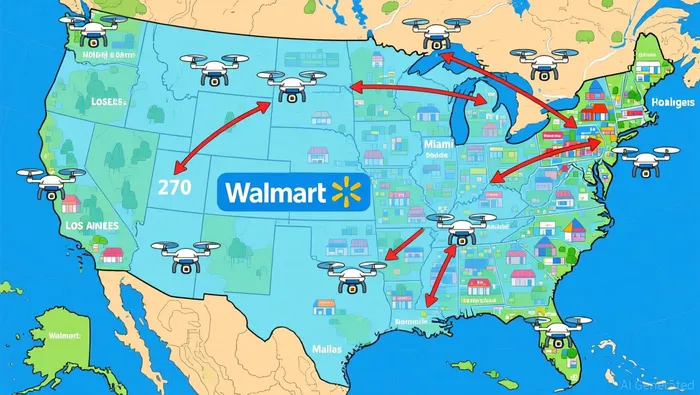
The scale of the ambition is clear. The companies plan to expand the service to over 270 Walmart stores by 2027, a rollout that will bring drone delivery to over 40 million Americans. That target represents a significant footprint, covering roughly 10% of the U.S. population. The strategic rationale is compelling. Last-mile delivery is the most expensive and complex leg of the supply chain, and drone technology promises to cut costs and accelerate delivery times. For a retailer like Walmart, owning this final link could be a powerful differentiator in the battle for e-commerce share.
The market opportunity is vast and accelerating. The global drone delivery service market is projected to grow at a CAGR of 31.3%, ballooning from an estimated $2.72 billion in 2025 to $18.26 billion by 2032. North America, where Walmart operates, is the dominant region. This explosive growth is fueled by rising e-commerce demand and the persistent need for faster, more efficient delivery solutions. For Walmart, being a foundational partner in this expansion could provide a long-term moat.
Evidence suggests the service is already resonating with early adopters. Wing's chief business officer noted that its top 25% of customers utilize the service three times a week. This level of repeat engagement is a strong signal of product-market fit and indicates the service is moving beyond novelty to become a regular part of customer routines. It validates the core assumption that consumers value the speed and convenience drones can offer.
The bottom line for a growth investor is the potential to capture a massive, growing market with a scalable network. While regulatory hurdles and initial costs are real, the partnership's aggressive rollout and the market's explosive trajectory frame this as a strategic bet on future dominance. The risk is high, but the potential reward-a commanding position in a $18 billion market-is what makes it a play worth watching.
Competitive Landscape: Walmart vs. Amazon Prime Air
The strategic battle for drone delivery dominance is now a two-horse race, with Walmart and Amazon as the clear frontrunners. Both companies are vying to own the most efficient, scalable last-mile network, but they are approaching the challenge from different angles. Amazon's Prime Air has the head start in technology development and a vast internal logistics infrastructure. Walmart's advantage, however, lies in its unmatched physical footprint and customer base, which provides a ready-made distribution network for scaling.
Amazon's expansion plans are aggressive, with new delivery facilities targeting cities like Dallas, Kansas City, and San Antonio. This mirrors Walmart's own push to dominate major metropolitan hubs. The companies are focusing on high-density areas like Los Angeles, St. Louis, Miami, and Cincinnati, where operational density is key to making drone fleets cost-effective. This convergence on the same geographic corridors means the competition will be fierce in these early adopter markets.
Walmart's model is built on leveraging its existing assets. The company's massive store footprint provides thousands of potential launch sites, drastically reducing the capital needed to build new infrastructure. This operational leverage is a critical scalability factor. While Amazon must build or adapt facilities, Walmart can deploy drones from its parking lots with minimal incremental cost. This gives Walmart a potential speed-to-market and cost advantage as it aims to reach over 40 million Americans by 2027.
The bottom line for scalability is operational density versus technological lead. Amazon may have a slight edge in pure drone technology and its ability to integrate with its own fulfillment centers. But Walmart's strategy of embedding delivery into its retail network creates a more scalable and lower-cost model for rapid geographic expansion. The race is now on to see which approach can capture the most customers in these dense urban corridors first.
Financial Viability: The Cost Curve and Revenue Potential
The ambitious rollout hinges on a fundamental financial question: can this model become profitable at scale? The numbers tell a story of a service that is currently far from competitive on cost, but with a clear path to improvement as operations expand.
The current cost structure is a major hurdle. Industry estimates place the cost of a drone delivery at $30 per package. That figure is more than four times the $7 target needed for the service to be economically viable and competitive with traditional delivery. This massive gap underscores the early, capital-intensive nature of the venture. Every delivery today is a loss leader, funded by the broader partnership and the strategic value of market capture.
Walmart is testing the waters with a premium price point. In its key operational hub of Dallas, the company is charging $20 per delivery for the service. This price sits between the current cost and the target, creating a significant per-package loss. It also signals a cautious approach to market pricing, likely aimed at early adopters and high-value customers willing to pay for speed. The test price is a critical data point for assessing customer willingness to pay and the service's perceived value.
The expansion strategy is designed to close this cost gap. By targeting major metropolitan hubs like Los Angeles, St. Louis, Miami, and Cincinnati, the partnership is focusing on areas with high population density and frequent delivery demand. This operational density is key to scaling efficiency. More deliveries per drone per hour, and more drones operating from a single launch site, will drive down the average cost per package. The goal of reaching over 40 million Americans by 2027 is not just about market share; it's about achieving the volume needed to flatten the cost curve.
The bottom line for a growth investor is the trajectory, not the current state. The financial model is in a pre-profit phase, but the partnership's aggressive expansion into high-density markets is the deliberate lever to achieve economies of scale. Success will depend on whether the cost per delivery can be driven down to the $7 target as volume surges. For now, the investment is in building a scalable network, with profitability a function of execution and scale.
Catalysts, Risks, and What to Watch
The path from a promising pilot to a scalable growth engine is fraught with milestones and obstacles. For Walmart's drone network, the next 12 to 18 months will be defined by a few critical catalysts, persistent risks, and key metrics that will reveal whether the first-mover bet is paying off.
The first major catalyst is the successful execution of the 2026 rollout. Wing has announced plans to expand the service to 150 more Walmart stores this year, bringing the total to over 270 locations by 2027. This aggressive expansion, targeting cities like Los Angeles and Miami, is the first real test of national scalability. Moving beyond the initial handful of stores into dense metropolitan areas will pressure the partnership to prove it can manage operations, regulatory approvals, and customer demand at a much larger scale. A smooth rollout here would validate the model's operational blueprint; any significant delays or hiccups would raise immediate questions about execution capability.
The most significant risk remains regulatory scrutiny and safety concerns. As drone traffic increases, so will the focus from federal agencies. The partnership is already operating amid increased federal scrutiny surrounding drone technology. Any safety incident, even a minor one, could trigger stricter rules, ground operations in key markets, or force costly redesigns. The companies must demonstrate not just technical reliability but also seamless integration with air traffic control systems and public safety protocols. This is a barrier to widespread adoption that cannot be engineered away with more drones.
For a growth investor, the key metrics to monitor are the cost per delivery and customer adoption rates as the network expands. The current cost of $30 per package is unsustainable, and the service's viability hinges on driving that number down through operational density. Watch for any public updates on cost trends as the fleet grows. Equally important is the health of the customer base. The early signal that the top 25% of customers order three times a week is promising, but it must be sustained and replicated across new markets. If adoption rates stall or customer acquisition costs rise sharply, it would indicate the service is struggling to move beyond novelty into a core convenience.
The bottom line is that this initiative is now entering its most critical phase. The 2026 expansion is the catalyst that will test scalability, regulatory pressure is the ever-present risk, and the cost-adoption balance is the metric that will determine if this becomes a profitable growth engine or a costly experiment.





Comentarios
Aún no hay comentarios