
Walmart vs. Costco: Which Retail Stock Offers a Better Risk-Adjusted Growth Opportunity in 2026?
The retail sector remains a cornerstone of global markets, but selecting the right stock requires a nuanced understanding of valuation, growth potential, and strategic adaptability. As we approach 2026, WalmartWMT-- (WMT) and CostcoCOST-- (COST) stand as two of the most prominent players, yet their divergent financial metrics and expansion strategies position them differently in the risk-adjusted growth landscape. This analysis evaluates their forward P/E ratios, revenue growth, operating margins, and strategic initiatives to determine which offers a more compelling investment opportunity.
Valuation: Walmart's Discount vs. Costco's Premium
Valuation metrics often serve as the first filter for investors seeking undervalued opportunities. As of 2025, Walmart trades at a forward P/E ratio of 36.02, while Costco commands a significantly higher multiple of 49.32. This 37% premium for Costco reflects market optimism about its membership-driven model and consistent growth, but it also raises questions about sustainability. A report by Yahoo Finance highlights that Costco's elevated valuation is justified by its 8.1% projected revenue growth for fiscal 2025, yet this growth rate far outpaces Walmart's 3.5%. However, Walmart's lower P/E suggests a more conservative pricing, which could appeal to risk-averse investors wary of overpaying for future earnings.
Revenue Growth: Divergent Paths to Expansion
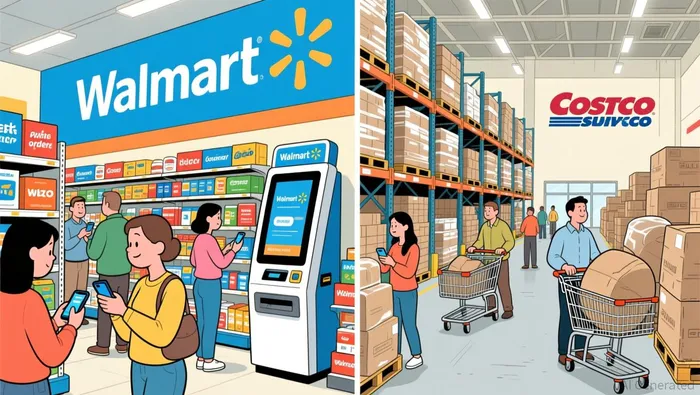
While Costco's 8.1% revenue growth appears superior on the surface, Walmart's strategic focus on e-commerce and cost optimization paints a more complex picture. For fiscal 2025, Walmart reported $681.0 billion in revenue, a 5.1% increase year-over-year, driven by a 27% surge in global e-commerce sales. This digital acceleration, particularly in store-fulfilled pickup and delivery services, underscores Walmart's ability to adapt to shifting consumer preferences. In contrast, Costco's growth, though robust, relies heavily on its 28 new warehouse openings planned for 2025. While physical expansion is a proven strategy, it is inherently slower and more capital-intensive than digital scaling.
Operating Margins: Walmart's Structural Advantages
Operating margins are a critical barometer of profitability and efficiency. Costco's 3.8% operating margin for fiscal 2025 is impressive given its low-margin merchandise business (less than 2% of revenue). However, Walmart's operating margin, calculated as $29.348 billion in operating income divided by $681.0 billion in revenue, stands at approximately 4.31%. This edge stems from Walmart's advertising revenue surge (up 46% year-over-year) and disciplined cost management. Moreover, Walmart's net income grew 34% in FY2025, outpacing its operating income growth, indicating stronger bottom-line resilience. For investors, this suggests Walmart's model is better insulated against margin compression during economic downturns.
Strategic Expansion: E-Commerce vs. Brick-and-Mortar
Walmart's investment in e-commerce is a defining feature of its 2026 strategy. Digital sales rose 22% in Q1 FY2026, with store-fulfilled delivery and marketplace services driving much of the growth. This hybrid model leverages existing infrastructure, reducing costs while enhancing customer convenience. Costco, meanwhile, continues to prioritize physical expansion, with 28 new warehouses slated for 2025. While this strategy aligns with its membership-centric model, it exposes the company to real estate risks and slower ROI compared to Walmart's digital-first approach.
Risk Considerations: Premium Pricing and Profit Vulnerability
Costco's premium valuation and reliance on membership fees introduce unique risks. Its U.S. and Canadian membership renewal rate of 92.7% is a strength, but economic downturns could erode this figure, directly impacting revenue. Additionally, Costco's merchandise margins (less than 2%) leave little room for error in pricing or supply chain disruptions. Walmart's diversified revenue streams-spanning retail, advertising, and e-commerce-offer greater flexibility to absorb external shocks.
Conclusion: A Case for Walmart's Balanced Approach
While Costco's growth trajectory is undeniably strong, its premium valuation and narrow operating margins make it a riskier bet in a volatile macroeconomic environment. Walmart, by contrast, offers a more attractive risk-adjusted profile: a lower P/E ratio, stronger operating margins, and a strategic pivot toward e-commerce that aligns with long-term consumer trends. For investors prioritizing stability and scalable growth, Walmart emerges as the more compelling choice for 2026.





Comentarios
Aún no hay comentarios