
Walmart's 2025 Thesis: A Wide Moat Compounding in a Shifting Retail Landscape
Walmart's enduring strength lies in a wide moat that has been built over decades and is now being reinforced by a powerful omnichannel strategy. The company's Moat Score of 8 signals a clear and robust competitive advantage, rooted in its market leadership, economies of scale, and superior distribution network. This isn't a fleeting edge; it's a durable foundation that allows WalmartWMT-- to compound value over long business cycles, even as it faces intense pressure from Amazon.
The company's "bricks plus clicks" strategy is the modern expression of that moat. By integrating its vast physical footprint of 4,600 stores with a digital platform that reaches 150 million customers weekly, Walmart creates a unique, hard-to-replicate ecosystem. This dual presence isn't just about convenience; it's a strategic asset that drives its fast-growing retail media business. As the CFO noted, advertisers follow the customers, and Walmart's scale is turning its advertising platform into a $5 billion business with the potential to quadruple. This channel, which includes a connected TV platform from its Vizio acquisition, generates high-margin revenue and deepens customer relationships, further widening the moat.
Critically, this moat has proven resilient against Amazon's relentless advance. While Amazon remains a formidable competitor, Walmart has narrowed the price gap to just $4% over the past year. This improvement shows the company's enhanced competitiveness and its ability to leverage its scale to offer compelling value. It's a tangible sign that Walmart's integrated model is not only holding its ground but actively gaining share in a key battleground.
For the long-term investor, this is the setup. A wide moat provides the margin of safety and pricing power needed to navigate economic cycles. The "bricks plus clicks" strategy provides the growth engine, diversifying revenue beyond traditional retail. And the narrowing price gap demonstrates that the moat is not eroding but is, in fact, being fortified. This combination creates a durable foundation for compounding, making Walmart a cornerstone of a portfolio built for the long haul.
The Engine of Future Growth: Advertising and Margin Expansion
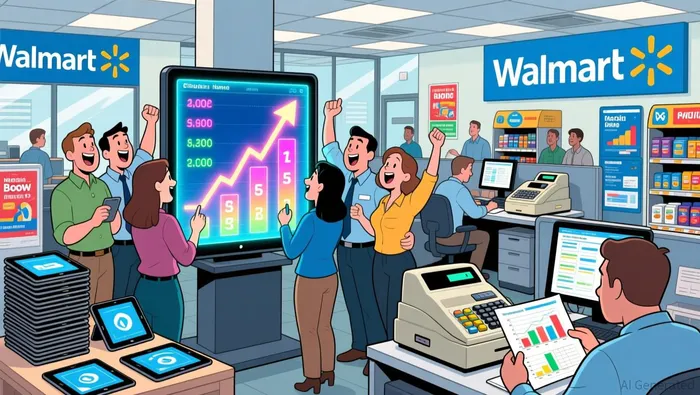
The most powerful growth story at Walmart isn't in its aisles or online checkout, but in the ads that now dominate its digital screens. The advertising business has transformed into a high-margin profit engine, accounting for nearly one-third of the company's operating income. This shift is the single biggest change to Walmart's profit and loss statement in recent years, fundamentally altering its financial profile.
The growth trajectory is explosive. Last quarter, Walmart Connect, its core U.S. retail media platform, grew 33%, outpacing overall U.S. retail sales growth by six times. This isn't a one-off surge; advertising has consistently outpaced sales growth every quarter since Walmart began reporting the metrics. The integration of Vizio has accelerated this momentum, with the company's global ad business-including its smart TV assets-surpassing 50% growth last quarter. This expansion into connected TV is a key strategic win, allowing Walmart to reach consumers across multiple screens and attract high-spending advertisers from industries like automotive and financial services.
The real magic, however, is in the margins. While the business is still a small fraction of total revenue-just 0.65% of Walmart's $681 billion in fiscal 2025-it is already a major contributor to profits. More importantly, it is a business with the potential to scale dramatically. As one analyst noted, the retail media business is a $5 billion business that could be much, much bigger, with the potential to quadruple and generate 60% plus margins. This high-margin profile is the hallmark of a true profit engine, where incremental revenue flows directly to the bottom line with minimal additional cost.
Viewed another way, this is a story of monetizing Walmart's vast customer base. The company reaches 150 million customers a week, and advertisers are following the eyeballs. By selling more screen real estate and offering sophisticated, closed-loop measurement tools, Walmart is extracting higher value from its existing traffic. The result is a business that is growing at a rate that dwarfs the underlying retail operations, providing a powerful buffer against any slowdown in consumer spending and a primary driver of future earnings growth.
Financial Health and Management Transition
Walmart's financial foundation is robust, providing the capital and stability needed to fund its digital transformation and shareholder returns. The company's strong balance sheet and consistent cash flow generation are the bedrock of its strategy. This financial strength allows it to make the massive technology investments required to compete, as evidenced by its $10.5 billion technology spend in 2015 and continued innovation through units like @WalmartLabs. More recently, the company's retail media business has become a powerful profit engine, now accounting for nearly one-third of operating income. This shift demonstrates a significant evolution in the P&L, where a new, high-margin revenue stream is subsidizing the core retail operations. For the long-term investor, this is a classic compounding story: a company using its cash-generating core to fund a high-growth, high-margin business that in turn boosts overall profitability and provides more capital for reinvestment.
The leadership transition from Doug McMillon to John Furner is occurring from this position of strength. As one analyst noted, the change is happening "from a position of strength", with the outgoing CEO praising the new leader's readiness and vision. This stability is crucial for a company executing a multi-year digital overhaul. The new CEO, John Furner, has already signaled his focus, emphasizing a "people-led, tech-powered" future and a commitment to innovation. This continuity of purpose, from a financially secure base, provides a clear path forward. The management team is not scrambling to fix a broken model; it is leading a well-funded, strategic evolution.
The bottom line is that Walmart's financial health and leadership stability create a powerful setup for compounding. The company has the cash to invest in its digital future, a new profit center is rapidly scaling, and the baton is passing to a leader with a clear vision. This combination of a fortress balance sheet, a transformative business model shift, and a smooth leadership handoff is the hallmark of a company positioned to grow its intrinsic value over the long cycle.
Valuation and Margin of Safety: Assessing the Price Paid
For a value investor, the margin of safety is the difference between price and intrinsic value. It is the buffer that protects capital when forecasts are wrong or markets turn. Evaluating Walmart's current price requires looking at multiple lenses: the premium valuation, a discounted cash flow check, and the company's capital allocation philosophy.
The stock trades at a significant premium to historical norms and its peers. As of late December, Walmart's trailing P/E ratio was approximately 40.28, a figure that has been elevated for the past year. This is a clear premium to the Consumer Retailing industry average of roughly 21.92x and well above its own 12-month average P/E of 39.68. In the context of a mature, stable business, such a high multiple suggests the market is pricing in exceptional, sustained growth. It leaves little room for error and implies near-perfect execution of its strategy.
A discounted cash flow analysis provides a more nuanced view of intrinsic value. A model projecting Walmart's future free cash flows estimates an intrinsic value of around $116.41 per share. At recent prices near $115, this suggests the stock is roughly fairly valued or perhaps slightly undervalued. The DCF approach, which focuses on the company's ability to generate cash, offers a more forward-looking assessment than the trailing P/E. It suggests the market's premium is not entirely unjustified, as the model incorporates growth expectations into the valuation.
Yet the company's capital allocation tells a different story. Walmart's annualized forward dividend yield is modest at 0.82%. This reflects a clear corporate philosophy of reinvestment over shareholder returns. The company is ploughing profits back into its business-expanding e-commerce, enhancing supply chains, and investing in higher-margin services. For a value investor, this is a double-edged sword. It supports the growth thesis that justifies the premium P/E, but it also means the stock does not currently offer a tangible income stream to cushion the investment. The margin of safety, if it exists, must come entirely from the growth in earnings and cash flow, not from a dividend.
Viewed through the value investing framework, the picture is mixed. The stock is not trading at a deep discount to its historical average or its peers. The DCF suggests it is close to fair value, but the high P/E ratio indicates the market's growth expectations are already baked in. The minimal dividend yield removes a traditional source of margin of safety. For a disciplined investor, the conclusion is that Walmart is a high-quality business trading at a premium price. The margin of safety is thin, and the investment thesis hinges entirely on the company's ability to deliver on its growth narrative for years to come.
Catalysts, Risks, and What to Watch
The investment thesis for Walmart hinges on its ability to leverage its massive scale and data assets to build a durable, high-margin advertising business. The key variables that will determine if this wide moat holds or erodes are threefold: execution on its retail media platform, defense against Amazon's relentless price pressure, and its capacity to navigate a volatile trade environment.
The primary catalyst is the continued integration of its Vizio acquisition and the rollout of closed-loop measurement. Walmart Connect is already a powerhouse, growing 33% last quarter and now representing about a third of operating income. The Vizio deal has been a major accelerator, with the global ad business surpassing 50% growth last quarter. The next phase is about proving the incremental value. By using Walmart's audience data to target ads on Vizio screens and measuring the sales impact, the company is creating a powerful feedback loop. Early signals are strong: customers who see CTV ads are 28% more likely to buy from Walmart. The real test is whether this can attract more non-endemic advertisers and drive a sustained increase in advertising margins, which would directly boost overall profitability.
The most persistent risk comes from Amazon, which remains America's lowest-price retailer across a wide range of discretionary categories. Recent data shows Amazon's prices were 14% lower on average than major online competitors. This pressure is particularly acute in high-margin categories like fashion and beauty, where Walmart's prices are still 7% and 4% more expensive than Amazon's, respectively. If Amazon continues to win on price in these critical areas, it will constrain Walmart's ability to grow its income faster than its revenue, as the company's core sales are still heavily weighted toward lower-margin grocery.
The key watchpoint is how Walmart leverages its scale and private-label brands to navigate potential tariff impacts. According to retail strategy research, tariffs are going to be the most important deciding factor in the near term for profitability. Walmart's physical store footprint and bulk purchasing give it more leverage than Amazon's sprawling marketplace with millions of third-party sellers. The company's aggressive push into private labels, like its "bettergoods" grocery line, is a direct tool to maintain pricing power and margins. Investors must monitor whether Walmart can use this advantage to protect its earnings as trade policy evolves, a factor that could ultimately determine which retail giant holds the crown.







Comentarios
Aún no hay comentarios