
Wallet Security Vulnerabilities in DeFi: Systemic Risks and Institutional Investment Implications
In 2025, the decentralized finance (DeFi) ecosystem faces a critical juncture. While institutional adoption has grown-47% of hedge funds now allocate capital to DeFi protocols-the sector's reliance on user-controlled wallets and immutableIMX-- smart contracts has exposed systemic vulnerabilities. The recent Hyperliquid breaches, including a $21 million loss in October 2025 and a $12 million JELLY token exploit in March, underscore how wallet security flaws can cascade into broader infrastructure risks, deterring institutional participation and inviting regulatory scrutiny.
The Hyperliquid Breach: A Case Study in User Error and Systemic Risk
Hyperliquid, a leading decentralized perpetual futures exchange, became a focal point for DeFi's security challenges in 2025. In June, a phishing attack compromised 1,200 user wallets over 60 days, exploiting a 1-of-1 multisig upgrade vulnerability, according to a Tekedia report. Users unknowingly signed malicious transactions via deceptive websites, granting attackers full control over their funds. This was not a protocol-level exploit but a failure of user education-a recurring theme in DeFi.
The October 2025 breach, however, was more severe. A private key leak led to the theft of $21 million in DAI and SYRUPUSDP, with funds moved to the EthereumETH-- network, as reported in a CCN article. Unlike traditional finance, where centralized custodians can freeze accounts, DeFi users had no recourse. This incident highlighted the double-edged sword of decentralization: while it eliminates single points of failure, it also shifts security responsibility entirely to individuals, many of whom lack the technical expertise to safeguard their assets, according to The Bulldog Law.
Systemic Risks: From Wallet Vulnerabilities to Market Instability
The Hyperliquid breaches are not isolated. Phishing attacks, private key leaks, and social engineering scams accounted for 70% of DeFi losses in Q3 2025, notes a WRAL report. These vulnerabilities create systemic risks in two ways:
- Liquidity Fragility: High-leverage environments like Hyperliquid amplify losses. The JELLY token exploit, where a whale manipulated price oracles to trigger a $12 million loss in the HLP vault, demonstrated how a single asset's manipulation can destabilize entire markets, as detailed in a Crypto.ro timeline.
- Governance Contradictions: Hyperliquid's response-delisting JELLY and force-settling positions-was criticized as centralized, contradicting DeFi's ethos, according to a CryptoNewsLand piece. Such actions erode trust, particularly among institutions seeking transparent, rule-based systems.
Institutional Hesitancy: Security, Compliance, and the Cost of Trust
Institutional investors, who prioritize risk mitigation and regulatory compliance, have reacted cautiously. Post-breach, Hyperliquid's TVL plummeted from $540 million to $150 million within two months, according to a CoinDesk report. This mirrors broader trends: 48% of institutional DeFi users now employ third-party audits, and 72% have adopted enhanced risk frameworks, per CoinLaw data.
Regulatory scrutiny has intensified. The SEC's enforcement actions against platforms like CoinbaseCOIN-- and Ripple, coupled with the EU's Markets in Crypto-Assets (MiCA) framework, demand clearer AML/KYC protocols, as discussed in a SmartLiquidity analysis. DeFi protocols are responding with innovations like zero-knowledge proofs and decentralized identity (DID) systems to balance privacy and compliance, described in an IknowCrypto overview. However, these solutions remain nascent, and institutions continue to favor protocols with proven security records.
The Path Forward: Balancing Innovation and Security
For DeFi to mature, it must address three pillars:
1. User Education: Platforms must prioritize tools like hardware wallet integrations and transaction verification prompts.
2. Protocol Resilience: Formal verification of smart contracts and decentralized oracleADA-- networks can mitigate exploit risks, according to a VKT Global analysis.
3. Regulatory Alignment: Collaborative frameworks, such as the Cryptocurrency Security Standard (CCSS), will bridge the gap between decentralization and compliance, as argued in a grvt.io blog.
Hyperliquid's October 2025 response-enhanced token delistings and liquidation protocols-signals progress, according to a CryptoNews report. Yet, the platform's TVL recovery to $5 billion by late 2025, despite a 60% drop in HYPE's value, illustrates the fragility of user trust, per a TradingKey analysis.
Conclusion: A Tenuous Equilibrium
The DeFi sector stands at a crossroads. While institutional adoption is growing, security breaches like those at Hyperliquid reveal the fragility of its infrastructure. For institutions, the calculus remains: Is the promise of decentralized finance worth the risks of wallet vulnerabilities, governance ambiguity, and regulatory uncertainty? The answer will depend on whether the ecosystem can evolve from a "wild west" of innovation to a robust, institutional-grade infrastructure-one where security is not an afterthought but a foundational principle. 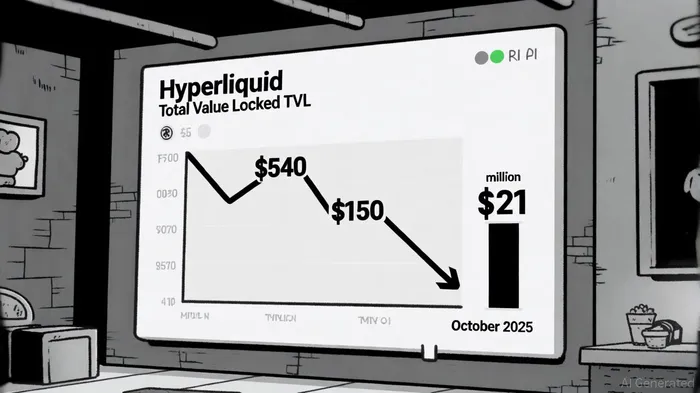





Comentarios
Aún no hay comentarios