
The Wall Street Journal's Skepticism and Bitcoin's Institutional Resilience: A Decade of Failed Predictions
The Wall Street Journal (WSJ) has long positioned itself as a gatekeeper of financial wisdom, yet its historical skepticism toward BitcoinBTC-- has repeatedly failed to align with market realities. From minimal coverage to alarmist narratives on regulation and cybersecurity, the WSJ's framing of Bitcoin has often diverged from the asset's actual performance. This disconnect underscores a broader tension between traditional finance's risk-averse lens and the disruptive logic of digital assets.
A Legacy of Miscalculation
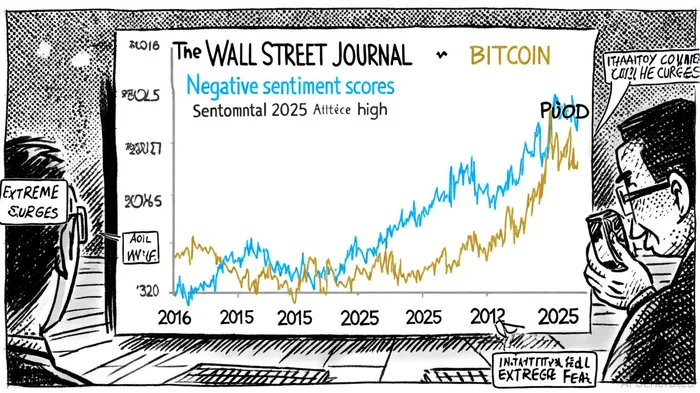
Between 2015 and 2024, the WSJ published over 3,000 Bitcoin-related articles, with negative sentiment dominating all six identified topics: regulation, cybersecurity, macroeconomics, and investing, according to a ResearchFeatures analysis. For instance, in 2020, the outlet amplified fears around a high-profile Twitter hack promoting a Bitcoin scam, driving Cybersecurity sentiment to its lowest point, as that analysis documents. Yet, Bitcoin's price surged 80% in the following year, defying the WSJ's cautionary tone. This pattern repeated in 2025, when the WSJ offered only two articles on Bitcoin during Q2 despite the asset's status as the decade's best-performing investment, according to Renaud Cuny's analysis. By contrast, outlets like Forbes and CNBC provided extensive, bullish coverage, creating an information asymmetry that left WSJ readers underinformed about Bitcoin's institutional adoption and macroeconomic tailwinds, a point Cuny also highlights.
Sentiment vs. Reality: The 84% Correlation
Bitcoin's price movements in 2025 revealed a striking 84% correlation with sentiment data from February to August, particularly during periods of fear and greed, as Cuny's analysis shows. When the Fear & Greed Index dipped into "Extreme Fear" (0-25), institutional buyers-such as corporate treasurers and hedge funds-systematically stepped in, stabilizing the market, per Cuny's findings. However, the WSJ's skeptical narratives likely exacerbated fear, delaying institutional purchases until critical support levels were breached. This dynamic highlights a structural shift: as institutional adoption grows, Bitcoin's volatility is increasingly tempered by algorithmic buying during downturns, reducing the predictive power of traditional media sentiment, according to the same analysis.
Institutional Adoption: The New Market Stabilizer
The maturation of Bitcoin as a treasury asset has fundamentally altered its price dynamics. By 2025, over 200 corporations had allocated Bitcoin to their balance sheets, with systematic purchasing protocols triggered by fear-driven dips, as Cuny documents. This institutional behavior contrasts sharply with retail-driven volatility, which the WSJ often amplifies through sensationalist coverage. For example, in 2024, Bitcoin faced resistance at $60,000–$65,000 despite the approval of spot ETFs and the halving event, according to a Business Insider report. While short-term traders panicked, institutional buyers absorbed the dip, ensuring Bitcoin's long-term trajectory remained intact, as that Business Insider piece noted.
Lessons for Investors
The WSJ's repeated miscalculations reflect broader flaws in traditional financial analysis. As noted in Cuny's work, 438 "Bitcoin will fail" predictions from 2011 to 2020 were invalidated by the asset's resilience, often due to psychological biases like confirmation bias and loss aversion. For investors, this underscores the need to prioritize fundamentals-adoption rates, technological upgrades, and macroeconomic trends-over speculative media narratives, a theme echoed in the ResearchFeatures analysis. Diversification and a focus on long-term institutional trends, rather than short-term price forecasts, are critical in navigating the crypto market's inherent volatility, as the ResearchFeatures piece suggests.
Conclusion
The WSJ's skepticism toward Bitcoin has proven to be a flawed lens for predicting market outcomes. While its coverage may amplify short-term fear, the asset's long-term trajectory is increasingly shaped by institutional adoption and algorithmic market behavior. For investors, the lesson is clear: the future of Bitcoin lies not in the headlines but in the quiet, systematic forces reshaping its role as a global store of value.






Comentarios
Aún no hay comentarios