
Wall Street's Crypto Debate Is Over as Banks Go All-In on BTC, Stablecoins, Tokenized Cash
Morgan Stanley has filed to launch two cryptocurrency exchange-traded funds (ETFs), one focused on BitcoinBTC-- and the other on SolanaSOL--, according to filings with the US Securities and Exchange Commission. The firm's move reflects growing demand for regulated crypto investment vehicles, particularly during the "clean-slate" period at the start of a new year.
The proposed ETFs will function as passive investment vehicles that track the performance of the underlying tokens. Morgan StanleyMS-- plans to list the shares on public exchanges, though the specific exchanges are not yet disclosed in the initial filings. If approved, the funds could attract inflows from the firm's 19 million wealth management clients according to reports.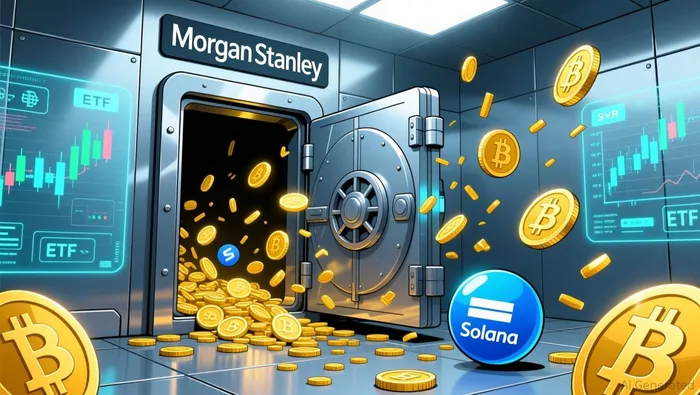
At the same time, Bank of AmericaBAC-- has allowed its wealth advisors to recommend Bitcoin ETFs to clients. The move enables the bank's 15,000 advisors to suggest exposure to Bitcoin ETFs on its platforms, including Merrill and Bank of America Private Bank according to analysis.
Why Did This Happen?
The rise in institutional crypto activity stems from increased demand for regulated digital asset products. Spot Bitcoin ETFs have already attracted $1.1 billion in inflows during the first two days of 2026, showing renewed appetite for crypto investments.
The shift toward regulated digital money is also evident in how large firms like Vanguard have enabled crypto ETF trading for their clients. BlackRockBLK-- had previously advised its clients on Bitcoin allocations, signaling broader institutional acceptance.
How Did Markets React?
Bitcoin's price has remained volatile, with recent swings that include a high above $126,000 in October 2025 and a drop to about $92,000 as of January 2026 according to market data. Despite the price movements, market participants are viewing crypto as a satellite sleeve in diversified portfolios, especially for clients who can handle the volatility according to industry reports.
JPMorgan is also expanding its digital asset infrastructure by launching its JPM Coin on the Canton Network. This move allows institutional clients to issue, transfer, and redeem digital dollars on a privacy-enabled blockchain.
The integration of JPM Coin into Canton Network is expected to improve the efficiency of institutional transactions. It marks the second major blockchain platform for JPM Coin after its initial deployment on Base according to reports.
What Are Analysts Watching Next?
The broader adoption of crypto and tokenized assets is being supported by major banks exploring digital money infrastructure. Barclays has invested in Ubyx, a stablecoin clearing platform that connects regulated issuers with banks and fintechs according to sources. This marks the British bank's first foray into the stablecoin settlement space according to financial reports.
Ubyx is building a global clearing system to enable par-value redemption of stablecoins. Barclays and Ubyx plan to work on developing tokenized money within the regulatory perimeter.
The move by Barclays reflects growing interest among traditional banks in blockchain-based payments that stay within regulatory frameworks. Similar initiatives are underway in Switzerland and other regions, with institutions exploring on-chain settlement infrastructure.
The market is now closely watching how these institutional moves will influence broader adoption and regulatory responses. The expansion of digital asset offerings by major banks is expected to provide more legitimacy and infrastructure support for crypto markets.
Barclays has historically been cautious about crypto, having previously restricted some crypto-related transactions. Its recent shift indicates a strategic pivot toward exploring new forms of digital money within the regulatory boundaries.
With major financial institutions like JPMorgan, Barclays, and Bank of America increasing their exposure to digital assets, the crypto landscape is evolving toward more institutional and regulated participation.





Comentarios
Aún no hay comentarios