
Wage Growth Misalignment and Its Impact on Wealth-Building and Investor Behavior
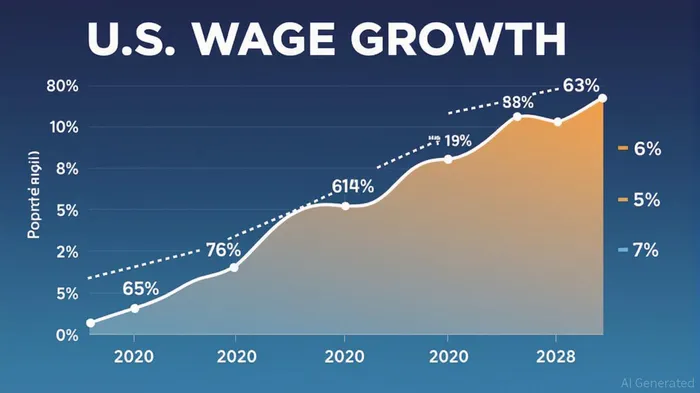
The U.S. labor market has experienced a persistent misalignment between wage growth and broader economic indicators since 2020. While GDP expanded by 3.0% in September 2024 and unemployment stabilized at 4.1%, median hourly wage growth has decelerated from a peak of 6% in early 2022 to 3.7% in 2025, with further declines projected to 2% by 2028 [1]. This divergence has created a paradox: households are navigating a "strong" macroeconomy while grappling with stagnant income gains, eroded purchasing power, and distorted investment decisions.
The Wealth-Building Bottleneck
Weak wage growth has directly constrained households' ability to accumulate wealth. Real disposable personal income has lagged behind spending on goods, particularly in the early part of the post-pandemic cycle [2]. The Hamilton Project notes that while compensation growth briefly outpaced inflation in 2021, it has since moderated to "modest levels," reflecting a broader slowdown in income gains [3]. This dynamic has forced households to rely increasingly on asset appreciation—such as rising home and stock prices—for financial stability. However, the volatility of corporate equities and high mortgage rates have limited access to these gains, particularly for lower-income households [4].
JPMorgan Chase Institute data reveals a troubling trend: while lower-income households have increased participation in financial markets since 2020, disparities in investment returns persist. For example, lower-income investors often purchase assets at higher valuations, reducing their potential returns compared to higher-income peers [5]. This "participation gap" exacerbates wealth inequality, as households with limited wage growth struggle to capitalize on market opportunities.
Investor Behavior and Psychological Biases
The behavioral economics literature underscores how weak wage growth distorts investor decision-making. A 2025 study in Sage Journals highlights that psychological biases—such as loss aversion, overconfidence, and herding—intensify during periods of economic uncertainty [6]. When wage growth stagnates, investors tend to overreact to market volatility, often shifting to risk-averse strategies that underperform long-term goals. For instance, research from Statistics Norway shows that doubling income volatility leads to a 5 percentage point reduction in risky asset allocation over four years [7]. This "flight to safety" amplifies market instability, as seen in the underrepresentation of low-risk assets in retirement portfolios.
Moreover, behavioral frictions—such as the cost of establishing brokerage accounts—further distort portfolio choices. A 2024 CEPR analysis found that even when default allocations in 401(k) plans are shifted toward equities, many workers maintain conservative positions for years, highlighting the role of inertia in investment behavior [8]. These frictions are compounded by weak wage growth, which reduces households' capacity to absorb short-term losses, reinforcing risk aversion.
The Sentiment-Reality Disconnect
The Brookings Institution has documented a growing disconnect between macroeconomic performance and household sentiment [9]. Despite robust GDP growth and low unemployment, consumer confidence remains subdued, driven by perceptions of personal financial strain and media narratives. This "sentiment gap" has dampened spending in discretionary sectors like travel and dining, even as wealth-to-income ratios remain elevated. Behavioral economists argue that this disconnect reflects a broader psychological toll of weak wage growth: households internalize uncertainty, leading to precautionary savings and delayed retirement planning [10].
Looking Ahead: Risks and Opportunities
The Federal Reserve's tightening cycle and lingering inflationary pressures add urgency to these trends. With real wage growth projected to fall further, households may face renewed financial stress, particularly in sectors like housing and utilities . For investors, the implications are twofold: first, a shift toward defensive assets may persist, and second, opportunities may arise in sectors catering to wealth-building for underrepresented demographics.
Policymakers and financial advisors must address the root causes of wage misalignment. Targeted interventions—such as expanding access to financial education, reducing investment frictions, and promoting wage growth in low-income sectors—could mitigate the behavioral distortions outlined here. In the absence of such measures, the U.S. economy risks a prolonged period of suboptimal wealth accumulation and market instability.





Comentarios
Aún no hay comentarios