
Wabash's Q1 Struggles Signal Persistent Headwinds in Transportation Sector
Wabash National Corporation (WNC) reported a stark turn in its financial performance for Q1 2025, swinging to a non-GAAP operating loss and slashing its annual guidance—a move that sent its stock plummeting 30.5% in a single day. The results underscore the challenges facing the transportation equipment sector, with demand weakness, tariff-driven uncertainty, and operational inefficiencies overshadowing modest growth in its Parts & Services division.
A Mixed Quarter, Dominated by Weakness
Wabash’s Q1 revenue fell to $380.9 million, a 26.1% year-over-year decline, as its core Transportation Solutions segment saw sales drop 26.3% to $346.8 million. The segment’s operating income collapsed into a $9.8 million loss, compared to a $44.3 million profit in Q1 2024. This was driven by lower trailer shipments—6,290 units versus 8,500 in the prior year—and weaker truck body sales. Meanwhile, the Parts & Services segment grew 5.5% to $52.0 million, though its margins shrank sharply to 13.3% from 21.4%, reflecting rising costs or pricing pressures.
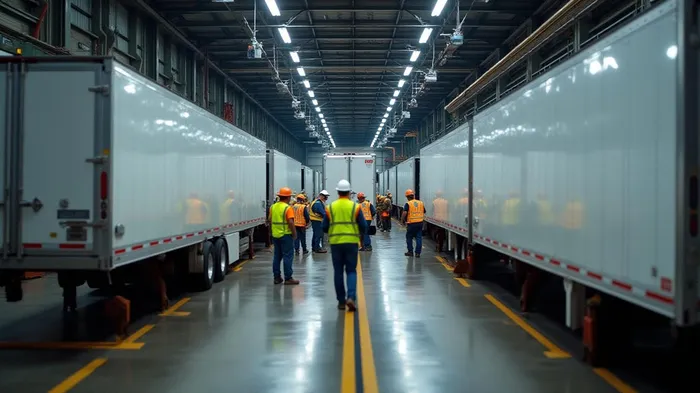
The company’s total backlog of $1.2 billion as of March 31 marked a 32% year-over-year decline, signaling a lack of new orders. Management cited tariff-related uncertainty as a key factor, with customers delaying capital investments amid U.S. trade policy shifts. This has reduced trailer demand to below replacement levels, potentially aging the fleet and delaying a rebound.
Legal Gains Mask Operational Struggles
Wabash’s GAAP results were buoyed by a $342 million gain from a reduced verdict in a Missouri product liability case, where punitive damages were cut from $450 million to $108 million. However, the company’s non-GAAP metrics—excluding this one-time windfall—paint a grim picture: a $27.4 million adjusted operating loss and non-GAAP EPS of -$0.58, compared to a $0.92 profit in Q1 2024.
The stock’s 30.5% drop to $6.91 on April 30 reflected investor skepticism toward the company’s ability to navigate its challenges. The decline pushed WNC to a 52-week low, underscoring its precarious position.
Guidance Cuts Highlight Deepening Concerns
Wabash slashed its full-year 2025 revenue guidance to $1.8 billion (from a prior, unspecified higher target) and now expects a non-GAAP EPS loss of $0.85 to $0.35. This contrasts sharply with analysts’ earlier estimates of $0.92 EPS for the year, as detailed in the search results. CEO Brent Yeagy acknowledged the “second-order tariff effects” depressing customer spending but expressed cautious optimism about long-term U.S. manufacturing trends.
Risks and Uncertainties Ahead
- Tariff-Driven Demand Lag: The delay in trailer purchases could prolong the downturn, as fleet owners wait for clarity on trade policies.
- Legal Uncertainty: The Missouri case’s appeal introduces potential financial volatility, with outcomes affecting both liability and reputation.
- Labor Cost Pressures: While Wabash claims to have “right-sized” its workforce, the prior quarter’s inflated labor costs suggest operational inefficiencies may persist.
The 26.1% revenue decline underscores the severity of the demand slump. Even if tariffs stabilize, rebuilding backlog and restoring margins will require time—and a recovery in freight demand.
Conclusion: A Sector Struggle, Not Just a Company Issue
Wabash’s Q1 results and stock collapse reflect broader industry challenges. With trailer demand projected to remain below replacement levels, the sector faces a prolonged slump. While Parts & Services growth offers a sliver of hope, the $27.4 million operating loss and $0.85 EPS loss guidance highlight the scale of operational hurdles.
Investors should remain wary until demand stabilizes and tariff risks subside. The stock’s 30% plunge to $6.91—marking a -56% decline from its 52-week high—suggests the market is pricing in a prolonged downturn. Unless Wabash can reverse the backlog decline and manage costs without sacrificing quality, its path to profitability will remain steep.
In a sector where uncertainty reigns, Wabash’s struggles are a warning sign—not just for its own prospects, but for the broader health of North American transportation infrastructure.





Comentarios
Aún no hay comentarios