
VW's Strategic Hurdles in the EV Transition: Assessing Operational Delays as Red Flags for Long-Term Profitability and Competitive Positioning
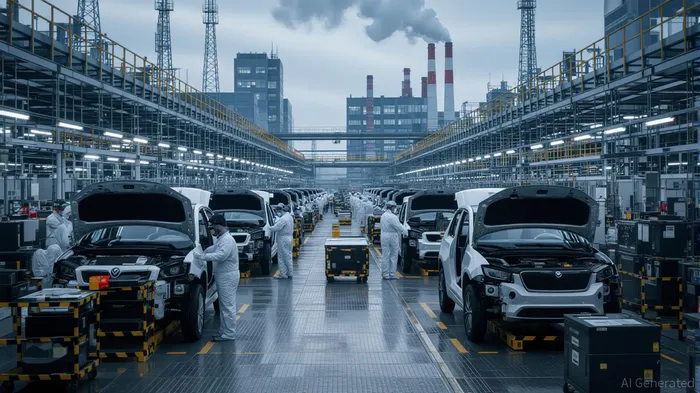
Volkswagen's (VW) electric vehicle (EV) transition is one of the most ambitious corporate overhauls in modern automotive history. The company has pledged to launch ten new EV models by 2026 and achieve 80% pure EV sales in Europe by 2030, with a long-term goal of full electric production by 2033 [1]. However, beneath the surface of these bold targets lies a growing risk: operational delays tied to software development and supply chain bottlenecks. These challenges, if unresolved, could erode VW's profitability and weaken its competitive positioning against rivals like TeslaTSLA-- and BMW.
The Software Conundrum
VW's EV strategy hinges on its modular e-drive system (MEB+), a platform designed to streamline production and reduce costs. Yet, as stated by Volkswagen, the company is grappling with “software development challenges” that threaten to delay EV production between 2023 and 2025 [1]. Software is no longer a peripheral component in modern vehicles—it is the backbone of user experience, safety, and differentiation. Tesla's dominance in over-the-air updates and BMW's integration of AI-driven infotainment systems highlight the stakes. If VW lags in software innovation, its EVs risk becoming commoditized products rather than premium offerings.
Supply Chain Bottlenecks and Capital Allocation
The EV transition also demands a reimagined supply chain. VW has invested €460 million to retrofit its Wolfsburg plant for MEB+ compatibility [1], a move aimed at consolidating production and reducing complexity. However, global supply chain disruptions—exacerbated by semiconductor shortages and geopolitical tensions—remain a wildcard. For every euro spent on EV infrastructure, VW must balance the risk of underutilized assets if production timelines slip. This is not merely a cost issue; it's a strategic one. Delays in scaling EV output could force VW to divert capital from R&D to crisis management, further widening the gapGAP-- with Tesla's vertically integrated model and BMW's agile supplier partnerships.
Profitability at Risk
VW's EV ambitions are predicated on achieving economies of scale. But operational delays could disrupt this calculus. Each postponed model launch represents lost revenue and higher fixed costs. Consider Tesla's recent profitability: its ability to iterate rapidly and scale production has allowed it to capture market share and margins that VW, still reliant on ICE (internal combustion engine) vehicles for 70% of its revenue, cannot match [2]. If VW's EV rollout falters, its cost structure will remain uncompetitive, and its brand equity—built on reliability rather than innovation—could be undermined.
Competitive Positioning in a Race Against Time
The EV market is a zero-sum game. Tesla's lead in battery technology and AI-driven manufacturing, coupled with BMW's early bets on premium EVs like the iX, are reshaping customer expectations. VW's “ID.7” and other flagship models must not only meet these benchmarks but exceed them to justify their price points. Yet, as noted by Volkswagen, supply chain bottlenecks and software delays could stretch timelines, giving rivals time to consolidate their positions [1]. This is particularly concerning in markets like North America, where VW's EV presence remains nascent compared to Tesla's dominance.
Conclusion: A Test of Strategic Resilience
Volkswagen's EV transition is a high-stakes gamble. While its investment in MEB+ and Wolfsburg's retrofitting demonstrates commitment, the company's operational delays—rooted in software and supply chain challenges—pose existential risks. For investors, these hurdles are not just technical setbacks but red flags for long-term profitability and competitive viability. The next 18 months will be critical: if VW cannot accelerate its EV production and innovation, it may find itself relegated to the second tier of the EV revolution, a fate it cannot afford.





Comentarios
Aún no hay comentarios