
VOO's Record Surge in a Goldilocks Economy: Why Large-Cap Equities Are the Safe Bet
The U.S. jobs market delivered a Goldilocks performance in June 2025: unemployment dipped to 4.1%, nonfarm payrolls beat expectations, and wage growth remained contained. This resilience has fueled a surge in the Vanguard S&P 500 ETF (VOO), which hit a record high of 570.29 amid investor confidence in the S&P 500's ability to navigate a balanced economy. But beneath the headline gains lies a complex story of sector rotation, bond market skepticism, and strategic opportunities for investors.
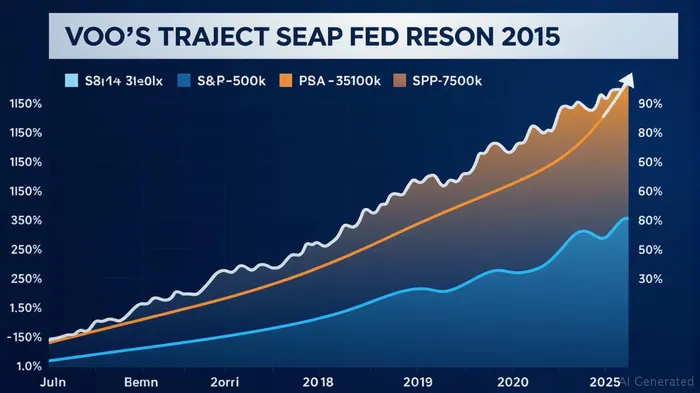
The Goldilocks Narrative: Why VOO Keeps Climbing
The June jobs report underscored a labor market that's “just right”—resilient enough to defy recession fears but not so hot as to ignite inflation. Unemployment fell to a 15-month low, while average hourly earnings rose only 0.2% month-over-month. This combination has kept the Federal Reserve in a data-dependent holding pattern, avoiding aggressive rate hikes that could spook equities.
VOO's YTD inflows of $60.09 billion (despite a $6.0 billion June outflow) reflect investor faith in the S&P 500's diversification and defensive characteristics. Even as the Fed debates rate cuts, the index's exposure to steady dividend-payers and cyclical stocks has made it a haven for capital.
Tech's Double-Edged Sword: QQQ's Resilience Amid Rotations
The Nasdaq-linked InvescoIVZ-- QQQ Trust (QQQ) faced $1.49 billion in June outflows, yet its YTD inflows of $8.25 billion highlight tech's enduring appeal. While investors trimmed exposure to megacap names like MicrosoftMSFT-- and NVIDIANVDA-- amid short-term volatility, the sector's long-term growth drivers—AI adoption, cloud infrastructure, and cybersecurity—are too strong to ignore.
The data shows a split: while passive investors rotated into cheaper alternatives like the Invesco NASDAQ 100 ETF (QQQM), active managers piled into thematic ETFs like the iShares AI Innovation ETF (BAI). This suggests a preference for targeted tech exposure over broad beta. For now, the sector's price-to-earnings premium remains justified by its ability to drive corporate profit growth.
Bond ETFs Falter: TLT's Outflows Signal Structural Shifts
The iShares 20+ Year Treasury Bond ETF (TLT) bled $3.04 billion in June, its largest monthly outflow since 2022. This exodus reflects broader skepticism toward long-duration bonds in an era of Fed uncertainty and geopolitical risk. Moody'sMCO-- downgrade of U.S. debt, fears of Chinese Treasury sales, and the allure of tech-driven equities have made TLT's yield unattractive.
Investors are instead favoring short-duration Treasuries (e.g., iShares 0-3 Month Treasury Bond ETF, SGOV) or securitized debt ETFs like JAAA (CLOs) and SMBS (MBS). These alternatives offer liquidity and yield without the duration risk of TLTTLT--.
Strategic Takeaways: Stay Anchored in VOO, Target Tech Selectively
- Embrace VOO's Diversification: VOO's $681 billion AUM and 0.03% expense ratio make it the most efficient way to access the S&P 500's stability. Its exposure to sectors like healthcare (up 39,000 jobs in June) and consumer discretionary provides a buffer against sector-specific downturns.
- Rotate into Thematic Tech: Avoid passive QQQ exposure; instead, focus on ETFs like BAIBAI-- (AI) or the First Trust Cloud Computing ETF (SKYY) for targeted growth.
- Avoid Bond Duration: Stick to short-term bond ETFs or cash until inflation and Fed policy clarity improve.
Conclusion: The Goldilocks Trade Isn't Over Yet
The June jobs data has reinforced the Goldilocks narrative: an economy that can grow without overheating. VOO's record highs are a testament to this, but investors must stay nimble. By pairing core exposure to large-caps with selective tech plays, portfolios can navigate Fed uncertainty while capitalizing on the S&P 500's proven resilience. As the Fed's next move hangs in the balance, the S&P 500's diversification remains the safest bet in an uncertain market.







Comentarios
Aún no hay comentarios