
Volkswagen's Strategic Response to U.S. Tariffs and Its Implications for European Automakers
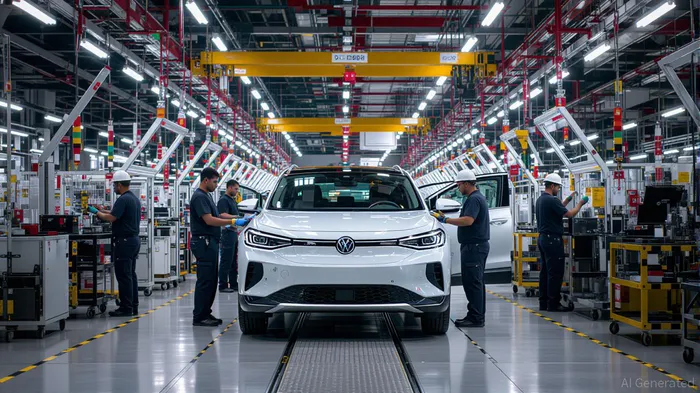
In the shadow of U.S. tariffs and geopolitical tensions, Volkswagen has emerged as a case study in resilience. The 25% import tariffs imposed in 2025 have added €8,750 to the cost of a $35,000 Tiguan, forcing the German automaker to absorb 40% of these costs to stabilize pricing. Yet, rather than retreating, Volkswagen has doubled down on a three-pronged strategy: aggressive cost-cutting, domestic production expansion, and a pivot to high-margin electric vehicles (EVs). For investors, the question is whether these moves will unlock value for Volkswagen and its European peers in the long term.
The Tariff Conundrum and Volkswagen's Counteroffensive
The U.S. tariffs have hit Volkswagen hard. Operating profit in Q2 2025 fell 29% year-over-year to €3.8 billion, and the company slashed its operating margin guidance to 4–5% (down from 5.5–6.5%). To offset this, Volkswagen CEO Oliver Blume has spearheaded a €5 billion annual cost-cutting plan by 2026, including 35,000 job cuts in Germany by 2030. Simultaneously, the company is leveraging its U.S. investments—such as a $5.8 billion stake in RivianRIVN-- and 20,000 direct jobs—as bargaining chips in trade negotiations with the Biden administration. These investments are not just symbolic; they position Volkswagen to demand a “phased reduction” in tariffs while aligning with U.S. political priorities like job creation and energy independence.
Domestically, Volkswagen is retooling its Chattanooga plant to produce more ID.4 EVs, aiming to shift 50% of U.S. imports to domestic production. This move could save the company $1.2 billion annually but requires upfront investments in battery gigafactories—a Catch-22 given current U.S. supply chain gaps. Yet, the shift to EVs is critical: the ID.7, with its higher margins, is designed to offset the lower profitability of SUVs like the Tiguan. This pivot aligns with U.S. regulatory trends (e.g., Biden's EV mandates) and global demand for electrification, even as the sector remains unprofitable today.
Comparing Strategies: How Volkswagen Stacks Up Against Peers
Volkswagen's approach contrasts with its European rivals. StellantisSTLA--, for example, has absorbed a 1–1.5 billion euro hit from tariffs and is shifting production of its XC60 SUV to South Carolina. Renault, less exposed to the U.S., has focused on cost discipline and new product launches but lacks Volkswagen's U.S. footprint. Volvo, similarly exposed, has also localized production of the XC60. However, Volkswagen's unique leverage lies in its U.S. investments and political capital, which could secure a more favorable trade deal.
The U.S.-Japan trade deal, which reduced tariffs from 25% to 15%, has set a precedent. European automakers are now watching closely, with Bloomberg Intelligence estimating that a similar EU-U.S. deal could add €1.6 billion in 2025 EBIT for Mercedes and Porsche. For Volkswagen, a 10% tariff reduction would be transformative, given its 16% U.S. sales decline in H1 2025.
The Long-Term Investment Case: Trade, Tech, and Timing
Volkswagen's success hinges on three factors:
1. Tariff Relief: A phased reduction in U.S. tariffs, secured through its U.S. investments, would restore margins and unlock $1.2 billion in annual savings.
2. EV Scalability: The ID.4 and ID.7 must achieve economies of scale, supported by U.S. battery partnerships and local production.
3. Political Leverage: Volkswagen's U.S. jobs and Rivian stake make it a strategic partner for the Biden administration, which could prioritize its interests over competitors.
For investors, Volkswagen represents a high-risk, high-reward opportunity. The company's restructuring costs and EV losses are real, but its U.S. strategy and political positioning could catalyze a rebound. By contrast, rivals like Stellantis and Renault lack the same U.S. footprint and political clout.
Conclusion: A Compelling Long-Term Play?
Volkswagen's response to U.S. tariffs is a masterclass in strategic adaptation. While the near-term pain is evident, the company's focus on domestic production, EVs, and trade negotiations positions it to benefit from a potential U.S.-EU deal. For investors, the key is patience: Volkswagen's EV strategy is still in its infancy, and its U.S. investments will take years to bear fruit. However, if the company secures tariff relief and executes its EV roadmap, the upside could be substantial.
In a world of protectionism and rapid technological change, Volkswagen's ability to blend political acumen with industrial strategy may prove to be its greatest asset. For those willing to look beyond the short-term noise, this is a compelling long-term investment case.







Comentarios
Aún no hay comentarios