
Volkswagen's Strategic Position Amid EV Transition and Strong Q2 Performance
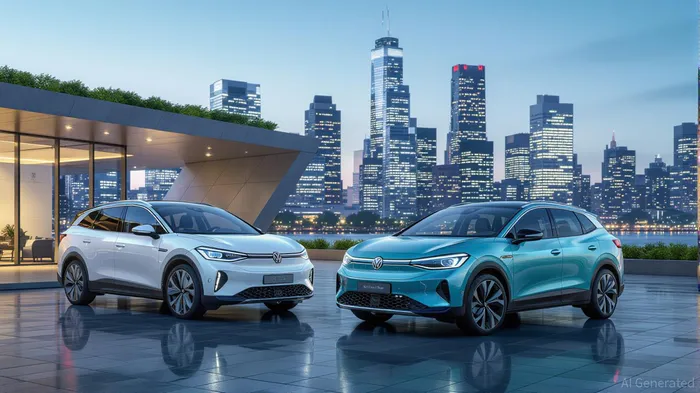
In the rapidly evolving automotive landscape, Volkswagen Group (VOW) has emerged as a critical player in the global shift to electric vehicles (EVs). Despite navigating headwinds like U.S. import tariffs and restructuring costs, the company's Q2 2025 results underscore its resilience and strategic adaptability. Deutsche Bank's recent “Buy” rating, with a target price of €125, reflects a conviction that Volkswagen's undervalued growth potential is poised to outperform in a sector still grappling with profitability challenges.
Q2 2025: A Snapshot of Resilience and Growth
Volkswagen delivered a robust performance in the first half of 2025, despite a 32.8% year-on-year decline in operating profit to €6.7 billion. The company's all-electric vehicle (BEV) deliveries surged by 46.7% to 465,500 units globally, with Europe leading the charge. In Western Europe, BEV deliveries skyrocketed by 89%, propelling Volkswagen to a 28% market share in the region—a testament to the success of models like the ID.7 Tourer, CUPRA Terramar, and Škoda Elroq.
The operating margin for the Automotive Division stood at 4.2% in Q2, a slight dip from 6.3% in Q2 2024, but analysts note that this was driven by external factors rather than operational missteps. U.S. import tariffs alone cost the company €1.3 billion in H1 2025, while restructuring expenses and CO₂ compliance costs further pressured profitability. Yet, Volkswagen's ability to maintain strong order intake—up 19% in Western Europe, with a 62% surge in BEV orders—highlights enduring demand for its electrified offerings.
Deutsche Bank's Rationale: A Long-Term Play on Structural Shifts
Deutsche Bank's “Buy” rating is anchored in Volkswagen's strategic realignment and its leadership in the EV transition. The bank's analyst, Tim Rokossa, emphasizes that Volkswagen's focus on software innovation through its CARIAD division—responsible for in-house software development—has already driven a 30% revenue increase compared to H1 2024. This progress positions Volkswagen to capitalize on the growing value of software in the automotive industry, a sector where margins can significantly outpace traditional manufacturing.
Moreover, Volkswagen's restructuring efforts, including a 4.8% operating margin in the Core brand group and a 7,000-job reduction in Germany, demonstrate its commitment to cost efficiency. The company's estimated future dividend yield of over 5% further enhances its appeal for income-focused investors. Deutsche Bank's target price of €125 implies a 25% upside from its current valuation, suggesting that the market has not yet fully priced in Volkswagen's long-term potential.
Navigating Risks in a Competitive EV Market
While Volkswagen's Q2 results are encouraging, the company faces structural challenges. The EV transition inherently carries lower profitability compared to combustion engines, and U.S. tariffs remain a wildcard. However, Deutsche Bank's analysis highlights that Volkswagen's diversified brand portfolio—spanning Audi, Škoda, Porsche, and CUPRA—provides resilience across market segments. The EU's extension of CO₂ emissions rules, which could save the company €1.5 billion in earnings, also mitigates some of the near-term pressures.
Competitors like TeslaTSLA-- and Chinese automakers (e.g., BYD) continue to dominate headlines, but Volkswagen's disciplined approach to cost management and its product offensive—30 new models across all brands in 2025—position it to capture market share in both Europe and North America. HSBC and Jefferies have echoed this sentiment, rating Volkswagen as a “buy” and noting early signs of progress in its cost-cutting and efficiency initiatives.
Investment Thesis: A Compelling Case for Resilience
Volkswagen's strategic position in the EV transition is underpinned by three key factors:
1. Leadership in European EV Market: With a 28% market share in Europe, Volkswagen is the region's dominant EV player, a position that offers both scale and brand equity.
2. Software and Technology Edge: CARIAD's progress in software development, including partnerships with Rivian and PowerCo, positions Volkswagen to monetize high-margin digital services.
3. Cost Efficiency and Liquidity: The company's net liquidity in the Automotive Division is projected to reach €31–33 billion by year-end, providing flexibility to fund its EV ambitions without diluting shareholders.
For investors, the current valuation appears attractive. At a forward P/E of 8.5x and a P/B of 0.9x, Volkswagen trades at a discount to its historical averages and peers. Deutsche Bank's target price implies a 12-month return of 25–30%, assuming a resolution of U.S. tariff uncertainties and continued execution on cost-cutting.
Conclusion: A Buy for the Long Haul
While short-term risks persist—particularly in China and the U.S.—Volkswagen's strategic focus on electrification, software, and cost discipline creates a compelling case for long-term investors. Deutsche Bank's “Buy” rating is not just a vote of confidence in Volkswagen's Q2 performance but a recognition of its undervalued potential to dominate the next phase of the automotive revolution. As the company navigates the complexities of the EV transition, its disciplined execution and market leadership in Europe make it a standout in a sector still searching for its footing.







Comentarios
Aún no hay comentarios