
Volkswagen's Shift Reductions: A Strategic Warning Signal for Auto Sector Investors?
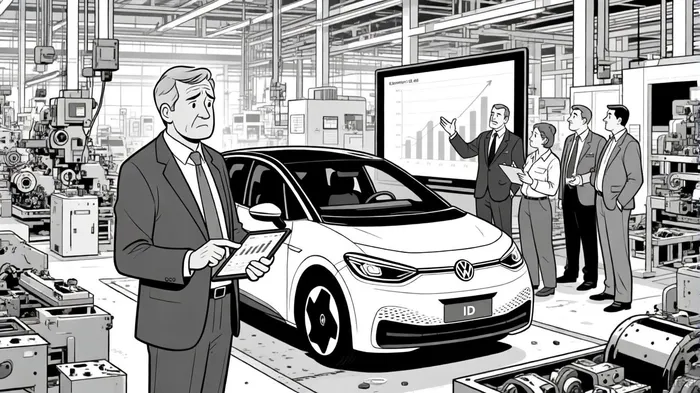
The automotive industry is at a crossroads, and Volkswagen's recent restructuring efforts—marked by significant job cuts, production reductions, and cost-cutting measures—highlight the existential challenges facing legacy automakers in the electric vehicle (EV) era. For investors, the German automaker's struggles serve as a cautionary tale about the risks of misaligned strategies, weak demand, and the high costs of transitioning to electrification.
Volkswagen's Restructuring: A Response to Weak Demand and Rising Costs
Volkswagen has announced a sweeping restructuring plan, including 35,000 job cuts by 2030, reduced apprenticeships, and a €1.5 billion annual labor cost savings target[1]. These measures are part of a broader €10 billion cost-cutting initiative aimed at addressing overcapacity, declining sales, and financial strain[2]. The company's core passenger car unit has been particularly hard hit, with operating margins collapsing to 2% in the first nine months of 2024[3].
The root cause? Weak demand in key markets. In Europe, where Volkswagen once dominated, sales have stagnated due to economic uncertainty and rising interest rates[4]. Meanwhile, in China—the world's largest EV market—Volkswagen's sales dropped 12% year-to-date in 2024, as locally produced EVs from companies like BYD and TeslaTSLA-- captured market share with superior affordability and software capabilities[5]. Even Volkswagen's EVs, such as the ID.3, have underperformed due to software glitches and tepid consumer adoption[6].
The Broader Industry Struggle: EV Transition Costs and Profitability Risks
Volkswagen's challenges are not isolated. Legacy automakers globally are grappling with the financial and operational hurdles of transitioning to EVs. For example, Ford's EV division reported a $1.2 billion loss in the latest quarter, with an average loss of $50,000 per vehicle[7]. Analysts attribute this to the high costs of retooling factories, developing new supply chains, and competing with vertically integrated rivals like Tesla and Chinese EV startups[8].
The sector-wide pain is evident in workforce reductions and plant closures. Suppliers such as Bosch and Continental have announced over 50,000 job cuts in 2024 due to slower-than-expected EV adoption[9]. Volkswagen's €4 billion cost-cutting plan, including a 10% wage cut and two-year pay freeze for 140,000 employees, reflects the urgency of aligning costs with shrinking demand[10].
Hybrid vehicles have emerged as a temporary lifeline for some automakers. Ford, for instance, reported higher profitability from hybrid models like the F-150 compared to gasoline-powered counterparts[11]. This suggests that a gradual transition—rather than an abrupt shift to full electrification—may be more viable in the short term. However, Volkswagen's pivot to hybrids remains limited, with its ID. lineup still central to its long-term strategy[12].
Strategic Risks for Investors: Can Restructuring Salvage Volkswagen's Prospects?
The success of Volkswagen's restructuring hinges on two critical factors: cost discipline and market adaptability. While the company has secured union support to avoid immediate plant closures[13], its ability to maintain profitability through 2030 remains uncertain. Analysts at Jefferies argue that the scale and timing of Volkswagen's cost-cutting measures will define its long-term viability[14]. However, others warn that the company's reliance on traditional internal combustion engine (ICE) models—while hybrids gain traction—could leave it vulnerable to regulatory and consumer shifts[15].
Broader sector risks further complicate the outlook. European automakers face potential policy shifts, including relaxed CO2 emission standards and protectionist measures against Chinese EVs[16]. Additionally, underutilized production capacity and rising refinancing costs could strain Volkswagen's financial performance[17].
Conclusion: A Strategic Warning for Auto Sector Investors
Volkswagen's shift reductions underscore the fragility of legacy automakers in an era of rapid technological disruption. For investors, the company's struggles highlight three key lessons:
1. Weak demand in core markets (e.g., Europe and China) can accelerate financial deterioration, even for industry leaders.
2. EV transition costs are a double-edged sword—necessary for long-term competitiveness but immediately dilutive to profitability.
3. Strategic flexibility (e.g., embracing hybrids) may be more critical than rigid timelines for full electrification.
As Volkswagen navigates this turbulent period, its ability to balance cost-cutting with innovation will determine whether its restructuring is a lifeline or a prelude to deeper decline. For the broader auto sector, the message is clear: investors must scrutinize not just the scale of restructuring but the adaptability of management in an increasingly unpredictable market.





Comentarios
Aún no hay comentarios