
Volkswagen's Marginal Q3 Delivery Growth: A Glimpse into Its EV Transition Challenges
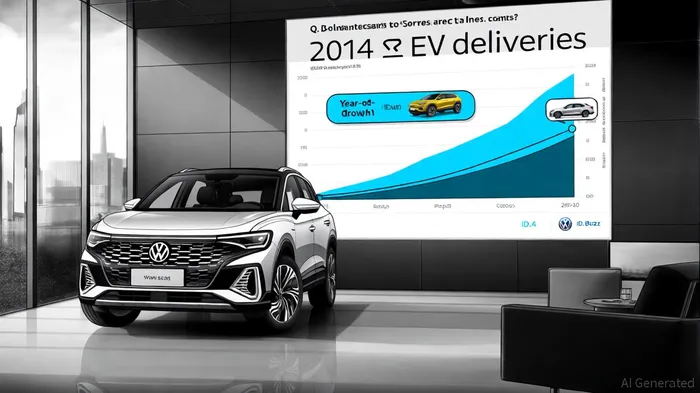
Volkswagen's third-quarter 2025 electric vehicle (EV) deliveries offer a mixed snapshot of its transition to electrification. While the automaker reported a 33.1% year-over-year increase in global EV sales, reaching 252,100 units, regional disparities and structural challenges underscore the complexity of its long-term competitiveness in the EV market.
Regional Performance: Strengths and Weaknesses
The U.S. emerged as Volkswagen's most dynamic market, with EV sales surging 213.5% year-over-year. The ID.4 and ID. Buzz models drove this growth, contributing 12,470 and 2,469 deliveries, respectively, according to Accio. This performance aligns with broader U.S. EV trends, where demand for electric SUVs and vans is accelerating. However, the European market, though a stronghold, revealed cracks. While Volkswagen's EV sales there rose 60% to 174,700 units, its market share in Western Europe-once a pillar of its dominance-now stands at 20% of total vehicle sales, down from 25% in 2023, according to Daxstreet. Meanwhile, China, Volkswagen's traditional growth engine, saw a 55.2% decline in EV deliveries to 25,800 units in Q3 2025, a sharp reversal from its earlier 47% global growth in H1 2025. This slump reflects intensifying competition from local rivals like BYD and the lingering impact of Trump-era tariffs in North America.
Strategic Investments and Partnerships: A Double-Edged Sword
Volkswagen's EV transition is underpinned by aggressive R&D spending and strategic alliances. The company allocated nearly $23 billion to R&D in 2024, with a focus on battery innovation and software development through its CARIAD division. Over the next five years, it plans to invest $131 billion in electrification and digitalization, aiming for 50% EV sales by 2030. These commitments are critical, given the sector's capital intensity.
Partnerships with QuantumScape, XPENG, and RivianRIVN-- further illustrate Volkswagen's strategy to mitigate risks. Collaborations with QuantumScape on solid-state batteries and XPENG on software-defined architectures aim to reduce costs and accelerate innovation, according to Latterly. Meanwhile, its financial backing of Rivian provides access to North American production expertise. Yet, these alliances also expose Volkswagen to external dependencies, particularly in volatile markets like China, where its joint ventures face stiff competition.
Profitability and Market Share: The Cost of Transition
Despite its growth in key markets, Volkswagen's profitability remains under pressure. In Q1 2025, its operating margin contracted to 3.7%, driven by EV subsidies and rising raw material costs, according to Daxstreet. This contrasts with traditional combustion engine margins, which historically averaged 8–10%. Analysts warn that without significant cost reductions-Volkswagen aims to cut production costs by 30% by 2026-the company may struggle to match the profitability of rivals like Toyota, which reported 8.69 million units in production in mid-2023 while maintaining a robust global brand.
Market share dynamics further complicate Volkswagen's outlook. While its ID.4 model captured 49% of Germany's EV market in H1 2025, that dominance is fragile. In China, where EVs account for over 40% of total sales, Volkswagen's retreat highlights the limitations of its current strategy. Local competitors like BYD now command 30% of China's EV market, leveraging lower costs and government support.
Long-Term Competitiveness: A Balancing Act
Volkswagen's EV ambitions hinge on its ability to balance innovation with profitability. The company's 2030 target of 50% EV sales is ambitious but achievable only if it addresses regional imbalances and cost inefficiencies. Its partnerships and R&D investments position it to compete with global leaders like GM and Ford, which are also scaling their Ultium and F-150 Lightning platforms. However, the Chinese market's volatility and the U.S. tariff environment remain wild cards.
Investors remain cautiously optimistic. While Volkswagen's Q3 growth and strategic pivots suggest resilience, the path to sustained profitability is fraught. As one analyst noted, "Volkswagen's EV transition is a marathon, not a sprint. The question is whether its cost-cutting measures and partnerships can bridge the gap between ambition and execution."
Conclusion
Volkswagen's Q3 2025 results reflect both progress and peril. The automaker's U.S. and European growth, coupled with its R&D and partnership strategies, signal a commitment to electrification. Yet, its struggles in China and profitability challenges highlight the risks of a fragmented global strategy. For long-term competitiveness, Volkswagen must not only scale its EV offerings but also adapt to regional dynamics and cost pressures-a test that will define its legacy in the electric era.





Comentarios
Aún no hay comentarios