
Volkswagen's EUR1 Billion AI Push: A Strategic Inflection Point for EV and Software Leadership
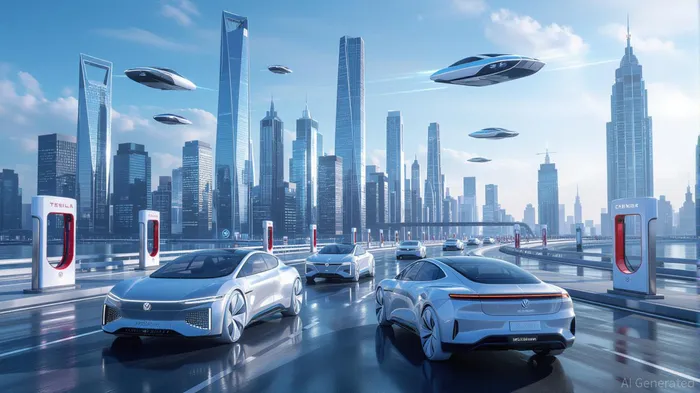
The automotive industry is at a crossroads. As the electric vehicle (EV) transition accelerates, traditional automakers must either reinvent themselves or risk obsolescence. Volkswagen, once a dominant force in internal combustion engines, is betting big on artificial intelligence (AI) to reclaim its position as a leader in the EV and software-defined vehicle (SDV) era. With a EUR1 billion investment in AI over the next decade, the German automaker is targeting a seismic shift in its technological DNA—one that could redefine its competitive edge against rivals like TeslaRACE-- and BYD.
The EUR1 Billion Bet: AI as the New Fuel
Volkswagen's AI strategy is not just about flashy tech—it's a calculated move to streamline development cycles, reduce costs, and future-proof its software ecosystem. According to a report by the Volkswagen Group China Technology Company, the automaker has allocated EUR1 billion to establish a cutting-edge AI hub in Hefei, China, as part of its “in China, for China” initiative[5]. This investment aims to cut time-to-market for new EVs by 30%, a critical advantage in a sector where speed and agility determine survival.
The company's E³ 2.0 architecture, a centralized computing platform consolidating vehicle functions into three high-performance computers, is a cornerstone of this strategy[3]. By shifting from distributed systems to a unified AI-driven framework, Volkswagen is enabling real-time data processing for advanced driver-assistance systems (ADAS), predictive maintenance, and over-the-air (OTA) software updates. This mirrors Tesla's approach to software monetization but with a focus on scalability across its diverse portfolio.
AI-Driven Efficiency: From Factories to Batteries
Volkswagen's AI applications extend beyond software. Its Digital Production Platform (DPP) is already optimizing manufacturing processes, reducing energy consumption by 15% and cutting CO₂ emissions in key plants[4]. Meanwhile, AI-powered virtual testing is slashing the need for physical prototypes in EV development, accelerating timelines by up to 40%[3]. This is no small feat: Tesla's recent struggles with production bottlenecks at its Austin Gigafactory highlight the risks of relying on traditional methods[5].
On the battery front, Volkswagen's collaboration with XPengXPEV-- to develop the China Electrical Architecture (CEA) is a game-changer. By reducing wiring and components, the CEA promises a 40% cost reduction compared to its MEB platform[3]. This positions Volkswagen to compete directly with BYD, whose vertically integrated supply chain and lithium-iron-phosphate (LFP) batteries have driven down costs to undercut even Tesla's economies of scale.
Competitive Edge: Metrics That Matter
Let's crunch the numbers. The Volkswagen ID.7 Pro, powered by E³ 2.0, boasts a real-world range of 621 km (WLTP), outpacing the Tesla Model 3 RWD's 513 km[1]. While Tesla's 6.1-second 0–100 km/h acceleration still edges out Volkswagen's 6.5 seconds, the ID.7's energy efficiency (14.6 kWh/100 km vs. Tesla's 13.5 kWh/100 km) suggests a trade-off between speed and sustainability[1]. More importantly, Volkswagen's AI-driven battery management systems are extending lifespans and improving thermal regulation—critical differentiators in a market where range anxiety still lingers.
BYD, however, remains the wildcard. With 4.2 million new energy vehicles (NEVs) sold in 2024—surpassing Tesla's 1.79 million—BYD's aggressive pricing and hybrid models have captured 11% of China's domestic market[2]. But Volkswagen's AI investments may yet close the gapGAP--. Its recent USD 1 billion SPAC deal with Glencore and Chrysler to secure nickel and copper assets[2] ensures a stable supply chain, countering BYD's cost advantages.
The Road Ahead: Can AI Deliver?
Volkswagen's AI push is ambitious, but execution will be key. Training 130,000 employees to work with AI tools is a massive undertaking[4], and regulatory hurdles in Europe could slow adoption. Meanwhile, Tesla's private 5G networks at its Gigafactories have already reduced production bottlenecks by 90%[5], a hard act to follow.
Yet, Volkswagen's focus on SDVs and AI-driven software monetization offers a path to profitability. Analysts estimate that software and services could account for 27% of automotive profits by 2030[3], a slice Volkswagen is determined to capture. Its partnerships with RivianRIVN-- and Dassault Systèmes[3] signal a willingness to collaborate, a stark contrast to Tesla's insular approach.
Investor Takeaway
Volkswagen's EUR1 billion AI bet is more than a technological pivot—it's a strategic inflection pointIPCX--. While Tesla and BYD dominate headlines, Volkswagen's methodical integration of AI into EVs, software, and supply chains positions it as a dark horse in the EV race. For investors, the question isn't whether AI will reshape the industry—it's whether Volkswagen can execute its vision faster than its rivals.





Comentarios
Aún no hay comentarios