
Volkswagen's Electric Vehicle Momentum and Scalability: A Long-Term Competitive Edge?
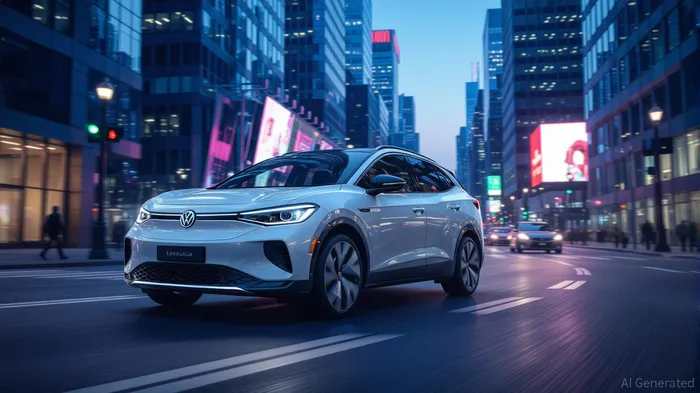
Volkswagen's transition to electric vehicles (EVs) has gained significant traction, with its ID. platform emerging as a cornerstone of its strategy. In 2023, the Volkswagen Group produced 9.31 million vehicles globally, a 6.8% increase year-over-year, driven by scalable platforms like the Modular Electric Drive Toolkit (MEB) [1]. This flexibility allows the company to adapt to shifting market demands and leverage synergies across brands, a critical advantage in the rapidly evolving EV landscape.
The ID. platform's scalability is further underscored by Volkswagen's ambitious production targets. The company now aims to produce up to 1.5 million electric vehicles annually by 2025, including models like the ID.4 [1]. This represents a leap from earlier projections and signals a commitment to outpacing rivals in manufacturing capacity. While TeslaTSLA-- and BYD dominate headlines, Volkswagen's ability to scale production across multiple brands (e.g., Audi, Skoda) could position it as a volume leader in the EV transition.
However, scalability alone is not enough. The ID. platform's technological edge must be evaluated against competitors. For instance, the 2025 ID.4 boasts a tighter turning diameter of 31.5 feet compared to the Tesla Model Y's 39.8 feet, making it more maneuverable in urban environments [2]. This design innovation addresses a key pain point for city drivers, differentiating Volkswagen's offerings in a crowded market. Yet, broader comparisons on battery efficiency, software ecosystems, or charging infrastructure remain sparse, leaving gaps in assessing long-term competitiveness.
Volkswagen's strategic focus on platform flexibility and urban usability is commendable, but investors must scrutinize its R&D investments and supply chain resilience. The company's partnerships and battery sourcing strategies—critical for sustaining EV momentum—remain underexplored in current data. Without robust supply chain visibility or detailed R&D benchmarks, it's challenging to gauge whether Volkswagen can maintain its edge against Tesla's vertical integration or BYD's cost advantages.
In conclusion, Volkswagen's ID. platform demonstrates strong scalability and niche innovations, but its long-term success hinges on addressing these gaps. For now, the company's production ramp-up and design ingenuity make it a compelling player in the EV transition—though the road ahead demands continuous innovation and transparency.
Source:
[1] Production - VW Annual Report 2023 - Volkswagen Group, [https://annualreport2023.volkswagen-group.com/group-management-report/sustainable-value-enhancement/production.html]
[2] New Volkswagen ID.4 vs Tesla Model Y, [https://www.dreyerreinboldvw.com/compare-vw-id4-vs-tesla-model-y/]







Comentarios
Aún no hay comentarios