
Volatility in the TSX Amid False Breakouts: A Tactical Case for Defensive-Growth Stocks
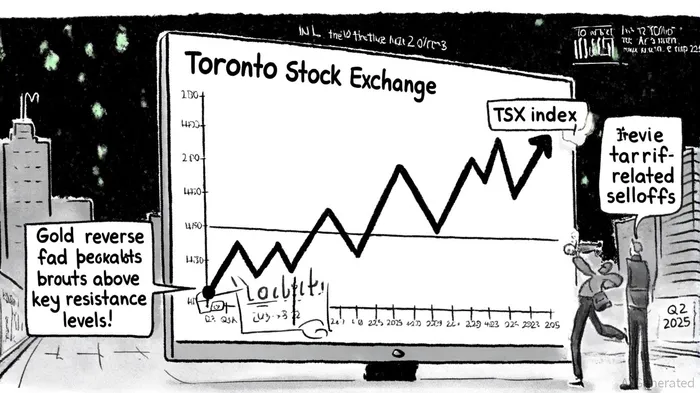
The Toronto Stock Exchange (TSX) has become a battleground for bulls and bears in 2025, with volatility driven by trade tensions, shifting investor sentiment, and macroeconomic headwinds. While the index has clawed back to all-time highs amid a 25% surge in gold prices[1], it has also experienced sharp reversals and false breakouts—moves that have left many investors questioning the sustainability of current valuations. For tactical investors, however, this turbulence presents a unique opportunity: to position in defensive-growth stocks with strong balance sheets and earnings resilience, leveraging volatility as a catalyst for long-term gains.
Volatility and False Breakouts: A Double-Edged Sword
The TSX's volatility in 2025 has been amplified by macroeconomic fragility. Elevated gold prices have buoyed miner stocks, while trade uncertainties have triggered periodic selloffs[1]. This tug-of-war has created fertile ground for false breakouts—price movements that appear to pierce key support or resistance levels but reverse quickly. According to PriceAction.com, false breakouts often signal a shift in market dynamics, as institutional investors exploit retail traders' emotional reactions to reestablish control[2]. For example, in Q3 2025, ShopifySHOP-- (SHOP.TO) and Cenovus EnergyCVE-- (CVE.TO) exhibited sharp false breakouts during tariff-driven selloffs, with prices rebounding after testing critical levels[2].
These patterns underscore a market in flux. While the TSX's forward P/E ratio of 15.8x suggests modest overvaluation, the index's resilience—despite a 10% earnings beat in H1 2025—reflects a disconnect between corporate fundamentals and investor sentiment[3]. Morgan Stanley's September 2025 report highlights this divergence, noting a -15% AAII Bull-Bear ratio despite strong corporate performance[3]. Such imbalances often act as contrarian signals, hinting at eventual sentiment realignment.
Tactical Positioning: Leveraging Volatility for Defensive Growth
In a market prone to sharp reversals, tactical positioning requires a dual focus: capitalizing on volatility while mitigating downside risk. Defensive-growth stocks—those with strong balance sheets, consistent earnings, and low cyclicality—offer a compelling solution. These companies thrive in uncertain environments, providing stability without sacrificing growth potential.
Case Study: Dollarama (DOL) and Waste Connections (WCN)
Dollarama (DOL), a discount retail leader, exemplifies this strategy. With total assets of $6.48 billion and equity of $1.19 billion[4], the company's low-cost model ensures steady demand even during economic downturns. Its 2025 revenue growth, driven by store expansion and inflationary tailwinds, has delivered double-digit returns for shareholders[5]. Similarly, Waste Connections (WCN) has capitalized on niche markets, reporting $8.9 billion in 2025 revenue and a 13.3% year-over-year revenue surge in Q3 2024[6]. By focusing on secondary markets and energy-related waste services, WCN has insulated itself from broader economic cycles.
Utilities and Consumer Staples: Fortis (FTS) and Metro (MRU)
Utility stocks like Fortis (FTS) and consumer staples like Metro (MRU) further strengthen the defensive-growth case. Fortis, with $51 billion in assets and $21.7 billion in long-term debt[7], benefits from stable demand and regulatory protections. While its interest coverage ratio of 2.28x raises questions about debt servicing[8], its utility model ensures consistent cash flows. Metro (MRU), a grocery and pharmacy giant, maintains a debt-to-equity ratio of 0.62[9], reflecting prudent leverage. Its $14.1 billion in assets and focus on essential goods make it a safe haven during volatility.
Strategic Entry Points in a Volatile Market
The TSX's false breakouts and sentiment swings create asymmetric opportunities. For instance, false breakouts in high-beta stocks like Shopify or Cenovus can signal short-term entry points for risk-tolerant investors, while defensive-growth stocks offer a floor during downturns. RBC Wealth Management notes that equity risk premiums have fallen below historical averages, suggesting investors are underpricing near-term risks[1]. This environment favors a barbell strategy: pairing high-conviction defensive-growth positions with tactical trades in volatile sectors.
Conclusion: Volatility as a Catalyst
The TSX's 2025 volatility, while daunting, is not a barrier to growth—it is a filter. By identifying defensive-growth stocks with robust balance sheets and earnings resilience, investors can navigate false breakouts and sentiment swings with confidence. As the Bank of Canada and Federal Reserve prepare rate cuts[10], the cost of capital will likely decline, further boosting valuations for these resilient companies. In a market where uncertainty is the only certainty, tactical positioning in defensive-growth stocks offers a path to outperformance.





Comentarios
Aún no hay comentarios