
The Volatility and Risks of Politically Linked Stocks: A Case Study of DJT (Trump Media)
Politically linked stocks have long been a source of fascination-and volatility-for investors. Nowhere is this more evident than in the case of Donald J. Trump's media venture, Trump MediaDJT-- & Technology Group (DJT). Over the past year, DJTDJT-- has become a poster child for speculative trading, regulatory scrutiny, and event-driven price swings tied to the political fortunes of its namesake. This article dissects the mechanics of DJT's volatility, the speculative forces fueling its momentum, and the regulatory risks that loom over its future.
Political Event-Driven Volatility: A Double-Edged Sword
DJT's stock price has been inextricably tied to the political calendar. During the 2024 U.S. election, the stock surged on speculation of a Trump victory, only to face sharp corrections as outcomes crystallized. By October 2025, the stock had swung between $10.35 and $16.95, with trading volumes spiking to 25.486 million shares on July 21, 2025-a stark contrast to its average volume of 7.16 million shares.
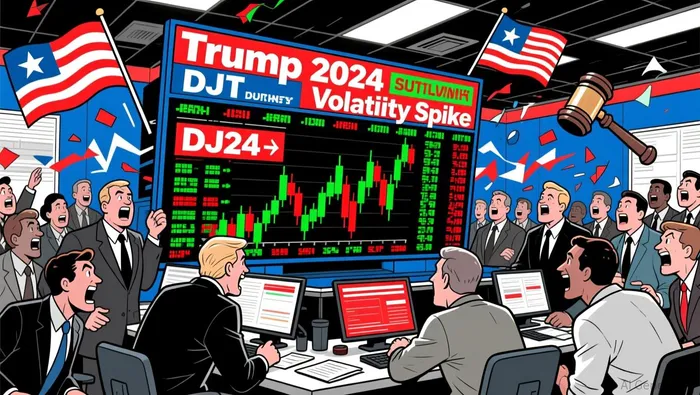
The 2025 Trump trial further amplified this volatility. On November 28, 2025, DJT closed at $11.54 with a trading volume of 4.44 million shares, a 22% drop from its closing price of $14.80 just two weeks prior. By December 1, 2025, the stock had fallen to $10.95, reflecting the market's sensitivity to legal developments. These swings underscore how politically linked stocks can act as barometers for public sentiment, often decoupling from traditional financial metrics.
Speculative Momentum: The Meme Stock Playbook
DJT's price action has been driven less by fundamentals and more by speculative momentum. Retail traders, galvanized by social media and political fervor, have treated DJT as a "meme stock," buying on hype and selling during dips. According to a report by , the stock's sharp rallies are often fueled by "momentum-driven retail activity," with traders betting on short-term volatility rather than long-term value.
This dynamic is exacerbated by DJT's low float-only 6.48 million shares traded on November 20, 2025 according to Yahoo Finance-which makes it highly susceptible to sudden influxes of capital. Analysts note that such stocks often experience "whipsaw" price movements, where retail buying pushes prices up rapidly and only for institutional sellers to offload shares and trigger a collapse. The result is a stock that behaves more like a political futures contract than a traditional equity.
Regulatory Risks: SPAC Scrutiny and Compliance Costs
DJT's origins as a SPAC merger with Digital World Acquisition Corp. (DWAC) have left it under a cloud of regulatory scrutiny. In 2023, the SEC fined DWAC $18 million for misleading investors about its merger with TMTG according to SEC press release. More recently, in April 2025, the SEC resolved a civil suit against Patrick Orlando, DWAC's former CEO, over similar allegations as reported by Bloomberg. These cases highlight the SEC's ongoing focus on SPAC transparency, a critical issue for DJT given its reliance on this fundraising structure.
Compounding these risks is the Trump administration's push to deregulate SPACs. The Department of Government Efficiency (DOGE) has proposed revisiting Biden-era rules designed to protect investors, potentially reducing compliance burdens for companies like DJT. While this could lower costs in the short term, it also raises questions about investor protections and the long-term viability of SPACs as a fundraising vehicle.
Financial Sustainability: A Question Mark
Even as DJT's stock dances to the tune of political events, its financials tell a different story. In 2024, the company reported a net loss of $400.9 million, with revenue plummeting to $3.6 million-a 12% decline from the prior year. Legal fees tied to SEC investigations and revenue-sharing agreements have further eroded profitability as reported by CNBC. By Q3 2024, losses had widened to $54.8 million, with revenue dropping 3.8% to $972,900 according to Reuters.
These figures underscore a critical challenge: DJT's business model lacks a clear path to profitability. Unlike traditional media companies, it generates minimal recurring revenue and relies heavily on speculative capital. As one analyst put it, "DJT is a political asset, not a business" according to Markets.com analysis.
Conclusion: A High-Risk, High-Volatility Proposition
DJT exemplifies the unique risks of politically linked stocks. Its price is driven by speculative momentum, political events, and regulatory shifts, with little regard for financial fundamentals. While this creates opportunities for short-term traders, it also exposes investors to extreme volatility and regulatory uncertainty. For long-term investors, the risks are clear: DJT's survival hinges on the political fortunes of its namesake and the ability to navigate a rapidly shifting regulatory landscape.
In a market increasingly defined by event-driven speculation, DJT serves as a cautionary tale. As the line between politics and finance blurs, investors must ask whether they're buying a stock-or a bet on a political narrative.







Comentarios
Aún no hay comentarios