
Volatility in Corn Futures Amid Regulatory Silence
The corn futures market has become a theater of extremes in 2025, with regulatory silence from the USDA amplifying volatility and reshaping trader behavior. As delays in critical reports like the World Agricultural Supply and Demand Estimates (WASDE) persist, market participants are navigating a landscape where uncertainty reigns. This volatility is not merely a function of data gaps but a reflection of how traders are recalibrating their strategies in the absence of authoritative signals.
Market Behavior During Regulatory Silence
When USDA reports are delayed or absent, corn futures prices often exhibit sharp, unpredictable swings. On September 12, 2025, the release of the WASDE report triggered an immediate eight-cent drop in December corn futures, driven by automated trading systems reacting to the report's bearish projections of record U.S. production (16.7 billion bushels for the 2025/26 marketing year), according to Farm Progress. However, prices rebounded within minutes as traders shifted focus to short-covering opportunities, ultimately closing the session with a 2% gain, the Farm Progress article added. This pattern-of rapid overreactions followed by corrections-highlights how the absence of consistent USDA data forces traders to rely on fragmented signals, often leading to exaggerated price movements.
The USDA's delayed reports have also created a tug-of-war between supply-side optimism and demand-side pessimism. While the agency's projections of elevated production and surplus stocks (2.1 billion bushels post-2025 harvest) suggest bearish fundamentals, traders have increasingly dismissed these signals. Speculative funds, for instance, have built their most bullish positions since November 2022, with managed money holding a net-long of 253,346 contracts as of January 21, 2025, according to Reuters. This divergence between official data and trader sentiment underscores the market's growing skepticism toward USDA forecasts, particularly when weather anomalies or geopolitical factors complicate supply-demand dynamics.
Shifting Trader Positioning and Open Interest
Open interest in CBOT corn futures has surged to 1.543 million contracts as of late 2025, up from 1.422 million a year earlier, per YCharts. This increase reflects heightened participation from both institutional and retail traders, many of whom are hedging against the risk of further USDA delays. Managed money, in particular, has been aggressive in its positioning, purchasing 678,000 contracts between July 2024 and January 2025-a move that signals confidence in tighter supply fundamentals despite official projections of surplus, according to YCharts.
The Renewable Fuels Association's advocacy for expanded ethanol markets, including E15 fuel, has further complicated positioning. While the USDA's bearish outlook for corn prices threatens farmer income and equipment purchases (hurting stocks like Deere & Company), the potential for corn to be redirected into renewable energy markets has created a floor for prices. This duality-of bearish supply and bullish demand-has left traders in a state of flux, with open interest serving as a barometer of their indecision.
Alternative Indicators in a Data-Scarce Environment
With USDA reports delayed, traders have turned to alternative metrics to gauge sentiment and adjust positions. The Commitments of Traders (COT) reports from the CFTC have become critical, offering insights into speculative positioning. For example, in March 2025, traders used COT data to anticipate a shift in momentum, pivoting from selling rallies to buying dips as large speculators reduced their short positions, Morningstar reported in its daily grain highlights (Morningstar).
Weekly export sales data and ethanol production figures from the EIA have also filled the void. When USDA's Prospective Planting report was delayed in early 2025, traders relied on private analyst surveys and weekly export inspections to estimate demand. These metrics, though less comprehensive than USDA data, provided enough granularity to inform short-term trades. For instance, weak Chinese buying activity, tracked via Agricultural Marketing Service inspections, prompted a 1.4% drop in May corn futures as traders adjusted to reduced export demand, Morningstar noted.
The Road Ahead
The corn futures market's volatility is unlikely to abate unless USDA restores regular reporting cadences. However, traders are increasingly adept at navigating regulatory silence, using a mosaic of alternative indicators to hedge risks and capitalize on dislocations. The Federal Reserve's potential rate cuts and the looming threat of government shutdowns-both of which could further delay USDA data-add layers of uncertainty.
For investors, the key takeaway is that corn futures are no longer driven solely by USDA fundamentals but by a complex interplay of speculative positioning, alternative data, and macroeconomic factors. As one trader put it, "The market is now pricing in the possibility of USDA errors, not just its data." In this environment, agility and access to real-time sentiment indicators will be paramount.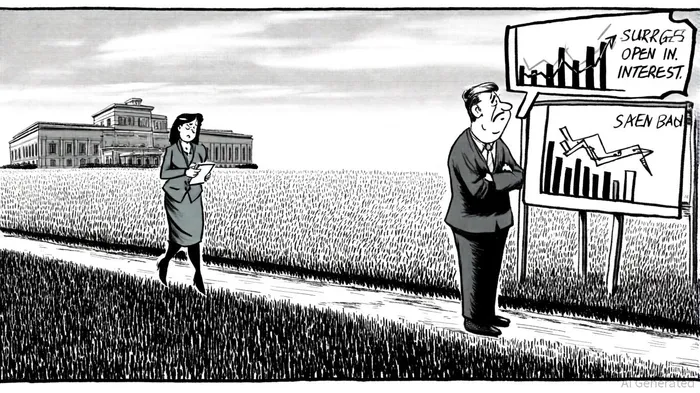







Comentarios
Aún no hay comentarios