
Vodacom Group's Strategic M&A and Financial Services Expansion in Africa: A Lucrative Investment Case in the Digital Transformation Era
Africa's digital economy is undergoing a seismic shift, driven by surging mobile adoption, financial inclusion, and infrastructure investments. At the forefront of this transformation is Vodacom Group, a South African telecommunications giant that has positioned itself as a key player in shaping the continent's digital future. Through strategic mergers and acquisitions (M&A), aggressive expansion of mobile money services, and infrastructure investments, Vodacom is not only capitalizing on Africa's digital potential but also creating a compelling investment case for stakeholders seeking growth in the region.
Strategic M&A: Strengthening Market Dominance and Geographic Reach
Vodacom's M&A strategy has been pivotal in consolidating its leadership in Africa's telecom sector. In 2023, the company acquired a controlling stake in Safaricom, a leading East African operator, for $2.1 billion, increasing its ownership from 35% to 55%. This move solidified Vodacom's presence in Kenya and Ethiopia, two of Africa's fastest-growing economies, while integrating Safaricom's M-Pesa platform-a cornerstone of financial inclusion. M-Pesa, which generates over 40% of Safaricom's profits, now operates in seven African countries, facilitating billions of transactions annually.
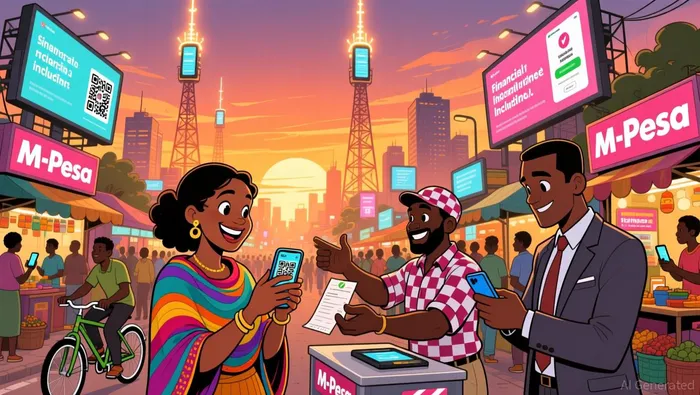
Beyond Safaricom, Vodacom has signaled its intent to diversify geographically. A proposed $2.7 billion acquisition of a controlling stake in Vodafone Egypt would expand its footprint into North Africa, a region with untapped digital potential. Such strategic acquisitions underscore Vodacom's ability to leverage scale, cross-border synergies, and regional expertise to drive long-term value.
Financial Services Expansion: Powering Africa's Digital Inclusion
Financial services have emerged as a core pillar of Vodacom's growth strategy. By 2025, the company aims to grow its fintech customer base to 75 million, up from 60.6 million in 2022, with M-Pesa alone serving 41.7 million users. This expansion is fueled by Vodacom's use of big data and machine learning to tailor offerings, reduce fraud, and enhance user trust-a critical factor in regions where traditional banking infrastructure remains underdeveloped.
The economic impact of these initiatives is profound. According to a report by the GSMA, mobile money services like M-Pesa have already contributed significantly to financial inclusion, enabling millions of unbanked Africans to access credit, savings, and insurance. Vodacom's CEO, Shameel Joosub, has emphasized that financial services will remain a strategic priority, with revenue from this segment growing by 10.8% year-on-year in 2022.
Africa's Digital Economy: A $270 Billion Opportunity by 2030
Vodacom's strategies align with the broader trajectory of Africa's digital economy. The GSMA's Africa Digital Economy Report 2023-2025 reveals that mobile technologies contributed $220 billion to Africa's GDP in 2024, accounting for 7.7% of the continent's total economic output. This figure is projected to rise to $270 billion by 2030, driven by 4G/5G adoption, AI integration, and digital innovation.
However, challenges persist. Nearly 75% of Africa's population remains unconnected, and 64% of those with mobile internet coverage do not use it, highlighting barriers such as device affordability and digital literacy. Vodacom's infrastructure investments, including a R9.4 billion ($530 million) commitment to expand 4G/5G coverage in South Africa and a partnership with Airtel Africa to share fiber networks in Mozambique, Tanzania, and the DRC, directly address these gaps.
Infrastructure and Partnerships: Building the Digital Backbone
Vodacom's infrastructure investments are equally transformative. In Limpopo, South Africa, the company is allocating over R500 million to deploy 250+ new 4G/5G sites, ensuring connectivity in underserved regions. Meanwhile, its collaboration with Airtel Africa to share towers and fiber networks reduces operational costs and accelerates deployment in high-growth markets. These initiatives not only enhance Vodacom's competitive edge but also align with the African Union's Digital Transformation Strategy, which aims to connect 260 million people by 2030.
The Investment Case: Why Vodacom Stands Out
For investors, Vodacom's dual focus on M&A and financial services creates a robust growth engine. Its acquisitions, such as Safaricom and Vodacom Egypt, offer immediate revenue diversification and regional dominance. Meanwhile, its fintech expansion taps into a market where mobile money is projected to grow at a compound annual rate of 15% through 2030.
Moreover, Vodacom's infrastructure investments position it to benefit from Africa's digital infrastructure boom. As governments and private players prioritize 5G, AI, and cloud technologies, Vodacom's hybrid cloud strategies and regulatory compliance expertise will be critical for enterprises seeking scalable solutions.
Conclusion
Vodacom Group's strategic M&A activities, financial services innovation, and infrastructure investments make it a standout player in Africa's digital transformation. With the continent's digital economy poised to grow by over 50% in the next seven years, Vodacom is not just adapting to change-it is actively shaping it. For investors seeking exposure to Africa's high-growth potential, Vodacom offers a compelling blend of scale, innovation, and long-term resilience.







Comentarios
Aún no hay comentarios