
VIX Volatility and Equity Market Resilience in the Face of Trump's Tariff Threats
The interplay between political uncertainty and financial markets has never been more pronounced than during the 2024-2025 period under President Trump's aggressive tariff policies. As the VIX index surged to levels not seen since the 2008 financial crisis, investors faced a dual challenge: navigating short-term volatility while maintaining long-term resilience in equity portfolios. This analysis examines how tactical asset allocation strategies, informed by real-time volatility metrics and sector-specific risks, enabled investors to mitigate downside exposure while capitalizing on market rebounds.
The VIX as a Barometer of Policy-Driven Uncertainty
The VIX, often dubbed the "fear gauge," became a critical indicator of investor sentiment during Trump's tariff escalations. The VIX spiked to 60 in April 2025-a level typically reserved for market meltdowns-according to Visual Capitalist. This surge reflected acute uncertainty about the economic fallout of trade wars, including inflationary pressures, disrupted supply chains, and potential retaliatory measures from trading partners. By October 2025, renewed threats of 100% tariffs on Chinese goods pushed the VIX to its highest level of 2025, marking a 34% increase in a single month, according to Benzinga. Such volatility underscored the market's sensitivity to policy shifts, even as broader economic fundamentals, such as strong corporate earnings and AI-driven growth, provided a counterbalance noted by Schroders.
Equity Market Resilience Amid Turbulence
Despite the VIX's extreme fluctuations, the S&P 500 demonstrated remarkable resilience. By Q3 2025, the index had rebounded to record highs, as Schroders noted, fueled by optimism over Trump's pro-growth policies and a dovish Federal Reserve. A Reuters poll of equity strategists projected gains of up to 9% for the S&P 500 by year-end 2025, though analysts cautioned that tariff-related risks remained a key headwind (coverage summarized by Benzinga). This duality-sharp corrections followed by rapid recoveries-highlighted the market's ability to discount short-term geopolitical noise while focusing on long-term structural trends. For instance, the S&P 500's 9.5% rally in early May 2025, following a temporary pause on tariffs, illustrated how policy reversals could swiftly restore investor confidence, as reported by Visual Capitalist.
Tactical Asset Allocation: Hedging and Sector Rotation
Investors who adopted tactical strategies fared better during this volatile period. A study by Business Perspectives demonstrated that portfolios dynamically adjusting allocations based on VIX levels outperformed buy-and-hold strategies by 38 basis points, with lower volatility and higher Sharpe ratios. For example, long VIX call spreads and protective puts became popular tools during periods of elevated fear, such as the April 2025 tariff announcements, as discussed in a GeekBacon analysis.
Sector rotation also proved critical. Defensive sectors like healthcare and utilities, less exposed to international trade, outperformed during tariff-driven selloffs, according to research from YCharts. Conversely, sectors with high foreign revenue exposure-technology, materials, and energy-faced significant headwinds. Morgan Stanley advised investors to overweight services-oriented industries, such as cybersecurity and AI, which were less vulnerable to tariffs and aligned with long-term growth trends. Similarly, ETFs like the SPDR Aerospace and Defense ETF gained traction as global military budgets expanded amid geopolitical tensions, a trend highlighted by Schroders.
Diversification and Macro Flexibility
Beyond sector shifts, diversification across asset classes and geographies mitigated risks. Treasury Inflation-Protected Securities (TIPS) and high-grade corporate bonds served as hedges in stagflation scenarios, while gold's volatility during tariff announcements reinforced its role as a safe-haven asset, as discussed by MSCI. A core-satellite portfolio structure, with a stable core of blue-chip equities and a nimble satellite of tactical allocations, allowed investors to balance resilience with adaptability (an approach explored by GeekBacon).
Conclusion: Navigating Uncertainty Through Strategy
The 2024-2025 tariff turbulence underscores a fundamental truth: in uncertain political climates, tactical asset allocation is not merely a tool but a necessity. While the VIX captured the immediate anxiety of policy shocks, the S&P 500's resilience demonstrated the market's capacity to adapt. By combining volatility-linked hedging, sector-specific rotations, and macroeconomic diversification, investors could navigate the storm while positioning for long-term growth. As geopolitical risks persist, the lessons from this period will remain relevant for those seeking to balance caution with opportunity.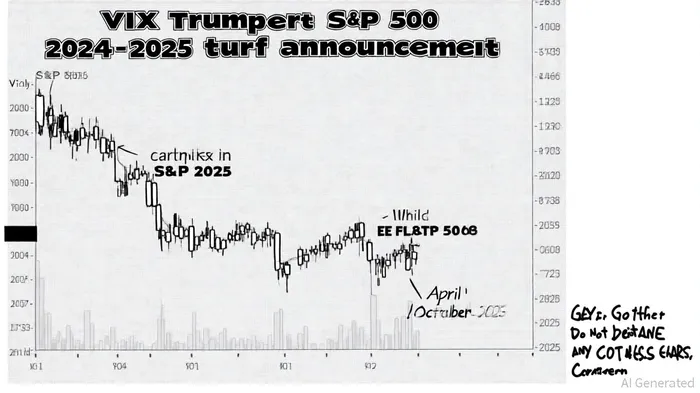





Comentarios
Aún no hay comentarios