
Vitalik Buterin's "Sovereign Web" Vision and Its Implications for Web3 Infrastructure
The crypto and Web3 ecosystems are undergoing a paradigm shift, driven by Vitalik Buterin's reassertion of Ethereum's mission as a foundation for digital sovereignty. In 2025, Buterin has crystallized his vision of a "sovereign web," a decentralized internet where users reclaim control over their identities, data, and governance mechanisms. This vision directly challenges the dominance of corporate platforms-what Buterin terms "corposlop"-which prioritize profit over user agency through addictive design, mass data extraction, and monopolistic control according to Tech Yahoo. For investors, the implications are profound: decentralized identity and governance tools are no longer niche experiments but core infrastructure for a new digital economy.
The Sovereign Web: A Framework for Digital Autonomy
Buterin's Sovereign Web is anchored in three pillars: privacy-preserving applications, decentralized identity systems, and autonomous governance models. He argues that the current internet model, dominated by centralized entities, erodes psychological autonomy and long-term digital freedom. To counter this, EthereumETH-- is evolving into a resilient base layer that ensures access during geopolitical crises. This shift is supported by institutional adoption, with regulatory frameworks like the U.S. Genius Act and Ethereum's stablecoin transfer volume surpassing $4 trillion in Q4 2025.
Central to this vision is the rejection of profit-driven metrics in favor of user sovereignty. Buterin emphasizes that Ethereum was never designed to optimize financial efficiency or application usability but to grant individuals "resilience in an increasingly fragile digital world". This ethos is now manifesting in tools that prioritize privacy, such as zero-knowledge proofs (ZKPs), and governance models like DAOs, which enable decentralized decision-making.
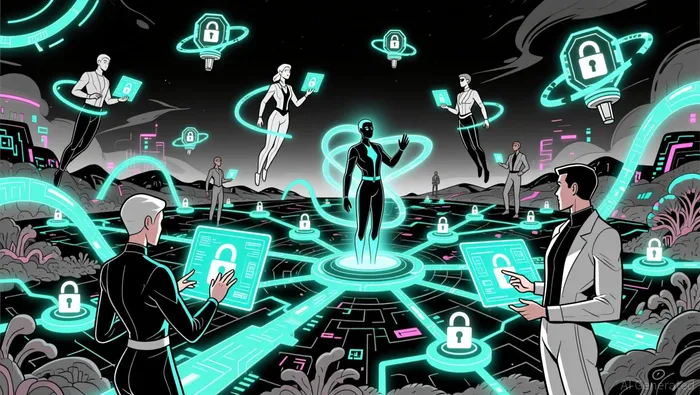
Decentralized Identity: The New Frontier of Web3 Infrastructure
Decentralized identity (DID) systems are emerging as a linchpin of the Sovereign Web. These frameworks allow users to control their digital identities without relying on centralized authorities, enabling selective sharing of attributes while preserving privacy. In 2025, the global blockchain identity management market was valued at USD 1.57 billion, with projections to reach USD 207.12 billion by 2034- a compound annual growth rate (CAGR) of 74.92%. Similarly, the decentralized identity market alone is expected to grow from USD 1.3 billion in 2025 to USD 103.3 billion by 2034, driven by a CAGR of 81.2%.
Key innovations include zero-knowledge proofs, which enable privacy-preserving identity verification. Projects like Polygon ID and zkSync Era are leveraging ZKPs to handle compliance and identity checks without exposing sensitive data. For instance, the European Blockchain Service for Identity (EBSI) uses blockchain for cross-border identity verification, while Worldcoin integrates biometric data with ZKP-based protocols. These tools align with Ethereum's modular architecture, where ZKPs are deployed at scale to balance privacy and regulatory compliance.
Investors are taking notice. The DeFi market saw over 8,400 funding rounds in 2025, with an average investment of USD 18.3 million per round. Institutional players like Andreessen Horowitz and Continue Capital are backing DID projects, recognizing their potential to disrupt identity verification in finance, healthcare, and beyond.
Governance Tools: From Theory to Institutional Adoption
Decentralized governance, particularly through DAOs, is another cornerstone of the Sovereign Web. Buterin has long advocated for DAOs as a countermeasure to centralized control, enabling communities to govern themselves without intermediaries. In 2025, DAOs are maturing beyond speculative experiments, with real-world applications in decentralized social media, virtual real estate, and cross-chain ecosystems.
A notable case study is Fiat24's collaboration with ONTO, which integrated NFT-powered digital banking to allow users to manage both traditional and crypto assets securely. Such projects highlight the convergence of decentralized identity and governance, where users can verify credentials and participate in decision-making without sacrificing privacy.
However, challenges remain. Government-led digital identity systems, such as Malaysia's MyDigital ID Superapp, risk expanding surveillance capabilities. Buterin's concept of "pluralistic identification"-where no single entity controls digital IDs- offers a solution by enabling diverse, interoperable identity networks.
Investment Implications: Where to Allocate Capital in 2026
For investors, the Sovereign Web represents a multi-trillion-dollar opportunity. The ZKP market, valued at USD 1.28 billion in 2024, is projected to grow to USD 7.59 billion by 2033, with a CAGR of 22.1%. This growth is fueled by real-world asset (RWA) tokenization and enterprise-grade identity solutions, which position blockchain as core infrastructure for digital trust.
Key investment themes include:1. ZKP-Enabled Identity Platforms: Projects like World ID (Tools for Humanity) and Polygon ID are leading the charge in privacy-preserving verification.2. DAO Tooling and Governance Protocols: Platforms that streamline decentralized decision-making, such as Railway and Signal, are gaining traction.3. Cross-Chain Interoperability Solutions: As the Sovereign Web expands, tools enabling seamless interactions between blockchains will be critical.
Conclusion
Vitalik Buterin's Sovereign Web is not merely a philosophical stance but a actionable roadmap for redefining the internet's architecture. Decentralized identity and governance tools are reshaping the crypto investment landscape, offering both technical innovation and institutional alignment. For investors, the message is clear: the future belongs to systems that prioritize sovereignty, privacy, and resilience. As Buterin himself has stated, Ethereum's mission is to provide a "permissionless, resilient base layer for global participation and financial autonomy". In 2026, the winners will be those who build-and invest-in that vision.







Comentarios
Aún no hay comentarios