
Vitalik Buterin's Endorsement of zkSync and the Future of Scalable Ethereum Solutions
Buterin's Endorsement: A Catalyst for zkSync's Momentum
Buterin's advocacy for zkSync underscores his belief in zero-knowledge (ZK) rollups as the optimal path for Ethereum's scalability. In a widely cited statement, he described zkSync's contributions as "underrated and valuable," emphasizing its ability to batch transactions off-chain while preserving the security of the Ethereum mainnet, Coinotag. The ZKSync Atlas upgrade, launched in October 2025, exemplifies this vision. By enabling 30,000 transactions per second (TPS) and real-time liquidity access between Layer 1 and Layer 2, the upgrade transformed Ethereum into a "unified liquidity hub," reducing fragmentation and improving user experience, CryptoFrontNews.
Buterin's influence extended beyond rhetoric. Following his endorsement, zkSync's native token (ZK) surged 120% to $0.74 within 48 hours, propelling its market cap toward $600 million-a peak not seen since May 2025, Yahoo Finance. This price rally was fueled by institutional interest, with over 30 financial institutions, including Citi and Mastercard, evaluating zkSync's Prividium, a private Layer-2 solution designed for enterprise applications, Yahoo Finance.
Technical Merits: zkSync vs. Competitors
While zkSync has gained traction, it faces stiff competition from optimistic rollups like OptimismOP-- and ArbitrumARB--. A comparative analysis of scalability, security, and adoption metrics reveals key differentiators:
Scalability:
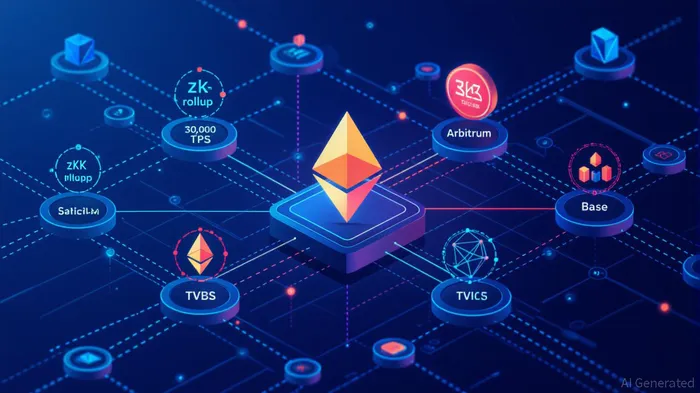
zkSync's ZK-rollups offer cryptographic proofs for instant transaction finality, a stark contrast to optimistic rollups, which rely on fraud proofs and introduce delays, Coinbureau. The Atlas upgrade's 30,000 TPS capacity positions zkSync as a leader in high-volume use cases, though Arbitrum's mature DeFi ecosystem and Base's rapid user growth remain competitive, RealSatoshiclub.Security:
ZK-rollups inherently provide trustless security, as transactions are validated through mathematical proofs. Optimistic rollups, by contrast, depend on external actors to flag fraud, creating potential vulnerabilities, Coinbureau. Buterin's recent proposal to replace Ethereum's modexp precompile with standard EVM code further strengthens ZK-rollup efficiency, albeit at the cost of a 15-25% gas increase, Coinotag.Adoption:
Arbitrum leads in TVL, with $16 billion locked in its ecosystem, while Base, backed by CoinbaseCOIN--, has surged to $4.94 billion in TVL and 43.5% market share, PowerDrill. zkSync, however, is closing the gap through institutional partnerships and its focus on privacy-centric applications, Yahoo Finance.
Investment Potential: Balancing Innovation and Market Realities
The investment landscape for Layer-2 solutions is shaped by three critical factors: technical innovation, ecosystem growth, and institutional adoption.
zkSync's Tokenomics and Institutional Appeal:
zkSync's recent tokenomics redesign, which allocates network revenue to token buybacks and burns, has created deflationary pressure and tied ZK's value to platform usage, Cryptopolitan. This model, combined with the Atlas upgrade's performance gains, has attracted over $300 million in 24-hour trading volume, Coinotag. However, skeptics argue that zkSync's ecosystem lags behind Arbitrum's in developer tools and DeFi integration, RealSatoshiclub.Arbitrum's Maturing Ecosystem:
Despite losing market share to Base, Arbitrum's $16 billion TVL and 250+ protocols underscore its entrenched position in DeFi, PowerDrill. Its recent BitcoinOS integration, enabling cross-chain bridging, further expands its utility, Coindesk. Yet, its reliance on optimistic rollups may hinder adoption in privacy-sensitive sectors.Optimism's Ambiguity:
While Optimism's Superchain vision and retroactive public goods funding are compelling, the lack of specific post-Buterin metrics (TVL, transaction volumes) leaves its investment potential unclear, Coinotag. Broader Ethereum growth, including $1.37 billion in institutional staking, indirectly benefits Optimism but does not offset its data gaps, Coinotag.
Conclusion: A Layered Approach to Investment
Vitalik Buterin's endorsement has elevated zkSync to a pivotal role in Ethereum's scalability narrative, but investors must adopt a nuanced strategy. For those prioritizing cutting-edge technology and institutional partnerships, zkSync's ZK-rollup architecture and Atlas upgrade present compelling long-term opportunities. Arbitrum and Base, with their established TVL and user bases, remain safer bets for capitalizing on DeFi's growth. Optimism, while innovative, requires clearer metrics to justify its inclusion in a diversified portfolio.
As Ethereum's scaling race enters a new phase, the protocols that balance technical rigor with ecosystem adoption will dominate. Buterin's vision, embodied in zkSync's advancements, offers a roadmap for achieving this balance-but the market's verdict will ultimately depend on execution, not just endorsements.





Comentarios
Aún no hay comentarios