
Vital Farms' Downgraded Price Target: A Buying Opportunity or a Warning Sign?
The recent price target reduction for Vital FarmsVITL-- (NASDAQ: VITL) by TD Cowen from $59.00 to $44.00 has sparked debate among investors. While the firm retained its "Buy" rating, the 25.42% cut reflects concerns about near-term disruptions in the premium egg market, including competitive pressures and shifting consumer behavior. This analysis evaluates whether the downgrade signals an overreaction to temporary challenges or a prudent recalibration in light of evolving market dynamics.
Short-Term Risks: Navigating Market Volatility and Operational Hurdles
TD Cowen's adjustment underscores immediate headwinds facing Vital Farms. The firm highlighted the company's 2025 guidance cut as a red flag, suggesting vulnerabilities in an increasingly competitive landscape for premium eggs. This aligns with broader industry trends: the highly pathogenic avian influenza (HPAI) outbreaks have historically eroded price premiums for specialty eggs, as all egg categories saw price surges during the 2014–15 crisis. Additionally, state-level animal welfare policies are narrowing the price gap between conventional and premium eggs, reducing the perceived value of Vital Farms' offerings.
Consumer behavior shifts also pose risks. While demand for cage-free and organic products remains robust, price-sensitive shoppers may delay purchases during economic uncertainty. This is compounded by uneven progress among major retailers in meeting cage-free commitments-Walmart and Dollar General, for instance, have lagged behind Kroger and Costco in this transition according to market analysis. 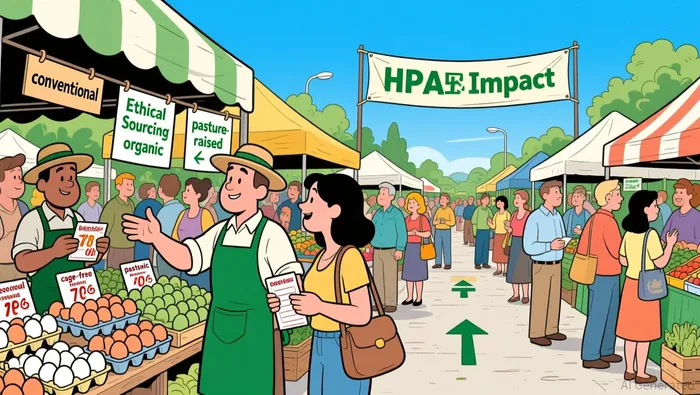 For Vital Farms, which relies on premium pricing, any softening in consumer willingness to pay could directly impact margins.
Long-Term Growth: Strategic Resilience in a Transforming Sector
Despite these challenges, Vital Farms' fundamentals suggest a compelling long-term story. The company reported a 37.2% year-over-year revenue increase in Q3 2025, reaching $198.9 million, driven by both volume growth and favorable pricing. Its strategic investments, including a third production line at Egg Central Station and the addition of 75 new family farms, have expanded capacity to support $1.2 billion in annual egg revenue. These moves position Vital Farms to meet its ambitious $2 billion sales target by 2030.
Financial strength further bolsters confidence. With $145.1 million in cash and no debt, the company has ample flexibility to fund expansion while maintaining profitability. Adjusted EBITDA is projected to exceed $115 million in 2025, reflecting operational efficiency. Moreover, Vital Farms' marketing strategy-emphasizing ethical sourcing, transparency, and sustainability-resonates with a growing demographic of conscious consumers. As global demand for specialty eggs rises, driven by health-conscious trends and ethical production preferences, the company is well-positioned to capture market share.
Competitive Landscape: Innovation and Adaptation
The premium egg market is evolving rapidly, with key players like Cal-Maine Foods and Hillandale Farms expanding cage-free and organic production to meet demand. However, Vital Farms' focus on pasture-raised eggs and its vertically integrated model-managing 575 family farms-offer a unique advantage. Smaller producers are also leveraging sustainable practices such as solar energy and composting to remain competitive. Meanwhile, technological advancements like AI-powered climate sensors are reducing costs for larger operations, but Vital Farms' emphasis on scalability and ethical branding differentiates it from both traditional and emerging competitors.
Conclusion: Balancing Caution and Confidence
TD Cowen's price target reduction appears to be a realistic recalibration rather than an overreaction. While near-term risks-such as HPAI volatility, competitive pressures, and consumer price sensitivity-warrant caution, Vital Farms' long-term trajectory remains intact. The company's financial health, strategic investments, and alignment with enduring consumer trends suggest that the downgrade could present a buying opportunity for investors with a multi-year horizon. As the premium agriculture sector matures, Vital Farms' ability to innovate and scale will likely determine its success in navigating these challenges.





Comentarios
Aún no hay comentarios