
Vista Gold Corp.'s Mt Todd Gold Project Feasibility Study: Strategic Catalysts and Valuation Implications of 15 ktpd Processing Capacity
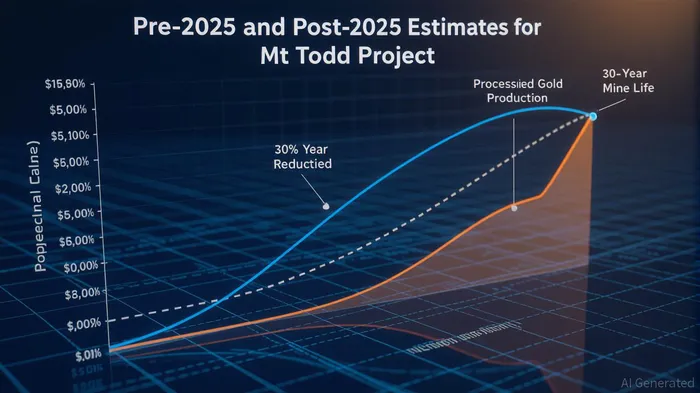
Vista Gold Corp.'s recent feasibility study for its Mt Todd Gold Project represents a pivotal strategic shift, recalibrating the project's scale and economics to align with evolving market dynamics and capital efficiency goals. By reducing the processing capacity from 50,000 to 15,000 tonnes per day (ktpd), the company has slashed initial capital requirements by 59% to $425 million, while extending the mine life to 30 years and boosting average reserve grades to 1.04 grams gold per tonne (g Au/t) in the early phase of operations[1]. This recalibration, announced in July 2025 and detailed in a September 2025 press release[2], underscores a disciplined approach to risk mitigation and value creation.
Strategic Catalysts: Capital Efficiency and Operational Flexibility
The 15 ktpd model introduces multiple strategic advantages. First, the 59% reduction in upfront capital expenditures—from an estimated $1.03 billion in prior studies[1]—lowers the project's financial barriers to entry, making it more attractive to equity and debt investors. This aligns with broader industry trends toward staged development and smaller initial-scale operations to de-risk exploration-stage projects[1]. Second, the feasibility study emphasizes the use of contract mining and third-party power generation, which transfer operational risks to specialized partners and reduce Vista Gold's exposure to cost overruns[1].
Third, the extended 30-year mine life, coupled with a projected average annual production of 153,000 ounces of gold in the first 15 years, positions the project to capitalize on long-term gold price trends. At a $2,500/oz gold price, the project's after-tax net present value (NPV5%) of $1.1 billion and internal rate of return (IRR) of 27.8%[1] suggest robust economics, particularly in a low-interest-rate environment where discounted cash flow models favor high-growth assets.
Valuation Implications: NPVNPV--, IRR, and Market Multiples
The revised feasibility study's financial metrics are a critical catalyst for re-rating Vista Gold's stock. A 27.8% IRR[1]—well above the industry average of 15–20% for greenfield gold projects—signals strong returns relative to peers, while the $1.1 billion NPV5%[1] provides a clear benchmark for valuation. At current gold prices, the project's economics imply a potential 10–15x revenue multiple, assuming a 10% discount rate and a 30% tax rate[1]. This compares favorably to the broader gold sector's average 8–12x multiple, suggesting upside potential if the company secures financing or partners to advance the project.
Moreover, the feasibility study's emphasis on scalability—such as the potential to expand processing capacity beyond 15 ktpd in later phases—adds optionality. As stated by Vista GoldVGZ-- in its Emerging Growth Conference presentation[1], the company is actively evaluating joint ventures and project-level transactions to unlock value, a strategy that could attract strategic buyers or lenders seeking long-term exposure to gold.
Risk Considerations and Market Dynamics
While the 15 ktpd model reduces capital intensity, it also raises questions about production scalability. At 153,000 ounces annually, the project's output is modest compared to industry giants like Barrick Gold or NewmontNEM--, which average 4–5 million ounces per year. However, Vista Gold's focus on cost efficiency—highlighted by a $2,500/oz all-in sustaining cost (AISC) estimate[1]—positions it to remain profitable even in a $2,000/oz environment.
The company's recent financial performance further supports its ability to fund the project. For Q1 2025, Vista Gold reported a net loss of $1.1 million, a 45% reduction from Q1 2024[1], while cash reserves increased to $13.2 million by Q2 2025[3]. These metrics, combined with the feasibility study's reduced capital burden, suggest the company is on a path to breakeven or profitability once the project reaches production.
Conclusion: A Recalibrated Path to Value Creation
Vista Gold's Mt Todd project, now restructured around a 15 ktpd model, exemplifies the strategic agility required in today's capital-constrained gold sector. By prioritizing capital efficiency, operational flexibility, and long-term scalability, the company has created a project with compelling economics and clear catalysts for near-term valuation uplift. Investors should monitor upcoming financing announcements, joint venture negotiations, and gold price trends, which could further amplify the project's potential.





Comentarios
Aún no hay comentarios