
Visa's USDC Gambit: How Blockchain is Rewriting the Rules of Cross-Border Payments
The global payments landscape is undergoing a seismic shift, driven by the convergence of blockchain technology and institutional-grade infrastructure. At the forefront of this transformation is VisaV--, which has aggressively expanded its stablecoin settlement capabilities in 2025, leveraging Circle's USDCUSDC-- to modernize cross-border transactions. This move isn't just about speed or cost efficiency-it's a strategic repositioning to dominate the next era of global finance.
The USDC Play: Bridging Legacy Systems and Programmable Money
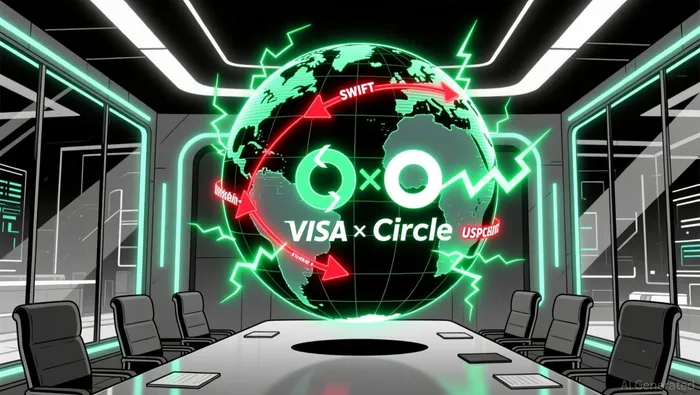
Visa's recent launch of a stablecoin settlement service in the United States marks a pivotal moment in its evolution. By enabling U.S. banks to settle VisaNet obligations in USDC over blockchains like SolanaSOL--, the company is addressing long-standing pain points in cross-border payments: slow settlement cycles, high operational friction, and limited liquidity management tools. For example, Cross River Bank and Lead Bank-early adopters of this system-now benefit from seven-day settlement windows and real-time tracking, a stark contrast to traditional ACH or SWIFT processes that can take days.
The partnership with CircleCRCL--, a leader in stablecoin issuance, is central to this strategy. USDC's fully reserved, dollar-backed structure provides the regulatory familiarity needed to onboard traditional banks while retaining the programmability of digital assets. Visa's decision to operate a validator node on Circle's upcoming Arc blockchain-a high-performance LayerLAYER-- 1 network-further underscores its commitment to building scalable infrastructure. This dual approach-leveraging existing blockchains for immediate impact and investing in next-gen protocols for the future-positions Visa to capture both short- and long-term value.
The financial implications of Visa's strategy are staggering. According to a Bloomberg report, stablecoin settlement volume reached a $3.5 billion annualized run rate in 2025, with Visa's pilot programs contributing significantly to this growth. But the real prize lies in the long-term potential: analysts project that stablecoin transactions could account for $50 trillion in annual payment flows by 2030.
Visa's expansion into this space isn't just about volume-it's about capturing a critical infrastructure role in the global payments ecosystem. By offering programmable liquidity management tools to banks and fintechs, the company is enabling real-time treasury operations that were previously impossible with legacy systems. For instance, a bank using USDC settlements can now automate cross-border reconciliations and reduce counterparty risk, creating a flywheel effect of efficiency and trust.
Strategic Differentiation: Speed, Resilience, and Advisory Expertise
What sets Visa apart from competitors is its ability to blend blockchain innovation with institutional-grade reliability. Unlike pure-play crypto platforms, Visa's approach prioritizes interoperability with existing financial systems. Its new Global Stablecoins Advisory Practice, launched in 2025, exemplifies this focus. By offering tailored guidance on stablecoin integration, regulatory compliance, and risk management, Visa is positioning itself as the go-to partner for institutions navigating the complexities of digital currency adoption.
This advisory arm also addresses a key bottleneck in stablecoin adoption: regulatory uncertainty. As governments worldwide grapple with how to classify and govern digital assets, Visa's deep regulatory relationships and compliance-first approach provide a critical edge. The company's emphasis on "bridging traditional payment systems with modern, programmable money movement" isn't just a technical upgrade-it's a strategic play to shape the rules of the emerging ecosystem.
The Bigger Picture: A $290 Trillion Market Awaits
The cross-border payments market is projected to grow to $290 trillion by 2030, and stablecoins are poised to become a foundational layer of this infrastructure. Visa's 2025 initiatives-ranging from blockchain-based settlements to validator node operations-position it to capture a disproportionate share of this growth. By 2026, the company plans to scale its USDC settlement capabilities globally, with broader availability expected as regulatory frameworks mature.
For investors, the implications are clear. Visa isn't just adapting to the digital currency revolution-it's accelerating it. By combining its unparalleled network effects with blockchain's inherent advantages (speed, transparency, programmability), the company is building a moat that rivals will struggle to replicate. As stablecoin adoption accelerates, Visa's role as a trusted intermediary between legacy finance and Web3 will only grow in value.





Comentarios
Aún no hay comentarios